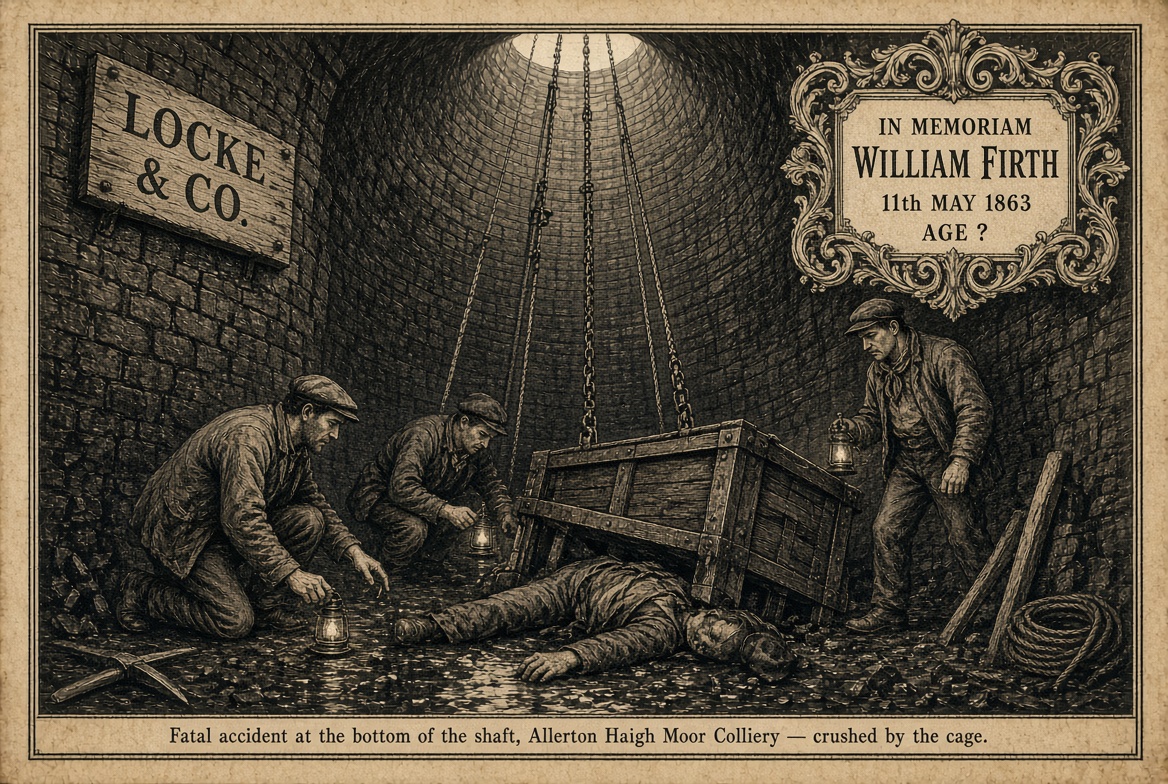
William Firth

WILLIAM FIRTH

Allerton Haigh Moor Colliery, Locke and Co.

Killed 11 May 1863  ·  Age not recorded by the inspector

1. Life

No baptism, marriage, census household or burial register has yet been tied to this William Firth with the same certainty as the inspector’s accident entry. Firth was the most common surname in nineteenth-century Kippax. Attaching a particular christening or a particular widow without a burial age, a GRO certificate, or a newspaper naming next of kin would be guesswork. This note therefore records what is proved about the death and leaves the private life open.

What can be said

He was employed at Locke and Co.’s Allerton Haigh Moor Colliery in May 1863. That pit worked the Haigh Moor seam from the shafts sunk in 1858 at Owl Wood, between Kippax and Allerton Bywater. Edward Bickerdike of Kippax had been killed at the same colliery, by a brick falling in the shaft, on 27 January 1863 — fourteen weeks earlier. Both deaths stand on the same page of Charles Morton’s 1863 report (accidents no. 8 and no. 24).

Allerton Bywater was still in Kippax parish until an Order in Council of 1863 created a separate parish; the foundation stone of the new church was laid on 31 August 1863, after William’s death. Men from Kippax village walked or rode to these shafts.

Names that are not this man

Charles Firth, aged about 60, killed in 1886 at a Locke / Kippax pit (run over by corves), is a later death.

William Firth of Rastrick, farmer, buried 3 August 1865 aged 58, is a different parish and a different year.

William Briggs Firth of Leeds, magistrate and ironmaster, who read a paper on coal-cutting machinery in 1863, was still alive in the 1870s.

William Firth, colliery proprietor of Shipley, died 24 March 1884.

Burial

The Durham Mining Museum still prints the burial as not known. No Kippax St Mary burial page for May 1863 was among the documents supplied for this note. St Mary’s remained the parish church for Kippax men; Allerton Bywater’s own church was not yet built.

2. The accident

On Monday 11 May 1863 William Firth was killed at Allerton Haigh Moor Colliery, the property of Locke and Co. The official cause is that he was crushed at the bottom of the shaft.

Charles Morton, H.M. Inspector of Mines, entered the case as accident no. 24 in his 1863 report, printed at page 182. The Durham Mining Museum abstract taken from that report reads: William Firth; died 11 May 1863; accident 11 May 1863; colliery Allerton Haigh Moor; company Locke and Co.; notes: crushed at the bottom of the shaft.

Crushing at the shaft bottom usually means the cage, or a loaded tub or baulk descending the shaft, came down on a man who was standing or working in the sump or at the inset. Morton’s printed table does not say whether the cage was lowered onto him, whether a tub left the cage, or whether he was struck by something falling from above. Those particulars are not in the open abstract. The commercial Coal Mining Accidents and Deaths Index uses the same wording: Crushed in the Bottom of the Shaft.

The same commercial index places the accident at Leeds. Leeds is the nearest large town. The pit was Allerton Haigh Moor, in the Kippax / Allerton Bywater township, then in the Pontefract registration district (Castleford sub-district).

3. Coroner, newspaper and conclusion

No inquest transcript and no newspaper report naming this William Firth have been found in the open indexes searched for this note. Inquests on pit deaths around Kippax were normally held by the coroner for the honour or borough of Pontefract, often sitting at a village inn within a day or two of the body being brought up.

What stands in official form is Morton’s classification: accidental death by being crushed at the bottom of the shaft at Allerton Haigh Moor, Locke and Co., 11 May 1863; one life lost — William Firth.

4. Sources and citations

Charles Morton, H.M. Inspector of Mines, 1863 Mines Inspectors Report, p. 182, accident no. 24.

Durham Mining Museum, individual page: William Firth, died 11 May 1863, Allerton Haigh Moor, Locke and Co., crushed at the bottom of the shaft.

UK, Coal Mining Accidents and Deaths Index: William Firth, 11 May 1863, Locke and Co., Crushed in the Bottom of the Shaft; place given as Leeds.

Alan Beales, England, Mining Disaster Victims: William Firth, 11 May 1863, Allerton Haigh Moor.

Charles Morton, same report, p. 182, accident no. 8: Edward Bickerdike, 27 January 1863, same colliery, fall of a brick in the shaft — for the sequence of deaths at this pit.

On Allerton Bywater parish: formed from Kippax by Order in Council, 1863; foundation stone 31 August 1863.

5. Corrections

Date. 11 May 1863 is consistent across Morton, DMM, the Coal Mining Accidents index and Beales. No correction is required.

Place. Leeds in the commercial index is the nearest city. The pit is Allerton Haigh Moor, Locke and Co.

Age. Morton printed no age. Indexes that leave age blank are incomplete, not contradictory. Do not borrow an age from another William Firth.

Identity. Do not attach the Rastrick farmer (d. 1865), the Leeds ironmaster, the Shipley proprietor (d. 1884), or Charles Firth of 1886.

Burial. Still not found. DMM is correct to mark it unknown until a May 1863 Kippax (or Castleford) register page is produced.

A GRO death certificate for Firth, May 1863, Pontefract or Castleford district, would give age and informant’s name and should be the next document sought.

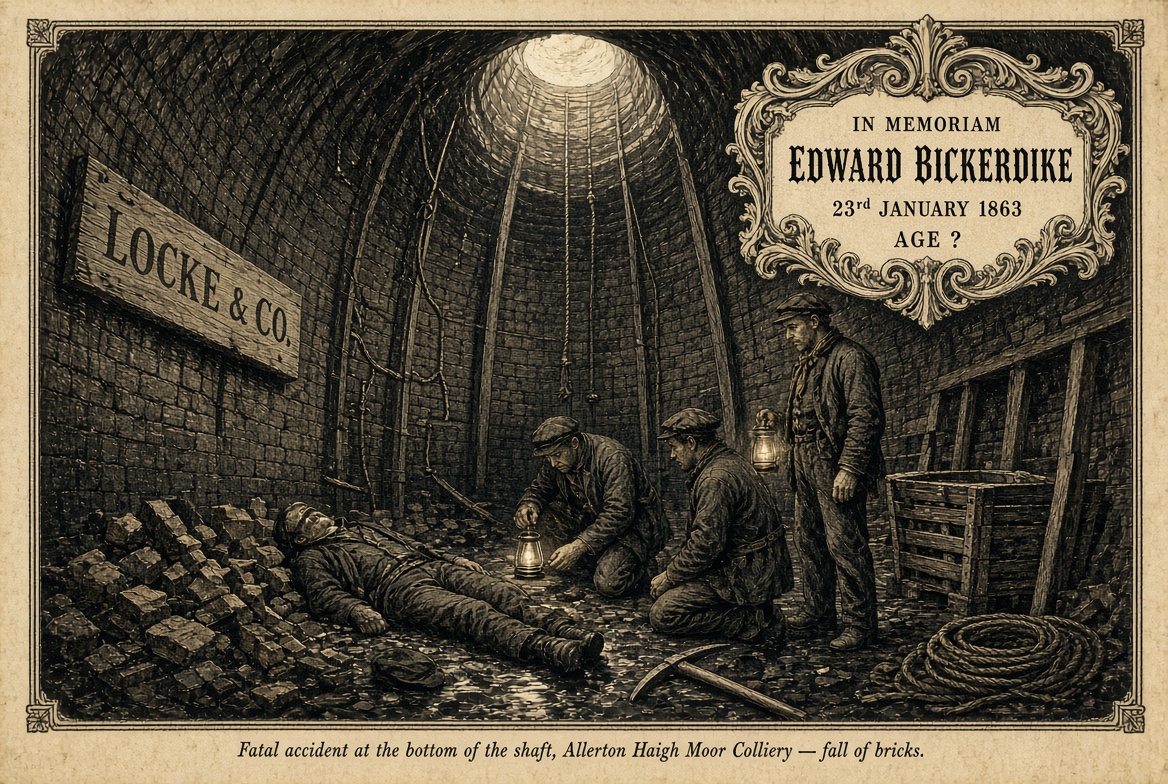
Edward Hesselgrave Bickerdike

EDWARD BICKERDIKE

Edward Hesselgrave Bickerdike, of Kippax

Christened 17 May 1801  ·  Died 27 January 1863, aged 62

1. Life

Birth and christening

Edward Hesselgrave Bickerdike was christened on 17 May 1801 at the parish church of St Mary the Virgin, Kippax. The printed christening index gives the name as Edwd. Haslegrave Bickerdike and names his father Benjamin Bickerdike. Haslegrave / Hesselgrave is a second forename used in the family; later records call him Edward.

The burial register of 30 January 1863 gives his age as 62. That agrees with a birth shortly before the May 1801 christening. He was therefore sixty-one years and about eight months old when he was killed.

Family

The Bickerdikes were a long-settled Kippax mining family. John Bickerdike married in the parish in the 1760s; Thomas Bickerdike married Mary Tate in 1764. Peter Bickerdike, a hewer at Locke and Co.’s Kippax West Main, was named by Charles Morton in 1858 as the man whose failure to set sprags caused the death of the boy Benjamin Pickard. That Peter belongs to the same village kinship, not necessarily the same household.

Edward married Eliza Beeston. Their son Charles was christened at Kippax on 19 December 1841. Edward appears as head of a household in Kippax on the censuses of 1841, 1851 and 1861, living with his wife and children throughout.

Work

By the 1860s Locke and Co. were working the Haigh Moor seam from the shafts sunk in 1858 at Owl Wood, between Kippax and Allerton Bywater. The official name of the pit in the 1863 inspector’s table is Allerton Haigh Moor. Edward was employed there at the time of his death. He was then in his early sixties, still going underground or into the shaft — the accident itself took place in the shaft, not at the face.

Death and burial

Edward was killed on Tuesday 27 January 1863. He was buried at St Mary’s, Kippax, on Friday 30 January 1863. The burial register, page 80, entry no. 338, reads: Edward Bickerdike, abode Kippax, 30 January, age 62, E. D. Bland, Vicar. West Yorkshire Archive Service reference P47/26.

Burial three days after the accident is the usual interval where an inquest had to sit. The same register page records Jane Bickerdike, buried 18 January 1863 aged 73 — an older kinswoman, not his wife. Civil registration of the death falls in the Castleford / Pontefract area; compiled trees give Castleford as the registration place.

DMM still marks the burial as not known. The parish register supplied with this research fills that gap.

2. The accident

On 27 January 1863 Edward Bickerdike was killed at Allerton Haigh Moor Colliery, the property of Locke and Co. The official cause is the fall of a brick in the shaft.

Charles Morton, H.M. Inspector of Mines, entered the case as accident no. 8 in his 1863 report, printed at page 182. The Durham Mining Museum abstract taken from that report reads: Edward Bickerdike; died 27 January 1863; accident 27 January 1863; colliery Allerton Haigh Moor; company Locke and Co.; notes: fall of a brick in the shaft.

A shaft lining of brick or a brick used in shaft repairs can come away from the wall and fall the full depth of the shaft. A man at the bottom, or riding in the cage, has no cover against it. Morton’s printed table does not add whether Edward was ascending, descending, or standing at the shaft foot, nor whether the brick was loose lining or a brick dropped from the surface. Those particulars are not in the open abstract.

The commercial Coal Mining Accidents and Deaths Index gives the same date, employer (written Lock and Co.) and description, and places the accident at Leeds. Leeds is the nearest large town. The pit was Allerton Haigh Moor, in the Kippax / Allerton Bywater parish, Pontefract then Castleford registration.

3. Coroner, newspaper and conclusion

No inquest transcript and no newspaper report naming Edward Bickerdike have been found in the open indexes searched for this note. Inquests on pit deaths around Kippax were normally held by the coroner for the honour or borough of Pontefract, often sitting at a village inn within a day or two of the body being brought up.

What stands in official form is Morton’s classification: accidental death by the fall of a brick in the shaft at Allerton Haigh Moor, Locke and Co., 27 January 1863; one life lost — Edward Bickerdike.

Burial on 30 January is consistent with an inquest opened on the Wednesday or Thursday and the body then released to the family.

4. Sources and citations

England Births and Christenings, 1538–1975 (FamilySearch): Edwd. Haslegrave Bickerdike, 17 May 1801, Kippax; father Benjamin Bickerdike. FHL film 496,807.

West Yorkshire Archive Service, Leeds: Kippax St Mary burial register, 1863, p. 80, no. 338. Edward Bickerdike, Kippax, 30 January 1863, age 62; E. D. Bland, Vicar. Reference P47/26.

England and Wales Census, 1841: Edward Bickerdike, Kippax. FamilySearch MQGP-NWG.

England and Wales Census, 1851 and 1861: Edward Bickerdike, Kippax, with wife and children. FamilySearch 1861 M7JB-SPT.

England Births and Christenings: Charles Bickerdike, 19 December 1841, son of Edward Bickerdike and Eliza Beeston.

Charles Morton, H.M. Inspector of Mines, 1863 Mines Inspectors Report, p. 182, accident no. 8.

Durham Mining Museum, individual page: Edward Bickerdike, died 27 January 1863, Allerton Haigh Moor, Locke and Co., fall of a brick in the shaft.

UK, Coal Mining Accidents and Deaths Index: Edward Bickerdike, 27 January 1863, Lock and Co., Fall of A Brick in the Shaft.

Alan Beales, England, Mining Disaster Victims: Edward Bickerdike, event date 23 January 1863, Allerton Haigh Moor — date corrected below.

WikiTree Bickerdike-16: Edward Hesselgrave Bickerdike (bef. 17 May 1801 – 27 January 1863), compiled from the parish and census sources above.

5. Corrections

Date of accident. The Beales / MDV transcript gives 23 January 1863. Morton, DMM, the Coal Mining Accidents index and the compiled death date all give 27 January 1863. Burial on 30 January fits a death on the 27th. The 23rd is treated as a copying error.

Burial is not before death. The parish burial is 30 January. The official death is 27 January. There is no contradiction once the 23 January index date is set aside.

Age. Burial age 62 agrees with the christening of 17 May 1801. No correction is required.

Employer spelling. Lock and Co. in the commercial index is Locke and Co.

Place. Leeds in the commercial index is the nearest city. The pit is Allerton Haigh Moor (Owl Wood / Allerton Bywater), Locke and Co. Civil registration is the Castleford / Pontefract area. Abode at burial is Kippax.

DMM burial. DMM still prints burial as not known. The Kippax register, no. 338, 30 January 1863, supplies it.

Jane Bickerdike. Jane, buried 18 January 1863 aged 73, is a separate entry on the same register opening. She is not Edward’s wife Eliza.

If a Pontefract or Leeds newspaper for late January 1863 is later abstracted, the coroner’s wording should be added to section 3.

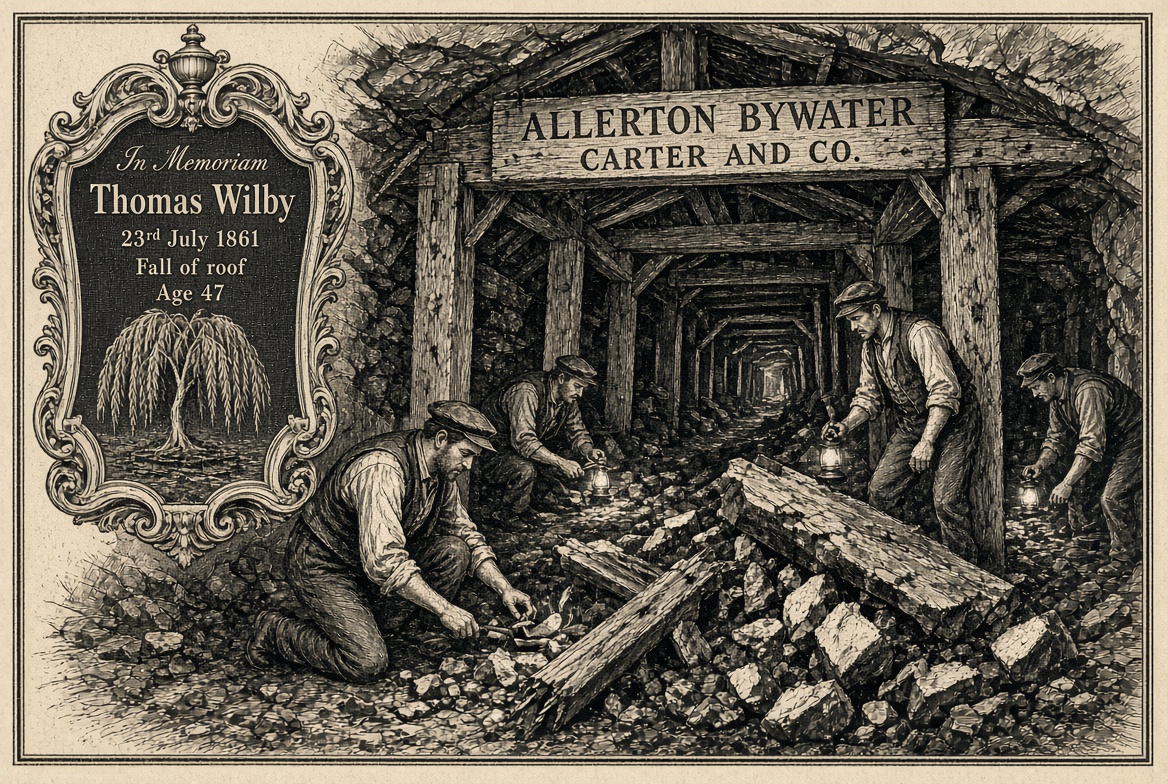
Thomas Wilby

IN MEMORIAM

Thomas Wilby

23 July 1861  ·  age 47

Fall of roof while drawing props

Allerton Bywater  ·  Carter and Co.  ·  of Soothill

His life

Thomas Wilby was a coal miner, aged 47, belonging to Soothill. That is the whole of what the contemporary paper says of him. Soothill was a township in the parish of Dewsbury, on the high ground north of Hanging Heaton and about a mile and a half from Dewsbury town. Age 47 in July 1861 puts his birth about 1814.

The 1861 census was taken on 7 April, three months before he was killed, so he should appear in a Soothill or Dewsbury household. No schedule that can be tied to this man has been found in the open indexes. No baptism, marriage or burial entry has been matched either. Durham Mining Museum still prints burial as not known. Parents, wife and children are not invented.

He was working away from home. Soothill is some fifteen miles from Allerton Bywater. The paper calls the working “Mr. Carter’s new pit.” Carter’s Haigh Moor shafts beside the Aire had been sunk from 1840. “New” may mean a fresh district, or a pit newly in his work, rather than the later Silkstone sinking of 1875, which had not begun.

The accident

On Tuesday evening, 23 July 1861, Wilby was underground in Mr Carter’s pit at Allerton Bywater. He was drawing props. A portion of the roof fell on him and killed him on the spot.

The Leeds and West Riding Express printed that on Saturday 27 July, in the local news, without a heading of its own. Charles Morton, H.M. Inspector, entered the death as Accident No. 41 in his 1861 tabular list, page 155, and described it only as a fall of roof in the mine. He wrote no narrative. The accidents index shortens the cause to “fall of coal.” The paper is the fuller account, and it says roof, not coal.

Newspaper report and conclusion

No coroner’s inquest paper has been traced. The paper does not give a verdict. It says he was killed on the spot.

On Tuesday evening, a coal miner named Thomas Wilby, aged 47, belonging to Soothill, was working in Mr. Carter’s new pit at Allerton Bywater, and whilst in the act of removing some props, a portion of the roof fell upon him, killing the poor fellow on the spot.

Leeds and West Riding Express, Saturday 27 July 1861, vol. IV, no. 189, page 2. The printed word is “spot.” A typed copy of the cutting reads “spct.”

1861 Mines Inspectors Report, Charles Morton, page 155, Accident No. 41. Thomas Wilby, Allerton Bywater, Carter and Co., fall of roof in the mine, 23 July 1861. No age. No narrative. Burial not stated.

Sources and citations

Leeds and West Riding Express, Saturday 27 July 1861, page 2. Thomas Wilby, aged 47, of Soothill, Mr Carter’s new pit, Allerton Bywater, killed on the spot while removing props.

1861 Mines Inspectors Report, Charles Morton, page 155, Accident No. 41. Cited by the Durham Mining Museum: died 23 July 1861, Allerton Bywater, Carter and Co., fall of roof in the mine, burial not known, age blank.

UK Coal Mining Accidents and Deaths Index: Thomas Wilby, 23 July 1861, place given as Normanton, employer Carter and Co, fall of coal in the mine.

Alan Beales, Database of Fatalities in the Coal Fields: Thomas Wilby, Allerton Bywater, 23 July 1861. No age.

Corrections

  • Date. Tuesday evening before the Saturday paper of 27 July is 23 July 1861. The indexes and the paper agree.
  • Cause. Fall of roof while drawing props, as the paper says, and as Morton’s table says. The accidents index’s “fall of coal” is the shorter and wrong form.
  • Place. The pit was Allerton Bywater. Normanton, in the accidents index, is dropped. Home was Soothill, in Dewsbury parish.
  • Age. 47, from the paper. The mining indexes leave it blank.
  • Burial and family. Still not verified. Not filled in.
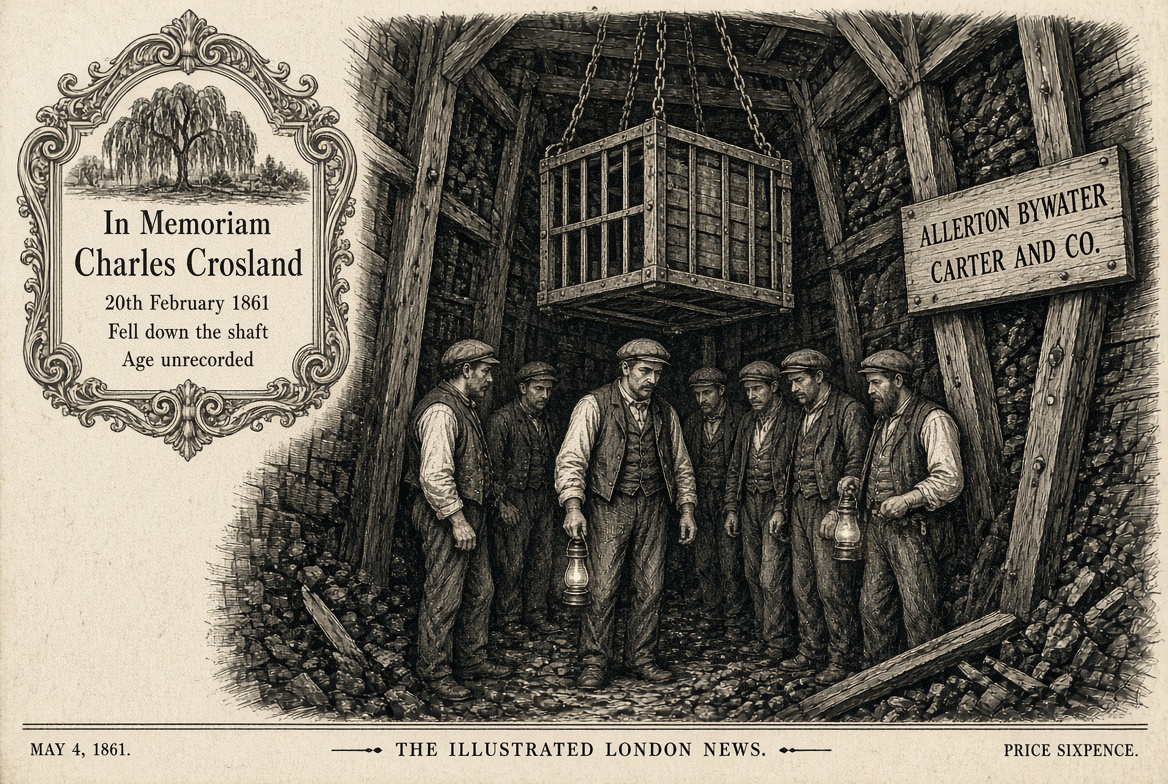
Charles Crosland

IN MEMORIAM

Charles Crosland

20 February 1861  ·  age not known

Fell down the shaft

Allerton Bywater Colliery  ·  Carter and Co.

His life

Almost nothing of Charles Crosland’s life is on the public record. The mining indexes give a name, a colliery, an owner and a date. They do not give an age, a birth year, a trade, a residence or a burial.

The name in the inspector’s list, and in the Durham Mining Museum and the Coal Mining Accidents and Deaths Index, is Crosland. Alan Beales’s Database of Fatalities prints Crossland. Both spellings were used in the West Riding, often for the same family. Crosland is the form taken from the 1861 inspector’s table, so that is the form used here.

No 1851 or 1861 census household has been tied to this man. No baptism and no burial entry has been found in the Allerton Bywater, Kippax, Castleford or Rothwell registers that are indexed online. Durham Mining Museum still prints burial as not known. That gap is real. Parents, wife and children are not invented.

He died on Wednesday 20 February 1861 at Carter’s colliery, Allerton Bywater, the Haigh Moor pit sunk from 1840 beside the River Aire. The later Silkstone sinking was not yet begun.

The accident

The whole of the contemporary official note is four words: falling down the shaft. Charles Morton, H.M. Inspector of Coal Mines, entered it as Accident No. 7 in his tabular list for 1861, page 154. Unlike George Hepworth’s death in 1856, Morton wrote no narrative. There is no account of whether Crosland fell from the bank, from a cage, or while riding the shaft, and no account of the depth.

Carter’s Haigh Moor shafts of that date went about 140 yards to a seam four feet six inches thick, between the present Victoria Street and Robinson Street. That is the pit, not a measured fall.

No Leeds, Pontefract or Castleford newspaper report of this death has been found in the papers indexed online.

Inspector’s report and conclusion

No coroner’s inquest paper, and no newspaper verdict, has been traced. The official record is the inspector’s table only.

1861 Mines Inspectors Report, Charles Morton, H.M. Inspector of Mines, page 154, Accident No. 7. Charles Crosland, Allerton Bywater, Carter and Co., falling down the shaft, 20 February 1861. No age. No occupation. No narrative.

There is nothing further to quote.

Sources and citations

1861 Mines Inspectors Report, Charles Morton, H.M. Inspector of Mines, page 154, Accident Number 7. Cited by the Durham Mining Museum, Charles Crosland individual page: died 20 February 1861, Allerton Bywater, Carter and Co., falling down the shaft, burial not known, age blank.

UK Coal Mining Accidents and Deaths Index: Charles Crosland, 20 February 1861, place given as Normanton, employer Carter and Co, falling down the shaft.

Alan Beales, Database of Fatalities in the Coal Fields: Charles Crossland, Allerton Bywater, 20 February 1861. Spelling differs. No age.

Allerton Bywater Parish Council, coal-mining history: Carter’s Haigh Moor, leased from 1840, two shafts near the River Aire, seam four feet six inches at about 140 yards, worked to 1875.

Corrections

  • Spelling. Crosland, as in the inspector’s list, the Durham Mining Museum and the accidents index. Crossland, on the Beales database and on an earlier plate in this series, is the variant. The plate now reads Crosland.
  • Place. The accidents index gives Normanton. That is not the pit. The colliery was Allerton Bywater. Normanton is a neighbouring registration place and is dropped.
  • Age. Not stated in any source checked. Left as not known. It is not guessed from a census that has not been matched.
  • Burial. Still not known. No parish entry has been verified.
  • Owner. Carter and Co., the 1861 form. Not the later T. M. Carter and Co. used on the plates after 1867.
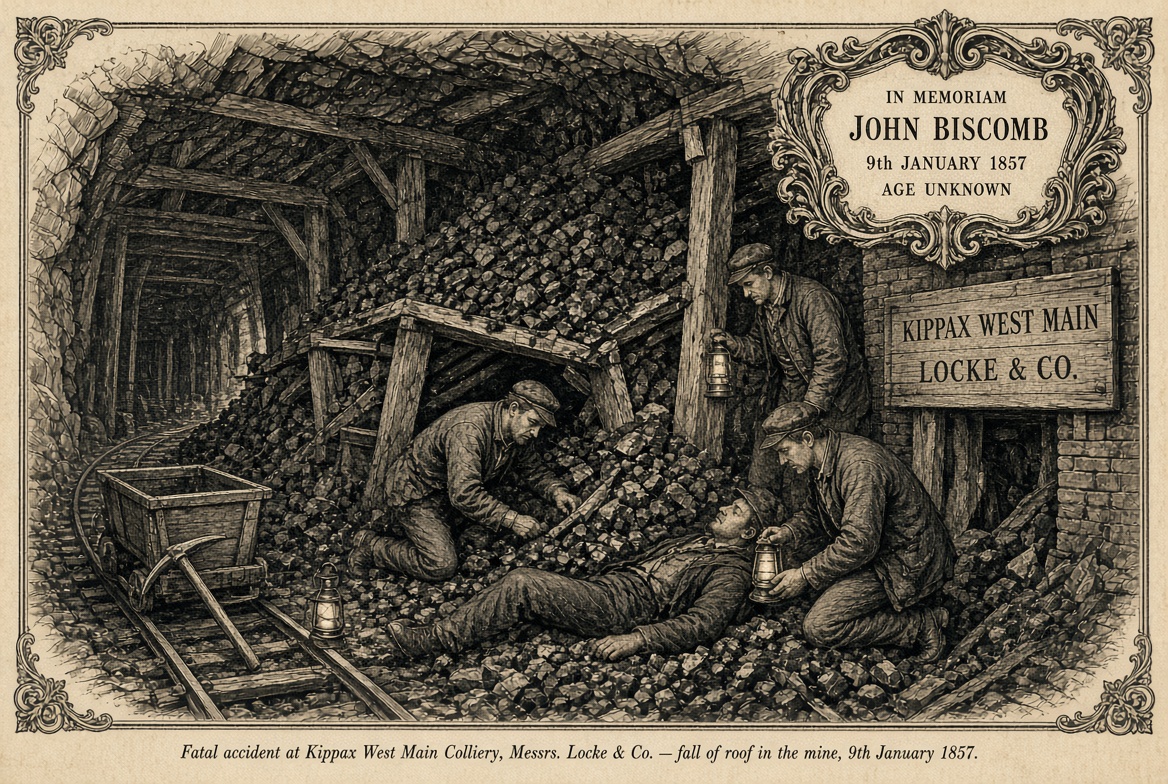
John Biscomb

JOHN BISCOMB

of Kippax, Yorkshire

Baptised 4 March 1832  ·  Died 9 January 1857, aged about 24

1. Life

Baptism

John Biscomb was baptised on 4 March 1832 at the parish church of St Mary the Virgin, Kippax. The register for 1832, page 143, entry no. 1137, records: John, son of William and Hannah Biscomb, abode Kippax, father’s quality labourer, ceremony performed by the Hon. and Rev. A. H. Cathcart, Vicar. West Yorkshire Archive Service reference P47/8.

Civil registration of births had not yet begun in 1832. A birth shortly before 4 March 1832 makes him about twenty-four years and ten months old on 9 January 1857. Charles Morton’s printed table does not give an age.

Parents and family

His father William Biscomb was a labourer living in Kippax. His mother was Hannah. The Biscombs were already numerous in the parish. William Biscomb of the Lord Nelson appears in Baines’s Directory of 1822; Henry Biscomb, carpenter, was father of Robert Biscomb, killed at the same company’s pit two years earlier. Thomas Biscomb, another Kippax carpenter, had a son Charles baptised in the same church in April 1832. Those are related households, not this baptism.

John must not be confused with Robert Biscomb (baptised 30 March 1823, son of Henry the carpenter), who died on 13 January 1855 when a pit rope broke at Locke and Co., Kippax.

Youth and work

Kippax in John’s boyhood was a growing coal parish east of Leeds. Locke and Co. were working Kippax and Kippax West Main by the mid-1850s. West Main is listed from 1854. The large Haigh Moor shafts at Owl Wood were not sunk until 1858, the year after John’s death.

No school record has been found. The son of a labourer in this parish commonly went to the pit as a boy. By January 1857 John was employed underground at Locke and Co.’s Kippax West Main. No printed 1841 or 1851 census extract has yet been tied to him with certainty.

Marriage — not proved

A John Biscomb married Mary Mosby at Leeds on 27 October 1851. That couple later appear in Kippax; Mary, widowed, married James Farrer in 1865. The dates would fit a man baptised in 1832, but the 1851 marriage register has not been seen for this note, so the identification is not treated as proved. Children attached to that household on later trees are therefore not listed here as his.

Death registration

The civil death of John Biscomb was registered at Pontefract. The national index entry reads: Biscomb, John; superintendent registrar’s district Pontefract; volume 9c, page 60. That is the January–March quarter of 1857, which contains 9 January. No burial register page for January 1857 has been supplied with this research; DMM marks the burial as not known.

2. The accident

On Friday 9 January 1857 John Biscomb was killed underground at Kippax West Main Colliery, the property of Locke and Co. The official cause is a fall of roof in the mine.

Charles Morton, H.M. Inspector of Mines, entered the case as accident no. 2 in his 1857 report, printed at page 165. The Durham Mining Museum abstract taken from that report reads: John Biscomb; died 9 January 1857; accident 9 January 1857; colliery Kippax West Main; company Locke and Co.; notes: fall of roof in the mine.

A fall of roof is the collapse of stone or coal from the roof of a working place or roadway. Morton printed a longer narrative for some Yorkshire roof-falls in those years; none has been reprinted against this particular entry. The case stands in the table as a single death. It is not grouped with the 1855 rope-break that killed Robert Biscomb and Joseph Pickard, and it is not the 1858 fall of coal that killed the boy Benjamin Pickard at the same West Main pit.

The commercial Coal Mining Accidents and Deaths Index gives the same date, employer and description (Fall of Roof in Mine), and places the accident at Leeds. Leeds is the nearest large town, not the pit. The pit was Kippax West Main, in the Pontefract registration district.

3. Coroner, newspaper and conclusion

No inquest transcript and no newspaper report naming John Biscomb have been found in the open indexes searched for this note. Inquests on pit deaths around Kippax were normally held by the coroner for the honour or borough of Pontefract, often sitting at a village inn within a day or two of the body being brought up. An example from the same year, printed in August 1857, shows Mr Taylor, coroner for the borough of Pontefract, sitting on a roof-fall at another West Riding pit; that sitting is not John’s.

What stands in official form is Morton’s classification: accidental death by a fall of roof at Kippax West Main, Locke and Co., 9 January 1857; one life lost — John Biscomb.

The civil registration at Pontefract (9c 60) is the legal record of that death.

4. Sources and citations

West Yorkshire Archive Service, Leeds: Kippax St Mary baptism register, 1832, p. 143, no. 1137. John, son of William and Hannah Biscomb, Kippax, labourer; 4 March 1832; A. H. Cathcart, Vicar. Reference P47/8.

Charles Morton, H.M. Inspector of Mines, 1857 Mines Inspectors Report, p. 165, accident no. 2.

Durham Mining Museum, individual page: John Biscomb, died 9 January 1857, Kippax West Main, Locke and Co., fall of roof in the mine.

UK, Coal Mining Accidents and Deaths Index: John Biscomb, 9 January 1857, Locke and Co., Fall of Roof in Mine.

Alan Beales, England, Mining Disaster Victims: John Biscomb, 9 January 1857, Kippax.

General Register Office death index: Biscomb, John; Pontefract; vol. 9c, p. 60.

Edward Baines, History, Directory and Gazetteer of the County of York, vol. I (1822), Kippax trades, for the earlier Biscomb and Locke entries.

5. Corrections

Identity. John Biscomb (1832–1857), son of William and Hannah, is not Robert Biscomb (1823–1855), son of Henry the carpenter. They died in different years, by different causes, at Locke pits in the same parish.

Place. The commercial index says Leeds. The inspector says Kippax West Main. Civil registration is Pontefract. Leeds is only the nearest city.

Age. No official age was printed by Morton. About 24 years 10 months follows from the baptism of 4 March 1832. Indexes that leave age blank are not wrong; they are incomplete.

Colliery name. Use Kippax West Main, Locke and Co. Do not substitute Owl Wood (sunk 1858), Medhurst Kippax, or Kippax Sand Co.

Marriage. A Leeds marriage of a John Biscomb to Mary Mosby in 1851 is not attached here until the register is seen.

Burial. DMM records burial as not known. No January 1857 Kippax burial page was among the documents supplied.

If a Pontefract or Leeds newspaper for mid-January 1857 is later abstracted, the coroner’s wording should be added to section 3.

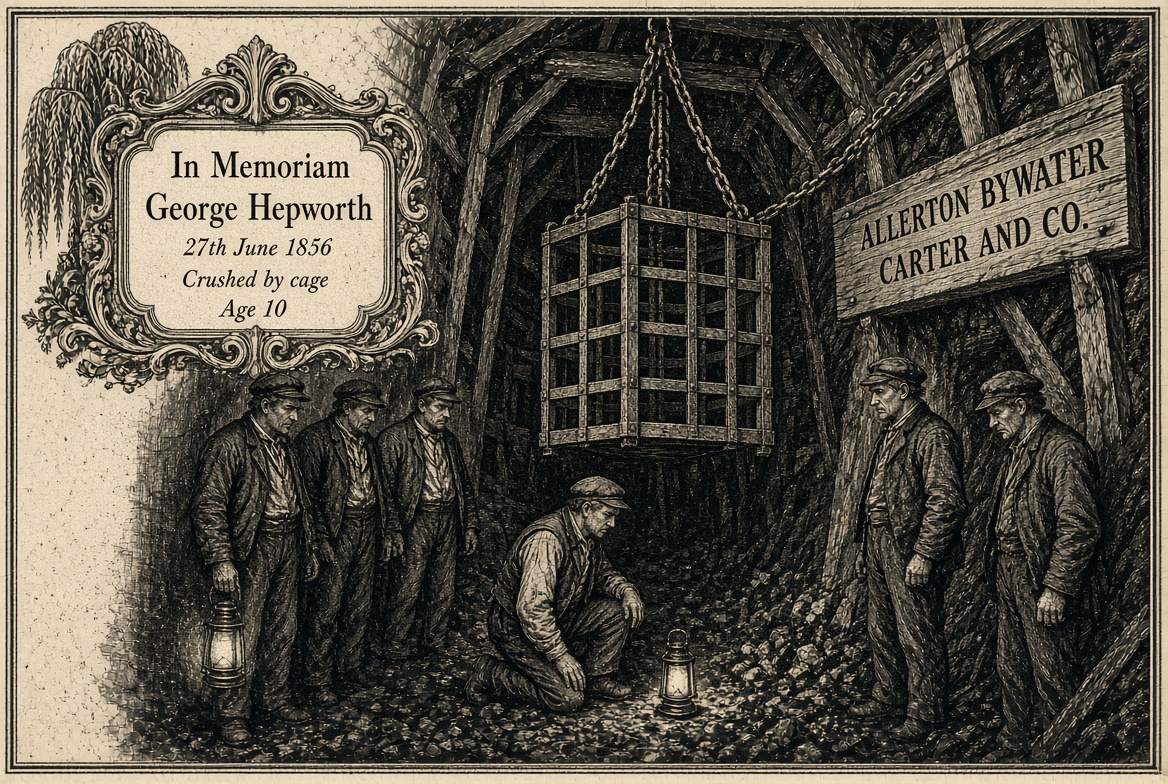
George Hepworth

IN MEMORIAM

George Hepworth

27 June 1856  ·  age 10

Crushed by the descending cage at the shaft bottom

Allerton Bywater Colliery, near Pontefract  ·  Carter and Co.

His life

George Hepworth was a boy of Lofthouse, in the ancient parish of Rothwell, in the West Riding. The burial register is the only record that fixes his age. He was ten years old when he was killed, so he was born about 1846.

No baptism, and no 1851 household, has been tied to him with certainty. Lofthouse-with-Carlton was a colliery township on the Rothwell side of the Aire, a short walk from Carter’s Haigh Moor workings at Allerton Bywater. Several Hepworth families lived in that parish. None of the published census extracts names a George of about five at Lofthouse in 1851, and the online indexes do not either. Parents’ names are not on the burial entry. They are not invented here.

By the Coal Mines Act of 1842, no boy under ten was to be employed underground. George was at the legal minimum. The inspector calls him only “a young boy.” The indexes call him a boy and give no trade. He was almost certainly a hurrier or a pit-bottom lad, crossing the shaft eye in the course of his work. That is an inference from the place of the accident, not a statement in the report.

He was killed on Friday 27 June 1856 and buried two days later.

The accident

On 27 June 1856, at Allerton Bywater Colliery, near Pontefract, worked by Carter and Co., George was underground at the shaft bottom. He was crossing from one side of the shaft to the other. There was no separate road cut alongside the pit bottom, so anyone passing had to cross the shaft eye itself, in the path of the cage and of anything falling in the shaft.

The cage was coming down. He did not see it. He was crushed and killed on the spot.

Charles Morton, H.M. Inspector of Coal Mines for the Yorkshire district, entered the case as Accident No. 26 in his tabular list for 1856, and wrote it up in the narrative report printed for Parliament in 1857. He did not treat it as a boy’s carelessness alone. He wrote that a road “should have been” excavated beside the pit bottom, so that people could pass without standing under the shaft. He told the agent to make that alteration at once. The agent agreed.

No contemporary newspaper report of this death has been found in the Leeds, Pontefract or Wakefield papers that are indexed online. The inspector’s account is the contemporary narrative.

Inspector’s report and conclusion

No coroner’s inquest paper, and no newspaper report of a verdict, has been traced. The official conclusion is Morton’s.

Accident No. 26 in the Tabular List.

At Allerton Bywater Colliery, near Pontefract, a young boy was imprudently crossing from one side of the shaft to the other, underground, when he was crushed unaware by the descending cage, and killed on the spot.

There was not a road excavated along side this pit bottom, (as there should have been,) to enable persons to pass unexposed to the danger attendant on falling substances in shafts; I therefore advised the agent forthwith to make such alterations as would tend to obviate the recurrence of similar mishaps in future; and he readily consented to carry my suggestions into effect.

Burial, parish of Rothwell, county of York, 1856, page 105, entry No. 837: George Hepworth, abode Lofthouse, buried 29 June, age 10. Ceremony by John Bell, station minister. West Yorkshire Archive Service reference P9/1/4/3.

The word “imprudently” is the inspector’s. The same paragraph says the road that would have kept him clear of the shaft had not been cut, and that it should have been.

Sources and citations

Rothwell parish burial register, 1856, page 105, entry No. 837. West Yorkshire Archive Service, P9/1/4/3. George Hepworth, Lofthouse, 29 June 1856, age 10, John Bell, station minister.

Reports of the Inspectors of Coal Mines to Her Majesty’s Secretary of State, to December 1856. London: Eyre and Spottiswoode, 1857. Charles Morton, Yorkshire district. Narrative of Accident No. 26; tabular list, pages 60 and 67.

Durham Mining Museum, George Hepworth individual page, colliery Allerton Bywater, company Carter and Co., died 27 June 1856, crushed by cage at bottom of the shaft. Source cited: 1856 Mines Inspectors Report, Charles Morton, pages 60 and 67, Accident No. 26. Burial given as not known. Year of birth given as about 1856.

UK Coal Mining Accidents and Deaths Index: George Hepworth, 27 June 1856, Pontefract, Allerton Bywater, Carter and Co., crushed by the cage at the bottom of the shaft, a boy.

Alan Beales, Database of Fatalities in the Coal Fields, England, Mining Disaster Victims: George Hepworth, Allerton Bywater, 27 June 1856, age recorded as boy.

Coal Mines Act 1842, 5 & 6 Vict. c. 99: females, and boys under ten, not to be employed underground.

Corrections

  • Age. The indexes say only “boy.” The burial register says 10. The plate and this account use 10.
  • Birth year. Durham Mining Museum prints “about 1856.” That is the year of death, not of birth. Age 10 in June 1856 puts birth about 1846.
  • Burial. Durham Mining Museum prints burial not known. He was buried at Rothwell on 29 June 1856, entry No. 837, abode Lofthouse.
  • Place. The accident indexes give Pontefract. That is the registration and reporting district. The colliery was Allerton Bywater. Home was Lofthouse.
  • Owner. Contemporary form is Carter and Co., not the later “T. M. Carter and Co.” used on the 1860s plates. The sign on this plate follows the 1856 indexes.
  • No parents, trade, or 1851 household is stated. None has been verified. They are left blank.
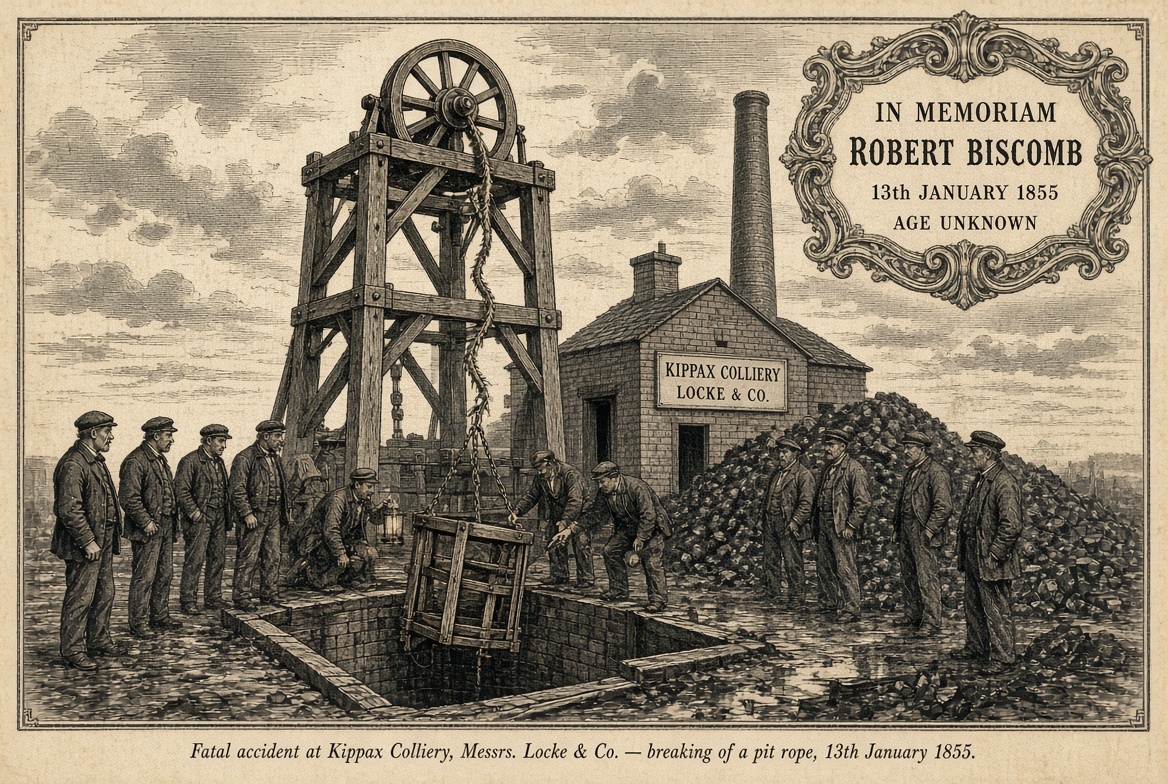
Robert Biscomb

ROBERT BISCOMB

of Kippax, Yorkshire

Baptised 30 March 1823  ·  Died 13 January 1855, aged 32

1. Life

Baptism

Robert Biscomb was baptised on 30 March 1823 at the parish church of St Mary the Virgin, Kippax. The register for that year, page 73, entry no. 579, records: Robert, son of Henry and Mary Biscomb, abode Kippax, father’s quality carpenter, ceremony performed by the Hon. and Rev. A. H. Cathcart, Vicar. West Yorkshire Archive Service reference P47/8.

No separate civil birth certificate exists. Civil registration of births began on 1 July 1837, fourteen years after this baptism. A birth shortly before 30 March 1823 agrees with the burial age of 32 in January 1855.

Parents and family

His father Henry Biscomb was a carpenter living in Kippax. The Biscombs (also written Biscombe, Biscam, Biscom) were already settled in the parish. In 1766 Henry Biscomb of Garforth married Sarah Dodgshon of Kippax; a later Henry Biscomb appears as a marriage witness. Baines’s Directory of 1822 lists William Biscomb as victualler of the Lord Nelson in Kippax. Thomas Biscomb, another Kippax carpenter, was raising a family in the same years, but Robert’s register names Henry and Mary, not Thomas and Abigail.

The Hon. and Rev. A. H. Cathcart, who baptised Robert, is the same vicar named in the 1822 directory. Kippax Park was the seat of T. D. Bland, Esq.; the later vicar E. D. Bland buried Robert in 1855.

Youth and work

Kippax in Robert’s boyhood was a small parish on the Yorkshire coalfield, eight miles east of Leeds. Coal was already being worked on a modest scale; John Locke appears in 1822 as a coal dealer. Locke and Co. were the owners of the Kippax pit by 1855. The large Haigh Moor shafts at Owl Wood were not sunk until 1858, three years after Robert’s death.

No school record has been found. The son of a village carpenter would commonly have been put to a trade or to the pit in his teens. By January 1855 he was employed at Locke and Co.’s Kippax colliery. No printed census extract for 1841 or 1851 has yet been tied to this Robert with certainty, and no marriage for him has been identified in the Kippax registers searched for this note. Later Kippax men named Robert Biscomb belong to other branches and later decades.

Death and burial

Robert was killed at work on Saturday 13 January 1855, the same hour as Joseph Pickard. He was buried at St Mary’s, Kippax, on Monday 15 January 1855. The burial register, page 17, entry no. 136, reads: Robert Biscomb, abode Kippax, 15 January, age 32, E. D. Bland, Vicar. Joseph Pickard, aged 42, was buried from the same church on the same day (entry no. 137). The two men therefore left the pit together and were laid in the same churchyard two days later.

2. The accident

On 13 January 1855 two men were killed at Kippax Colliery, Locke and Co. They were Robert Biscomb, aged 32, and Joseph Pickard, aged 42. Charles Morton, H.M. Inspector of Mines, recorded the cause as the breaking of a pit rope. The case is accident no. 53 in his half-year report for January–June 1855, printed at page 72.

A pit rope is the winding rope that raises and lowers men and coal in the shaft. When it parts, the cage or corf falls. Two deaths on one rope at one time almost always means the two men were riding together, either ascending or descending. Morton’s published table does not add the depth of the shaft, the type of rope (hemp or wire), or whether a splicing-plate or a “mark” on the rope was at fault. Those details appear in his narratives of other Yorkshire rope-breaks in the same decade, but not against this Kippax entry.

The pit of 1855 was Locke and Co.’s existing Kippax working, not the later Owl Wood sinking and not Medhurst or the Kippax Sand Co.

3. Coroner, newspaper and conclusion

No full inquest transcript and no newspaper report of the jury have been found in the open indexes searched for this note. Inquests on pit deaths in this district were normally held by the coroner for the honour of Pontefract, often sitting at a Kippax inn within a day of the bodies being brought up.

What stands in official form is Morton’s classification, which the coroner’s finding would have supported: accidental death by the breaking of a pit rope at Kippax Colliery, Locke and Co., 13 January 1855; two lives lost — Robert Biscomb and Joseph Pickard.

Burial of both men on 15 January is consistent with an inquest opened on the Sunday or Monday and the bodies then released to their families.

A later commercial index describes the same two deaths as “Bursting of an Underground Boiler.” That wording is not in Morton and is treated here as an error. A broken winding rope and a boiler explosion are different events.

4. Sources and citations

West Yorkshire Archive Service, Leeds: Kippax St Mary baptism register, 1823, p. 73, no. 579. Robert, son of Henry and Mary Biscomb, Kippax, carpenter; 30 March 1823; A. H. Cathcart, Vicar. Reference P47/8.

West Yorkshire Archive Service, Leeds: Kippax St Mary burial register, 1855, p. 17, no. 136. Robert Biscomb, Kippax, 15 January 1855, age 32; E. D. Bland, Vicar. Reference P47/26.

Charles Morton, H.M. Inspector of Mines, 1855 (January–June) Mines Inspectors Report, p. 72, accident no. 53.

Durham Mining Museum: Colliery disaster 13 January 1855, Kippax, Locke and Co.; cause, breaking of a pit rope; lives lost, 2 — Biscomb, Robert; Pickard, Joseph.

UK, Coal Mining Accidents and Deaths Index and Alan Beales, England, Mining Disaster Victims: Robert Biscomb, 13 January 1855 — used only with the correction in section 5.

Edward Baines, History, Directory and Gazetteer of the County of York, vol. I (1822), Kippax: William Biscomb, Lord Nelson; John Locke, coal dealer; Hon. and Rev. A. H. Cathcart, vicar.

George Denison Lumb (ed.), The Registers of the Parish Church of Kippax, 1539–1812 (YPRS vol. 10, 1901), for earlier Biscomb marriages in the parish.

5. Corrections

Cause. Commercial indexes attached to this research say “Bursting of an Underground Boiler. 2 Killed” or “Boiler burst underground.” The contemporary inspector, Charles Morton, recorded a broken pit rope. The inspector is followed.

Age. Burial age 32 in January 1855 matches a baptism of 30 March 1823. No correction is required.

Date of death versus burial. The accident was 13 January 1855. The burial was 15 January 1855. The two dates must not be collapsed.

Identity. John Biscomb, killed by a fall of roof at Kippax West Main on 9 January 1857, is a different man. Later Roberts in Kippax census and WikiTree profiles are later generations.

Marriage. No marriage for this Robert has been verified. It would be wrong to attach a wife or children from another Biscomb household.

If a Pontefract or Leeds newspaper for mid-January 1855 is later abstracted, the coroner’s wording should be added to section 3.

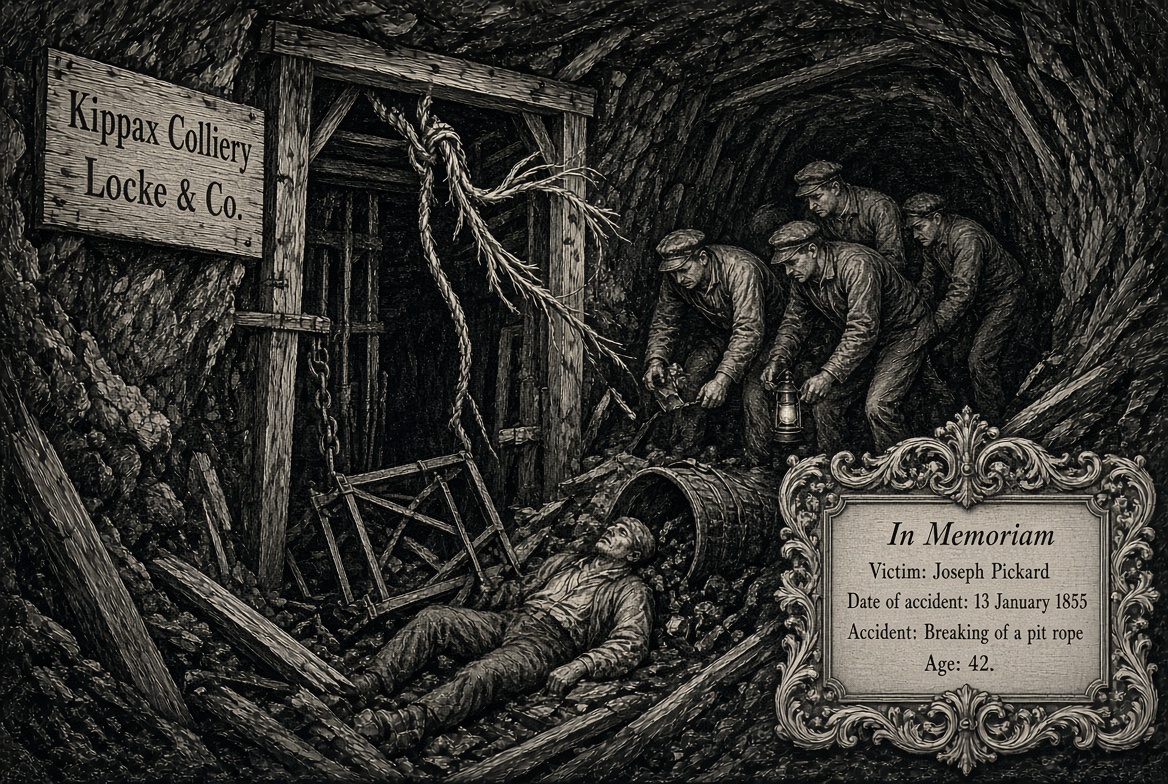
Joseph Pickard

Kippax Colliery, Locke and Co.

Killed 13 January 1855  ·  Buried 15 January 1855, aged 42

1. Life

Baptism

Joseph Pickard was baptised at Kippax on 26 October 1812, son of John Pickard. The extracted Church of England parish record names the father and no mother. The burial age of 42 in January 1855 fits that baptism: he would have turned 43 in October 1855.

Marriage

On 12 November 1837, at the parish church of Kippax, entry no. 251, Joseph Pickard of this parish married Sarah Fawcett of this parish, by banns. Both made their marks. Witnesses Joseph Hill and Harriet Pickard (Harriet also made her mark). The vicar signed A. Heart. West Yorkshire Archive Service P47/17, pages 84–85.

A published parish index gives Sarah Fawcett’s baptism as 2 January 1820 at Kippax, daughter of Benjamin Fawcett and Zilpha. That identification is consistent with the marriage, but the 1837 register does not name her father.

Census

The 1851 census schedules for this household were not among the documents supplied. A published index of that census places Sarah Pickard in the household of Joseph Pickard in the West Riding. The same indexes place a Sarah Pickard at Kippax in 1861 and 1871, after Joseph’s death. Those later entries have not been seen as images and are not used here for children’s names. No occupation for Joseph appears on the burial or the inspector’s abstract.

Death and burial

He was killed on Saturday 13 January 1855 and buried on Monday 15 January 1855 at St Mary’s, Kippax, entry no. 137: Joseph Pickard, abode Kippax, age 42, E. D. Bland, Vicar. West Yorkshire Archive Service P47/26. The Durham Mining Museum still prints the burial as not known.

2. The accident

On 13 January 1855 the winding rope broke at Kippax Colliery, Locke and Co. Two men were killed: Joseph Pickard and Robert Biscomb.

Charles Morton, H.M. Inspector of Mines, entered the case as accident no. 53 on page 72 of his report for January–June 1855. The Durham Mining Museum abstract taken from that report reads: Joseph Pickard; died 13 January 1855; accident 13 January 1855; colliery Kippax; company Locke and Co.; notes: breaking of a pit rope. The companion entry for Robert Biscomb carries the same cause and the same date.

A broken pit rope is a shaft accident. Men were in the cage, or the cage fell, when the rope parted. The open abstract does not say how far the cage fell, whether a detaching hook was fitted (they were not yet general), or what job either man was doing.

This was not the later Owl Wood sinking. Locke and Co. were already working coal at Kippax in 1855. The deep Haigh Moor shaft near Owl Wood is dated 1858 in local accounts. The 1855 pit was one of the shallower workings then standing in the township.

3. Coroner, newspaper and conclusion

No inquest transcript and no newspaper paragraph naming Joseph Pickard in January 1855 have been found in the open indexes searched for this note. A double death in the shaft would normally have gone before the Pontefract coroner.

Official conclusion, from the inspector’s table: accidental death, breaking of a pit rope, Locke and Co., Kippax, 13 January 1855. Two killed.

4. Sources and citations

Kippax baptism, 26 October 1812: Joseph Pickard, son of John Pickard. Yorkshire extracted Church of England parish records.

West Yorkshire Archive Service: Kippax marriage register, 12 November 1837, no. 251 (P47/17). Joseph Pickard and Sarah Fawcett, both of this parish, by banns; marks; witnesses Joseph Hill and Harriet Pickard.

West Yorkshire Archive Service: Kippax burial register, 1855, no. 137 (P47/26). Joseph Pickard, Kippax, 15 January 1855, age 42; E. D. Bland.

Charles Morton, Mines Inspectors Report, January–June 1855, p. 72, accident no. 53.

Durham Mining Museum: Joseph Pickard, died 13 January 1855, Kippax, Locke and Co., breaking of a pit rope; and the disaster page for the same date, two lives, with Robert Biscomb.

UK Coal Mining Accidents index and Alan Beales’s Mining Disaster Victims: Joseph Pickard, 13 January 1855, cause given as bursting of an underground boiler. These two commercial lines are not followed. See corrections.

5. Corrections

Cause. The commercial indexes say “bursting of an underground boiler, 2 killed.” Morton’s table, as abstracted by the Durham Mining Museum, says breaking of a pit rope, and names the same two men. The inspector’s classification is preferred.

Place. Pontefract in the commercial index is the registration and coroner’s district. The colliery and the grave are Kippax.

Age. Burial 42. Baptism 26 October 1812. The two agree. The inspector’s abstract gives no age.

Burial. DMM “not known” is filled by Kippax no. 137, 15 January 1855, two days after the accident.

Companion. Robert Biscomb died in the same rope failure. He is not to be folded into a boiler story.

error: Content is protected !!