
WILLIAM FIRTH
Allerton Haigh Moor Colliery, Locke and Co.
Killed 11 May 1863 · Age not recorded by the inspector
1. Life
No baptism, marriage, census household or burial register has yet been tied to this William Firth with the same certainty as the inspector’s accident entry. Firth was the most common surname in nineteenth-century Kippax. Attaching a particular christening or a particular widow without a burial age, a GRO certificate, or a newspaper naming next of kin would be guesswork. This note therefore records what is proved about the death and leaves the private life open.
What can be said
He was employed at Locke and Co.’s Allerton Haigh Moor Colliery in May 1863. That pit worked the Haigh Moor seam from the shafts sunk in 1858 at Owl Wood, between Kippax and Allerton Bywater. Edward Bickerdike of Kippax had been killed at the same colliery, by a brick falling in the shaft, on 27 January 1863 — fourteen weeks earlier. Both deaths stand on the same page of Charles Morton’s 1863 report (accidents no. 8 and no. 24).
Allerton Bywater was still in Kippax parish until an Order in Council of 1863 created a separate parish; the foundation stone of the new church was laid on 31 August 1863, after William’s death. Men from Kippax village walked or rode to these shafts.
Names that are not this man
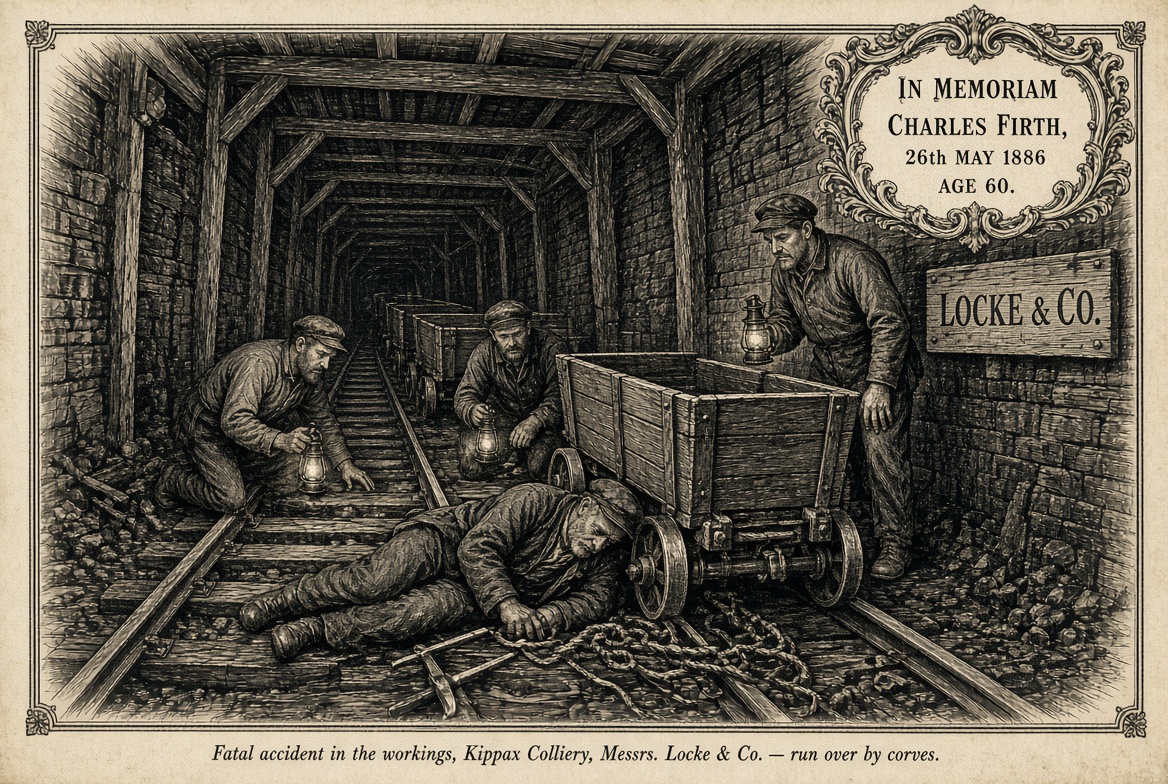
Charles Firth, aged about 60, killed in 1886 at a Locke / Kippax pit (run over by corves), is a later death.
William Firth of Rastrick, farmer, buried 3 August 1865 aged 58, is a different parish and a different year.
William Briggs Firth of Leeds, magistrate and ironmaster, who read a paper on coal-cutting machinery in 1863, was still alive in the 1870s.
William Firth, colliery proprietor of Shipley, died 24 March 1884.
Burial
The Durham Mining Museum still prints the burial as not known. No Kippax St Mary burial page for May 1863 was among the documents supplied for this note. St Mary’s remained the parish church for Kippax men; Allerton Bywater’s own church was not yet built.
2. The accident
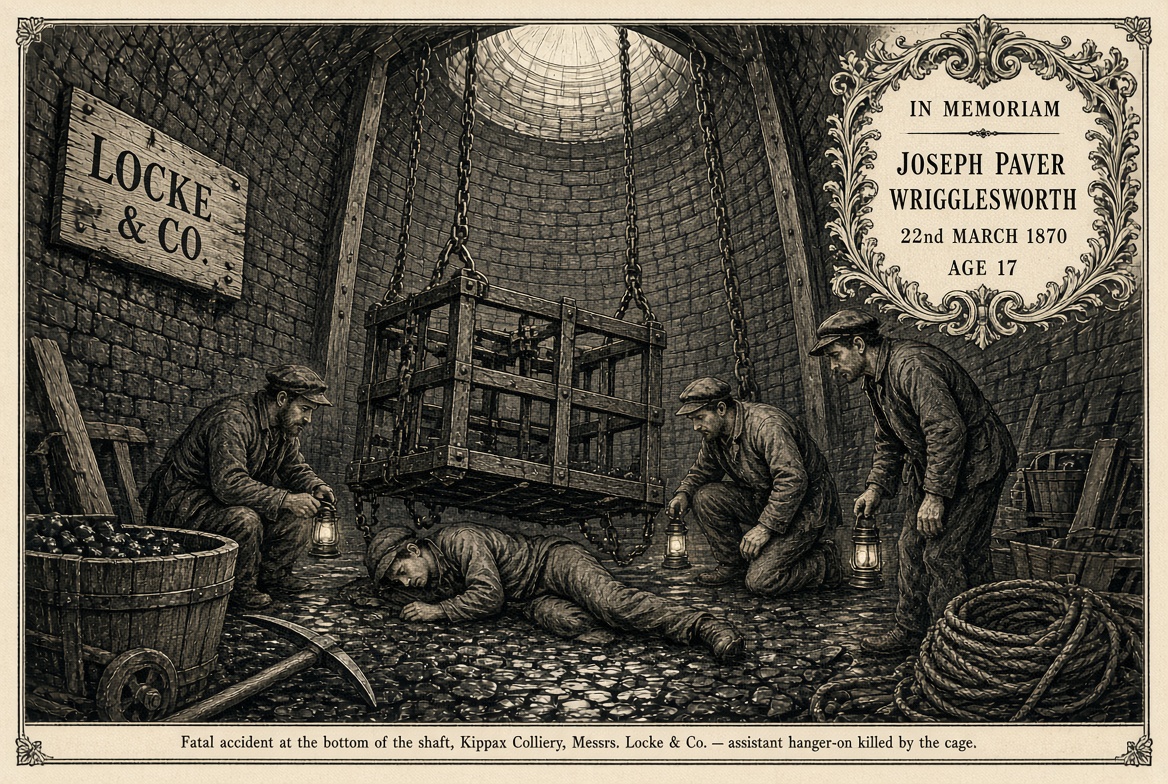
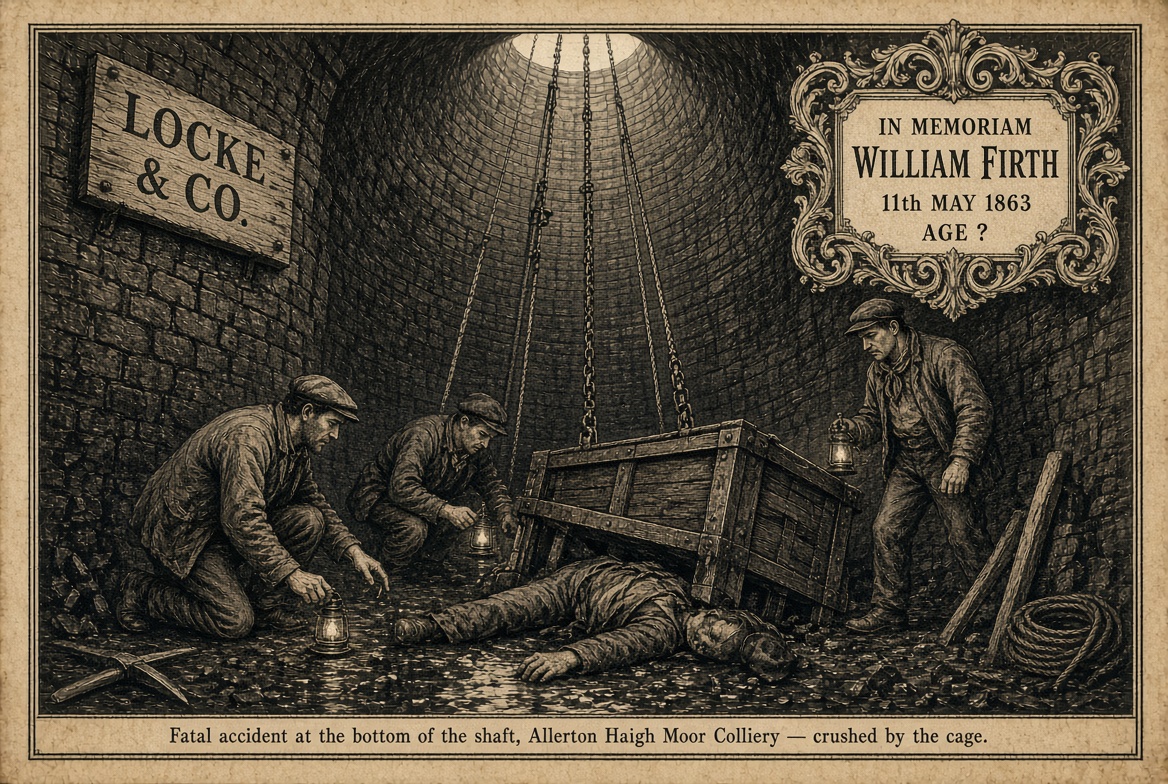
On Monday 11 May 1863 William Firth was killed at Allerton Haigh Moor Colliery, the property of Locke and Co. The official cause is that he was crushed at the bottom of the shaft.
Charles Morton, H.M. Inspector of Mines, entered the case as accident no. 24 in his 1863 report, printed at page 182. The Durham Mining Museum abstract taken from that report reads: William Firth; died 11 May 1863; accident 11 May 1863; colliery Allerton Haigh Moor; company Locke and Co.; notes: crushed at the bottom of the shaft.
Crushing at the shaft bottom usually means the cage, or a loaded tub or baulk descending the shaft, came down on a man who was standing or working in the sump or at the inset. Morton’s printed table does not say whether the cage was lowered onto him, whether a tub left the cage, or whether he was struck by something falling from above. Those particulars are not in the open abstract. The commercial Coal Mining Accidents and Deaths Index uses the same wording: Crushed in the Bottom of the Shaft.
The same commercial index places the accident at Leeds. Leeds is the nearest large town. The pit was Allerton Haigh Moor, in the Kippax / Allerton Bywater township, then in the Pontefract registration district (Castleford sub-district).
3. Coroner, newspaper and conclusion
No inquest transcript and no newspaper report naming this William Firth have been found in the open indexes searched for this note. Inquests on pit deaths around Kippax were normally held by the coroner for the honour or borough of Pontefract, often sitting at a village inn within a day or two of the body being brought up.
What stands in official form is Morton’s classification: accidental death by being crushed at the bottom of the shaft at Allerton Haigh Moor, Locke and Co., 11 May 1863; one life lost — William Firth.
4. Sources and citations
Charles Morton, H.M. Inspector of Mines, 1863 Mines Inspectors Report, p. 182, accident no. 24.
Durham Mining Museum, individual page: William Firth, died 11 May 1863, Allerton Haigh Moor, Locke and Co., crushed at the bottom of the shaft.
UK, Coal Mining Accidents and Deaths Index: William Firth, 11 May 1863, Locke and Co., Crushed in the Bottom of the Shaft; place given as Leeds.
Alan Beales, England, Mining Disaster Victims: William Firth, 11 May 1863, Allerton Haigh Moor.
Charles Morton, same report, p. 182, accident no. 8: Edward Bickerdike, 27 January 1863, same colliery, fall of a brick in the shaft — for the sequence of deaths at this pit.
On Allerton Bywater parish: formed from Kippax by Order in Council, 1863; foundation stone 31 August 1863.
5. Corrections
Date. 11 May 1863 is consistent across Morton, DMM, the Coal Mining Accidents index and Beales. No correction is required.
Place. Leeds in the commercial index is the nearest city. The pit is Allerton Haigh Moor, Locke and Co.
Age. Morton printed no age. Indexes that leave age blank are incomplete, not contradictory. Do not borrow an age from another William Firth.
Identity. Do not attach the Rastrick farmer (d. 1865), the Leeds ironmaster, the Shipley proprietor (d. 1884), or Charles Firth of 1886.
Burial. Still not found. DMM is correct to mark it unknown until a May 1863 Kippax (or Castleford) register page is produced.
A GRO death certificate for Firth, May 1863, Pontefract or Castleford district, would give age and informant’s name and should be the next document sought.
Authors