J Rhodes

J. RHODES

Screener, Locke and Co., Kippax Colliery

Died 14 January 1892, aged 54

1. Life

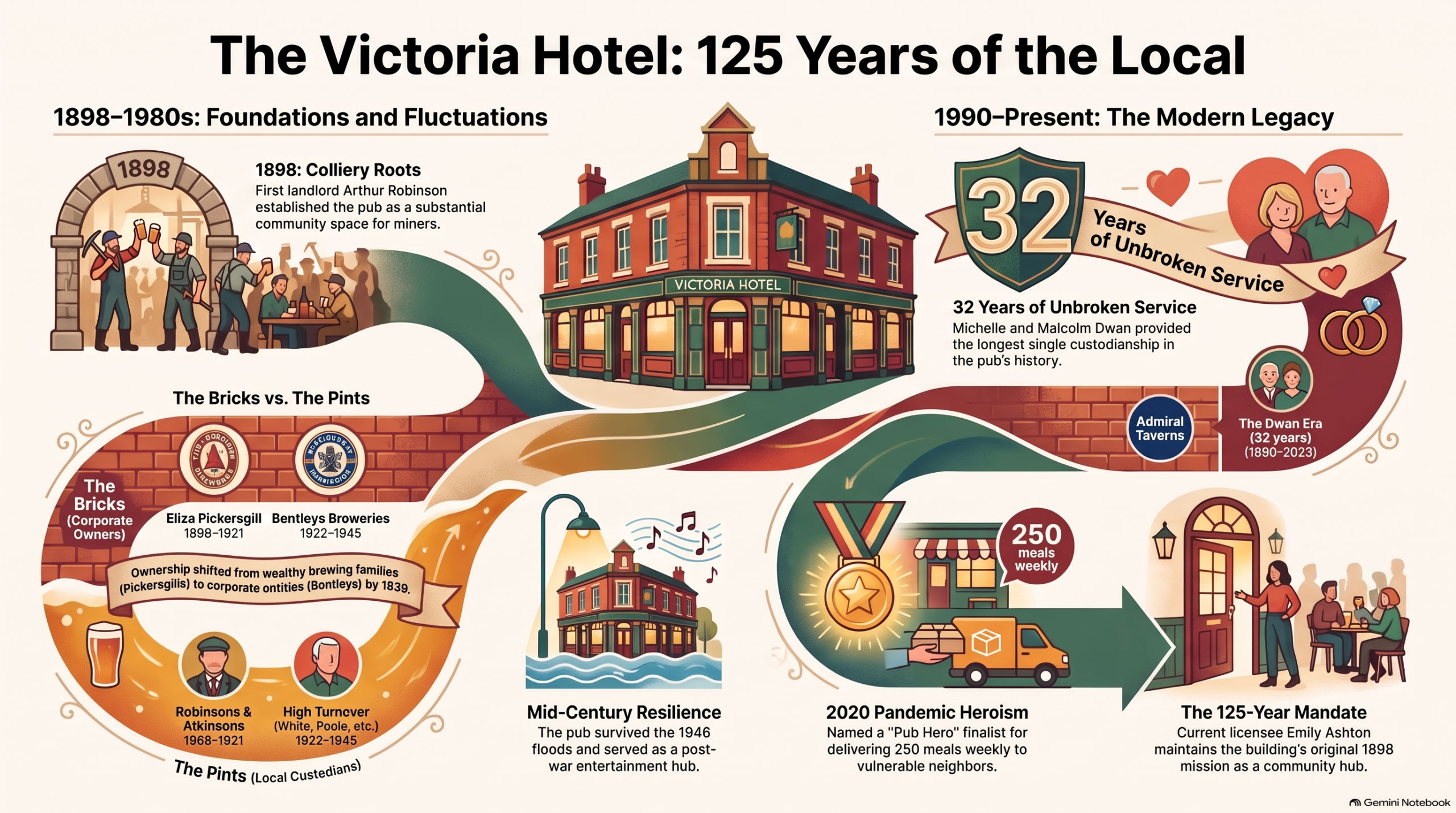
The official tables give only an initial. J. Rhodes was about 54 when he was killed, which puts his birth about 1837 or 1838. He was a screener at Locke and Co.’s Kippax Colliery. A screener worked on the surface, at the screens that sized the coal as it came from the shaft, with railway waggons standing under or beside those screens.

Rhodes is a common Kippax surname. The 1871 heads of household alone include Riley, Joseph, Henry, William and James Rhodes. John Pickersgill of this series married Ann Rhodes of Castleford in 1865. None of those lines can be tied to this death without a first name, a burial entry or a death certificate. DMM still prints the burial as not known. No 1891 census household has been matched.

What can be said is the work. He was on the seventh hour of the shift when he was killed, at 12.25 in the afternoon. That is a day-shift screener, not a night banksman.

2. The accident

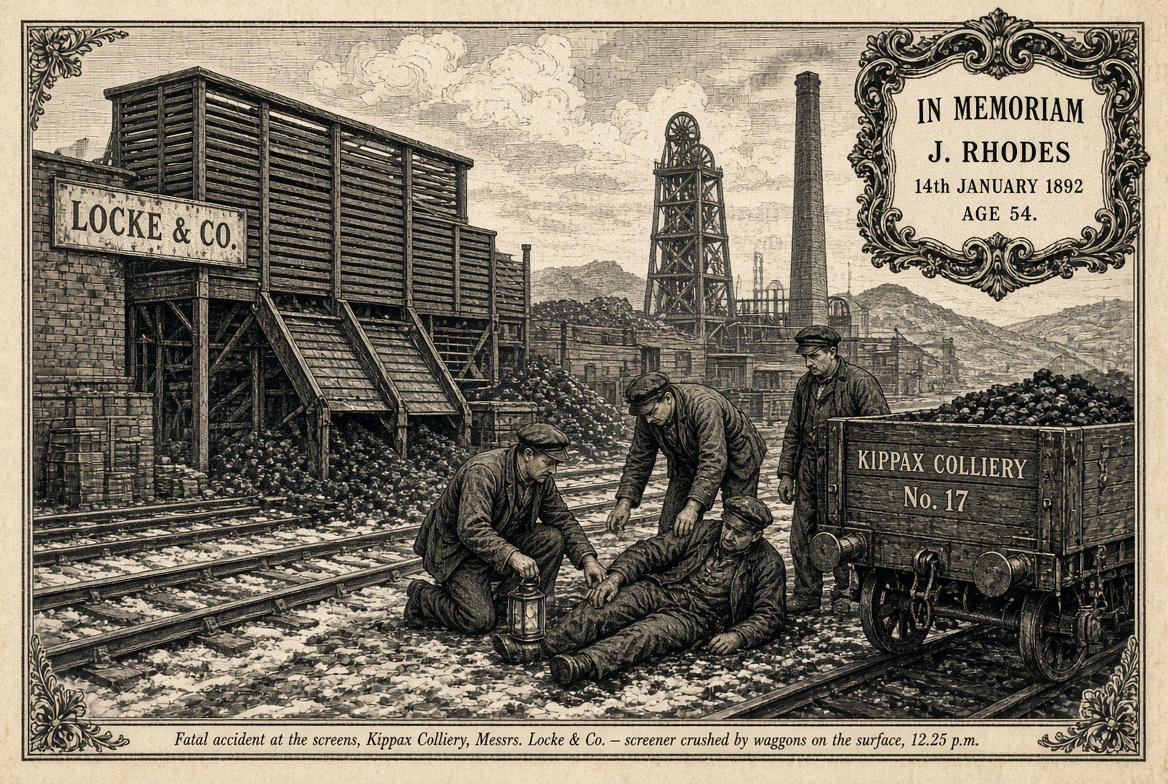
Thursday 14 January 1892, 12.25 p.m., seventh hour of the shift, Kippax Colliery surface, Locke and Co. J. Rhodes, screener, aged 54, was crushed by waggons.

Frank N. Wardell, inspector for Yorkshire and Lincolnshire (District No. 5), entered the case as accident no. 3 on page 27 of his 1892 report, Command Paper C. 6986. The Durham Mining Museum abstract taken from that report is the source of the hour and the shift number. The printed table does not add whether a waggon was being lowered under the screens, whether a sprag failed, or whether he was coupling.

The same class of accident killed John Pickersgill, screenman, at the same company’s Kippax screens on 13 November 1877. Surface waggon roads at the screens were a standing danger.

The commercial index places the accident at Leeds. Leeds is the nearest city. The colliery is Kippax.

3. Coroner, newspaper and conclusion

No inquest transcript and no newspaper paragraph naming J. Rhodes of Kippax in January 1892 have been found in the open indexes searched for this note. Surface deaths at Kippax were normally taken by the Pontefract or Tadcaster coroner.

Official conclusion: accidental death, crushed by waggons on the surface, screener, Locke and Co., Kippax, 14 January 1892, 12.25 p.m.

4. Sources and citations

Frank N. Wardell, 1892 Mines Inspectors Report (C. 6986), Yorkshire and Lincolnshire District (No. 5), p. 27, accident no. 3.

Durham Mining Museum: J. Rhodes, age 54, born about 1838, died 14 January 1892, accident 14 January 1892 at 12.25 p.m., seventh hour of shift, Kippax, Locke and Co., screener, crushed by waggons.

UK Coal Mining Accidents and Deaths Index, 1878–1951: J. Rhodes, age 54, born about 1838, 14 January 1892, Leeds, Locke and Co., screener, crushed by waggons.

5. Corrections

Place. Leeds in the commercial index is the nearest city. The pit is Kippax.

Surface, not underground. Screener plus waggons is a screen-road accident, the same class as John Pickersgill in 1877.

Identity. Do not attach a particular Kippax Rhodes household until a first name, burial or GRO certificate is produced. The inspector recorded only J.

Burial. Still not known. A Kippax or Allerton Bywater register search for mid-January 1892, age about 54, would settle it.

A GRO certificate from Tadcaster or Pontefract, January–March 1892, Rhodes, age 54, would give the first name and the informant.

Charles Firth

CHARLES FIRTH

Byeworker, Locke and Co., Kippax Colliery

Died 26 May 1886  ·  Buried 29 May 1886, aged 62

1. Life

Birth and parents

Charles Firth was born at Little Preston, in the parish of Kippax, about 1824. He was 17 on the 1841 census, 26 in 1851, 37 in 1861, 46 in 1871, 56 in 1881, and 62 at burial in May 1886. Those ages run in a straight line. His father, named on the 1847 marriage, was George Firth, smith. In 1841 Charles was already in George and Sarah Firth’s Little Preston house, occupation written engine-keeper or engineman.

Marriage

On 12 April 1847, at the parish church of Leeds, entry no. 489, Charles Firth, full age, bachelor, smith, of Ellerby Lane, son of George Firth, smith, married Jane Wilkinson, full age, spinster, of George Street, daughter of Reuben Wilkinson, clothier. Charles signed; Jane made her mark. Witnesses Emmanuel Gill and Rebecca Firth (mark). Officiant W. Farley, French, officiating minister. West Yorkshire Archive Service P68/5/24. The civil index is Leeds XXIII 343.

Children and Jane’s death

1851, Little Preston, HO 107/2329, schedule 40: Charles, 26, coal miner, born Little Preston; Jane, 25, born Great Preston; Edward, 2; Reuben George, 8 months. Both boys born Little Preston.

Alfred was baptised at Swillington on 26 December 1858, no. 18: Alfred, son of Charles and Jane Firth, Little Preston, miner. Jane was therefore still alive at the end of 1858. By census night 1861 Charles is a widower. A daughter Sarah, about eight in 1861, sits between Reuben George and Alfred.

From 1861 to 1871 the housekeeper was Hannah Sampson, widow.

Later censuses

1861, Little Preston, RG 9/3431, schedule 56: Charles Firth, widower, 37, coal miner; Edward, 12; Reuben George, 10; Sarah, 8; Alfred, 2; Hannah Sampson, housekeeper.

1871, Little Preston, RG 10/4739, schedule 71: Charles, widower, 46, coal miner; Edward, 22, coal miner; Reuben George, 20, wheelwright; Sarah, 18; Alfred, 12, scholar; Hannah Sampson, 55, housekeeper.

1881, Little Preston, RG 11/4712, schedule 14: Charles, widower, 56, coal miner; Sarah, unmarried, 28; Alfred, unmarried, 22, joiner.

He stayed a coal miner of Little Preston for forty years. In 1886 the inspector’s table calls him a byeworker — a man working a bye, or heading, underground.

Burial

Kippax St Mary, 1886, page 59, no. 465: Charles Firth, Little Preston, 29 May 1886, 62 years, W. W. Dennett, Curate. West Yorkshire Archive Service P47/27. A commercial transcript that first printed 29 April is wrong; the register is May.

2. The accident

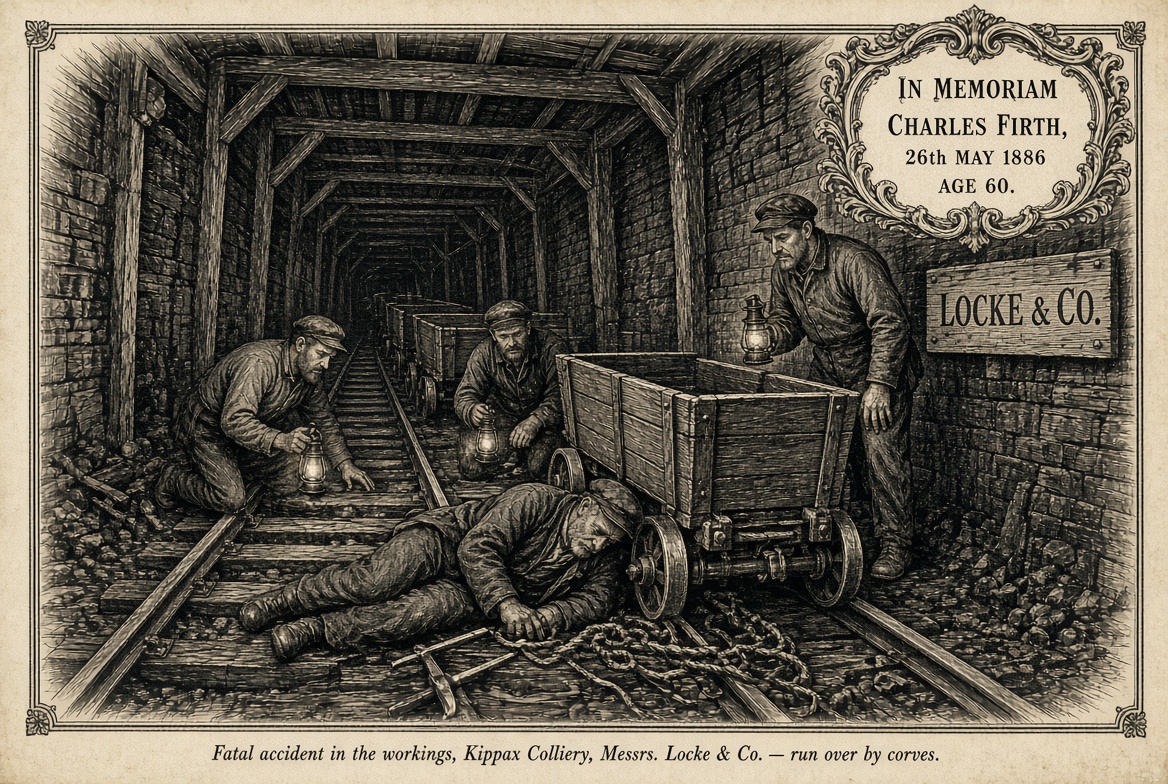
On Wednesday 26 May 1886 Charles Firth, byeworker, was run over by corves at Kippax Colliery, Locke and Co. He was buried three days later.

A corf is an underground tub. A byeworker works in a bye, off the main roads. The accident is therefore underground, on a gate or in a heading, not on the surface screens. The original request asked that this be settled: it is underground.

The compiled mining index gives age 60 and birth about 1826. The burial age 62 and the census run are preferred. Place of death in that index is Leeds, the nearest city; the pit and the grave are Kippax / Little Preston.

No longer printed inspector’s narrative for this entry has been found in the open DMM pages searched for this note. The one-line official classification remains: run over by corves.

3. Coroner, newspaper and conclusion

No inquest transcript and no newspaper paragraph naming Charles Firth of Little Preston in May 1886 have been found in the open indexes. Surface and underground deaths at Kippax were normally taken by the Pontefract or Tadcaster coroner.

Official conclusion: accidental death, run over by corves underground, byeworker, Locke and Co., Kippax, 26 May 1886.

4. Sources and citations

1841 Census, Little Preston, HO 107/1311/17: Charles Firth, 17, engineman, in the house of George and Sarah Firth.

Leeds parish church marriage register, 12 April 1847, no. 489 (P68/5/24): Charles Firth, full age, bachelor, smith, Ellerby Lane, son of George Firth, smith, to Jane Wilkinson, full age, spinster, George Street, daughter of Reuben Wilkinson, clothier.

GRO marriage index: Firth, Charles, Leeds, XXIII 343.

1851 Census, Little Preston, HO 107/2329, schedule 40: Charles 26, coal miner; Jane 25; Edward 2; Reuben George 8 months.

Swillington baptism register, 26 December 1858, no. 18 (P99/4/2): Alfred, son of Charles and Jane Firth, Little Preston, miner.

1861 Census, Little Preston, RG 9/3431, schedule 56: Charles, widower, 37, coal miner, with Edward, Reuben George, Sarah, Alfred and Hannah Sampson.

1871 Census, Little Preston, RG 10/4739, schedule 71: Charles, widower, 46, coal miner, same children plus Hannah Sampson, housekeeper.

1881 Census, Little Preston, RG 11/4712, schedule 14: Charles, widower, 56, coal miner; Sarah 28; Alfred 22, joiner.

Kippax St Mary burial register, 1886, no. 465 (P47/27): Charles Firth, Little Preston, 29 May 1886, age 62, W. W. Dennett.

UK Coal Mining Accidents index: C. Firth, age 60, born about 1826, 26 May 1886, Leeds, byeworker, Kippax, Locke and Co., run over by corves.

5. Corrections

Underground, not surface. Byeworker plus corves is a pit-road accident. The earlier memorial brief that left the place open is settled.

Age. Burial 62 and the census line (17, 26, 37, 46, 56) beat the index age 60. Birth is about 1824, not 1826.

Burial date. The register is 29 May 1886. A commercial transcript that first printed 29 April is wrong.

Place. Leeds in the commercial index is the nearest city. He lived and was buried as of Little Preston / Kippax.

Wife. Jane Wilkinson, married 1847, alive at Alfred’s baptism in December 1858, dead by April 1861. Charles did not remarry.

John Pickersgill

JOHN PICKERSGILL

Screenman, Locke and Co., Kippax Colliery

Died 13 November 1877  ·  Buried 4 December 1877, aged 36

1. Life

Birth and trade

John Pickersgill was born at Kippax about 1841. He gave his age as 23 when he married in September 1865, and as 30 on census night 1871; the burial register of December 1877 gives 36. Those three figures agree on a birth in 1840–42. He was a joiner at the time of his marriage. By 1871 he was a labourer at a coal pit; by 1877 he was a screenman on the surface at Locke and Co.’s Kippax Colliery.

Marriage

Banns were called at South Milford on 13, 20 and 27 August 1865 between John Pickersgill of that parish and Ann Rhodes of South Milford. The marriage was solemnized after banns at the parish church of South Milford on 23 September 1865, entry no. 24. John, 23, bachelor, joiner, of South Milford. Ann Rhodes, 25, spinster, domestic servant, of Castleford, daughter of Thomas Rhodes, post-office clerk. Witnesses Thomas Chapman and Ann Chapman. Officiant Frederic John Young.

Ann’s census age in 1871 is written 23, which does not match a woman of 25 in 1865. The enumerator’s 23 is treated as a slip; the marriage age and the two Kippax-born daughters are the better guide.

1871 household

Kippax, 1871, page 22, schedule 136, Public Record Office RG 10/4739. John Pickersgill, head, married, 30, labourer at a coal pit, born Kippax; Ann, wife, married, written 23, born Garforth; Eliza Ann, daughter, 2, born Kippax; Mary Jane, daughter, 1, born Kippax.

Schedule 138, two doors on, is James Pickersgill, 24, agricultural labourer, born Kippax, with wife Martha, 20. He is the right age to be John’s younger brother. Schedule 135 is Eliza Biscomb, widow, and her son Henry, coal miner — the same Kippax Biscomb kinship already recorded in this series.

Death and burial

He was killed on the surface on 13 November 1877. He was buried at St Mary’s, Kippax, on 4 December 1877, entry no. 288: John Pickersgill, abode Kippax, age 36, E. D. Bland, Vicar. West Yorkshire Archive Service P47/26. Three weeks between death and burial is long but possible after an inquest. DMM still prints the burial as not known.

2. The accident

On Tuesday 13 November 1877 John Pickersgill, screenman, was crushed by waggons on the surface at Kippax Colliery, Locke and Co.

Frank N. Wardell, inspector for Yorkshire and Lincolnshire, entered the case as accident no. 85 in his 1877 report (Command Paper C. 2003), page 235. The Durham Mining Museum abstract taken from that report reads: J. Pickersgill; died 13 November 1877; accident 13 November 1877; colliery Kippax; company Locke and Co.; occupation screenman; notes: crushed by waggons on surface.

A screenman worked the surface screens that sized the coal as it came from the shaft. Railway waggons stood under or beside those screens to take the sorted coal away. Being crushed by waggons on the surface is a siding or screen-road accident: a moving waggon, or a pair of waggons, catching a man against a buffer, a wall or another vehicle. Wardell’s printed table does not add whether the waggons were being lowered, whether a sprag failed, or whether John was coupling. Those particulars are not in the open abstract.

The commercial index places the death at Leeds. Leeds is the nearest city. The pit and the burial are Kippax.

3. Coroner, newspaper and conclusion

No inquest transcript and no newspaper paragraph naming John Pickersgill have been found in the open indexes searched for this note. Surface deaths at Kippax were normally taken by the Pontefract coroner.

Official conclusion: accidental death, crushed by waggons on the surface, screenman, Locke and Co., Kippax, 13 November 1877.

4. Sources and citations

South Milford marriage register, 23 September 1865, no. 24: John Pickersgill, 23, bachelor, joiner, of South Milford, to Ann Rhodes, 25, spinster, domestic servant, of Castleford, daughter of Thomas Rhodes, post-office clerk.

South Milford banns, 13, 20 and 27 August 1865: John Pickersgill of this parish and Ann Rhodes of South Milford.

1871 Census of England, Kippax, RG 10/4739, p. 22, schedule 136: John Pickersgill, 30, labourer at a coal pit, with Ann, Eliza Ann (2) and Mary Jane (1).

West Yorkshire Archive Service: Kippax St Mary burial register, 1877, no. 288. John Pickersgill, Kippax, 4 December 1877, age 36; E. D. Bland. Reference P47/26.

Frank N. Wardell, 1877 Mines Inspectors Report (C. 2003), Yorkshire and Lincolnshire, p. 235, accident no. 85.

Durham Mining Museum: J. Pickersgill, died 13 November 1877, Kippax, Locke and Co., screenman, crushed by waggons on surface.

UK Coal Mining Accidents index: J. Pickersgill, 13 November 1877, Leeds, screenman, Kippax, Locke and Co., crushed by waggons on surface.

5. Corrections

Age. Burial 36 and the 1865 / 1871 ages agree on a birth about 1841. The original memorial wording Age 37 is one year out. A GRO index entry for John Pickersgill, age 40, Leeds 9b 346, October–December 1877, is a different registration district from Kippax (then Tadcaster / Pontefract) and should not be attached until the certificate is seen.

Wife’s census age. Ann 23 in 1871 cannot be the Ann who was 25 in 1865. Treat 23 as an enumerator’s error.

Occupation. Joiner in 1865, pit labourer in 1871, screenman in 1877. The surface job is the one in which he died.

Place. Leeds in the commercial index is the nearest city. The colliery and the grave are Kippax.

Burial. DMM “not known” is filled by Kippax no. 288, 4 December 1877.

A GRO certificate from the Tadcaster or Pontefract volume for November 1877 would settle the registrar’s age and the informant.

John Paver Wigglesworth

JOSEPH PAVER WIGGLESWORTH

also indexed as Wrigglesworth

Assistant hanger-on, Owl Wood Pit  ·  Died 22 March 1870, aged 16

1. Life

Parents and census

Joseph Paver Wigglesworth was the eldest son of William Wigglesworth and Frances (the 1861 wife’s second forename is written Ann). On census night 1861 the family was in Allerton Bywater, schedule 25, Public Record Office piece RG 9/3431, page 6.

William Wigglesworth, head, married, farm labourer, born Walton, Yorkshire; Frances his wife, 35, born Sherburn; Joseph, son, 7, born Kippax; John, son, 6, born Kippax; William, son, 4, born Allerton Bywater; Catharine, daughter, 1, born Allerton Bywater. Two Townend lodgers, a blacksmith and a cattleman, shared the house.

Joseph’s age of 7 in April 1861 gives a birth in 1853 or early 1854. That agrees with the GRO death age of 16 in March 1870 and with his father’s sworn statement at the inquest. The mining indexes that print age 17 and birth about 1853 are a year out, or count the next birthday.

Work

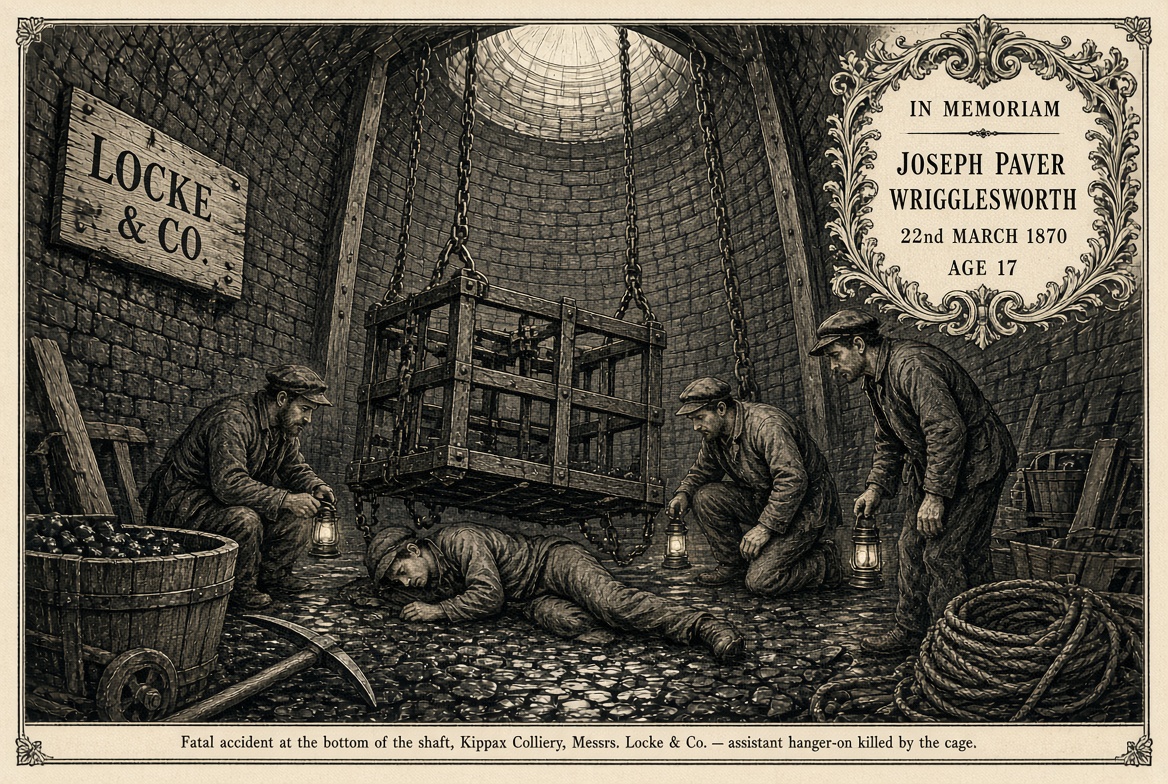
By March 1870 the father was a colliery horse-keeper at Allerton Bywater, but not at the same pit as his son. Joseph had been a hurrier (pushing corves underground) until about ten weeks before his death. He then became assistant hanger-on to Christopher Reed at Messrs Locke and Co.’s Owl Wood Pit — written Hool Wood in the coroner’s book. The hanger-on worked the cage at the pit bottom: empty corves off, full corves on. The cage held two corves. Joseph’s job, Reed said, was to take the empty corves away after Reed had thrust the full ones in. He had nothing to do with the full corves and nothing to do with control of the pit bottom.

Reed described him as following him down the pit about six o’clock on the morning of the accident. The father described him as strong and active.

Death and burial

He was killed at the shaft bottom on Tuesday 22 March 1870. The inquest sat the next day. He was buried on Thursday 24 March 1870 at Allerton Bywater, entry no. 95, page 12 of the 1870 register: Joseph Paver Wigglesworth, abode Allerton Bywater, age 16, E. Winterbottom. West Yorkshire Archive Service P313/1.

Civil registration: Joseph Paver Wigglesworth, age 16, Tadcaster district, January–March 1870, volume 9c, page 483. The printed national index lists him in the Wigglesworth block as Joseph Paver, 16, Tadcaster 9c 483.

2. The accident

Owl Wood (Hool Wood) Pit, Locke and Co., Allerton Bywater, Tuesday 22 March 1870, about eleven in the morning.

Reed sent an empty corf away with Joseph and signalled the engineman to wind. When the full cage left the bottom Reed went to the top of the porch for another full corf. Coming back he found the cage with the empty corves had landed. One end of the cage was raised. Joseph’s legs were on the door plates. Reed signalled at once for the cage to be raised and pulled him out. Head and shoulders were under the cage, face downward, left arm straight out past the head. Nobody else was at the bottom. Reed lifted him. He struggled three times, bled from the mouth and rattled in the throat, and was dead in about half a minute.

Reed had given him no order about the sump-hole. There was a road round the porch. How Joseph came to be under the descending or settling cage is not further explained in the depositions. The compiled mining note is: killed by cage at bottom of shaft.

3. Coroner’s inquest

Held on Wednesday 23 March 1870 at the house of John Cheesbrough, the butcher, Allerton Bywater, on view of the body of Joseph Paver Wigglesworth deceased. (The facing leaf in the same book is a different sitting, on Annabella Firth, natural causes; Joseph’s case begins on the right-hand page numbered 1937 in the photographer’s count.)

William Wigglesworth

William Wigglesworth of Allerton Bywater, colliery horse keeper, sworn, says: Deceased was 16 years old and an Assistant Hanger on in Messrs Locke & Co.’s Hool Wood Pit in Allerton Bywater. He was my son. He was strong and active. I do not work at the same Colliery. I go to work before deceased starts. About ½ past 11 o’clock yesterday forenoon I reached the Pit bank and saw deceased’s body in a Cart. The body was taken home.

Christopher Reed

Christopher Reed of Kippax, hanger on at Hool Wood Pit, sworn, says: Deceased was a hurrier until about ten weeks ago when he began to assist me to take the empty corves away when I thrust them out by shoving full corves in. The cage holds 2 corves. Deceased had nothing to do with the full corves nor with the control of the Pit bottom. He followed me down the Pit about 6 o’clock yesterday morning and worked up to about 11 o’clock. He then went away with an empty corf and I gave the Engineman the signal to go on. When the full cage left the Pit bottom I went to the top of the Porch for a full corf. On reaching the Pit bottom I found the cage with the empty corves had lighted on the proper spot. I saw the end of the cage was raised and deceased’s legs were on the door plates. I instantly signalled for the cage to be raised and I then pulled him away. His head and shoulders were under the Cage. He was face downward and his left arm was straight out past his head. Nobody else was about the bottom. I lifted deceased up and he seemed to struggle 3 times then began to bleed from the mouth as he rattled in the Throat. He did not live more than about half a minute. I had not given any directions to do anything about the sump hole and I do not know that anything was required to be done in the bottom. There is a road round the Porch.

Verdict

Verdict. Accidentally crushed.

Paid: Joseph Bulmer, 19 shillings, personal expenses. The next sitting in the same book, 24 March 1870 at the Royal Oak, Allerton Bywater, is John Stead, coke burner, and is not this case.

4. Sources and citations

1861 Census of England, Allerton Bywater, RG 9/3431, p. 6, schedule 25: William Wigglesworth household, Joseph aged 7, born Kippax.

West Yorkshire Archive Service: Allerton Bywater burial register, 1870, p. 12, no. 95. Joseph Paver Wigglesworth, Allerton Bywater, 24 March 1870, age 16. Reference P313/1.

GRO death index, January–March 1870: Wigglesworth, Joseph Paver, 16, Tadcaster, 9c 483.

Coroner’s depositions, 23 March 1870, house of John Cheesbrough, butcher, Allerton Bywater: William Wigglesworth and Christopher Reed; verdict accidentally crushed.

Durham Mining Museum: J. Wrigglesworth, age 17, died 22 March 1870, Kippax, Locke and Co., assistant hanger-on, killed by cage at bottom of shaft.

UK Coal Mining Accidents indexes, 1878–1935 and 1878–1951: J Wrigglesworth, age 17, born about 1853, 22 March 1870, Normanton, Locke and Co., assistant hanger-on, killed by cage at bottom of shaft.

5. Corrections

Surname. Census, burial, GRO and the father’s own signature-form in the inquest heading are Wigglesworth. Mining indexes use Wrigglesworth. Paver is the second forename, not a variant of the surname.

Age 1 in a commercial burial transcript. Wrong. The register reads age 16. The database that printed birth year about 1869 has misread the sixteen.

Age 16 or 17. Father, burial and GRO say 16. DMM and the accident indexes say 17. Prefer 16.

Pit. Wool Wood in the coroner’s book is Owl Wood, Locke and Co., Allerton Bywater. Indexes that say Kippax / Normanton are using the company and the nearest towns.

DMM burial. Not unknown. Allerton Bywater no. 95, 24 March 1870.

Facing page of the coroner’s photograph. Annabella Firth (natural causes) is a different inquest and must not be folded into this death.

Joseph Hewitt

JOSEPH HEWITT

Staithman, Locke and Co., Kippax Colliery

Died 5 November 1868  ·  Buried 8 November 1868

1. Life

Age and residence

Frank N. Wardell, the Yorkshire inspector of mines, recorded Joseph Hewitt as aged 66 in November 1868, which implies a birth about 1802. The burial register at St Mary’s, Kippax, three days later, gives age 60. Alan Beales’s compiled list gives birth year 1803 and age 65. The three figures are not reconciled without a baptism or a GRO certificate. What is certain is that he was an elderly surface worker living at Kippax.

The burial entry is no. 347 on page 130 of the Kippax register for 1868: Joseph Hewitt, abode Kippax, buried 8 November, age 60, E. D. Bland, Vicar. West Yorkshire Archive Service reference P47/26. DMM still prints the burial as not known; the register supplied with this research fills that gap.

Work

He was a staithman for Locke and Co. at Kippax Colliery. A staithman worked the coal staithe — the riverside or canal-side wharf where tubs were tipped into barges. From 1858 coal from the Owl Wood / Haigh Moor shafts was carried south on a tramway over the road to the coal staithe on the Aire and Calder Navigation. That tramway is the line on which he was killed.

He is not the same man as Robert Hewitt of Kippax (baptised 1803, coal miner, buried 1877), nor John Locke Hewitt who heads a Kippax household in 1871. No baptism naming Joseph’s parents has been produced for this note, so the household is not reconstructed.

2. The accident

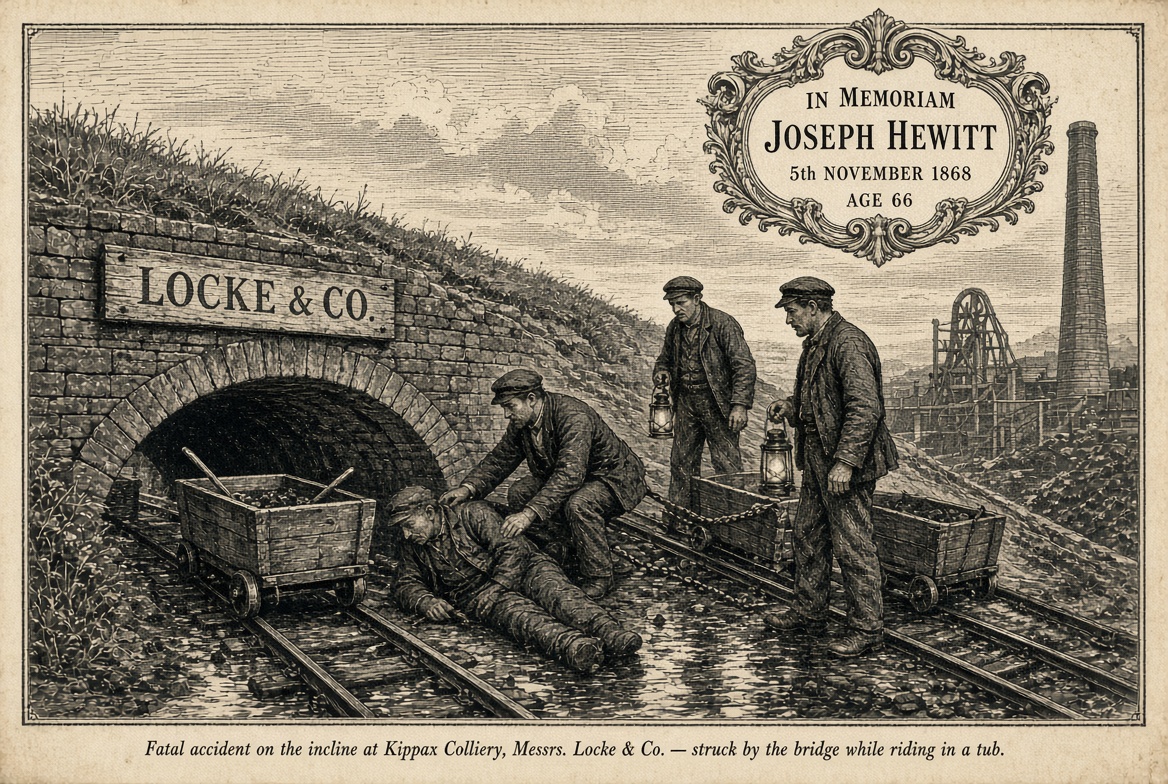
On Thursday 5 November 1868 Joseph Hewitt was killed on the surface incline that joined the Kippax Colliery staiths to the pit. He was not underground. He was not killed by a fall of roof.

Wardell printed the case as accident no. 67 in his 1868 Yorkshire report (narrative at page 155; table at page 161). The Durham Mining Museum transcript of that narrative is as follows.

There is a tramway connecting the staiths with Kippax Colliery, on which this accident occurred. The colliery is the property of Messrs. Locke and Co., and is situated near Normanton. The deceased, Joseph Hewitt, was riding up to the pit in one of the tubs on this incline, — the men having permission so to do, — when he lost his stick into the tub next that in which he was seated, and during his attempt to regain it his head came in contact with a bridge, thereby dislocating his neck. The tramway at this bridge passes under the highway. There was no violation of any rule, and the accident can only be attributable to the poor man’s forgetfulness of the danger, he having constantly travelled in the same way before.

My opinion was that if men were allowed to travel in this manner, they should only do so at stated times, and then under the charge of one steady and careful man who would be responsible for their taking proper precautions to avoid similar accidents.

The short DMM note on the individual page is the same event in one line: while riding in a tub on an incline his head came against a bridge underneath which the tubs ran. Occupation: staithman. Age: 66.

The commercial Coal Mining Accidents index and Beales both print Fall of Roof. That is a classification error. Wardell’s own words are the authority.

3. Coroner, newspaper and conclusion

No separate coroner’s transcript and no Leeds or Pontefract newspaper paragraph naming Joseph Hewitt have been found in the open indexes searched for this note. Wardell’s printed opinion, written after he had seen the place, stands in place of those missing texts.

Conclusion. Accidental death. Joseph Hewitt, staithman, Locke and Co., Kippax, 5 November 1868. He was riding in a permitted tub on the staith-to-pit incline, reached for a dropped stick, and struck his head on the highway bridge that the tramway passed under. His neck was dislocated. No rule of the colliery was broken. Wardell thought the practice of riding the incline should be confined to set times and placed under one responsible man.

He was buried at St Mary’s, Kippax, on Sunday 8 November 1868.

4. Sources and citations

West Yorkshire Archive Service, Leeds: Kippax St Mary burial register, 1868, p. 130, no. 347. Joseph Hewitt, Kippax, 8 November 1868, age 60; E. D. Bland, Vicar. Reference P47/26.

Frank N. Wardell, H.M. Inspector of Mines, 1868 Mines Inspectors Report, Yorkshire District, p. 155 (narrative) and p. 161, accident no. 67.

Durham Mining Museum, individual page and disaster page: Joseph Hewitt, age 66, died 5 November 1868, Kippax, Locke and Co., staithman; riding a tub on the incline, head against a bridge.

UK, Coal Mining Accidents and Deaths Index: Joseph Hewitt, age 66, born about 1802, 5 November 1868, Normanton, Locke and Co., staithman — description Fall of Roof (corrected from Wardell).

Alan Beales, England, Mining Disaster Victims: Joseph Hewitt, born 1803, age 65, 5 November 1868, Kippax, fall of roof (corrected from Wardell).

Allerton Bywater Parish Council, Kippax Colliery: from 1858 coal carried south on a tramway over the road to the coal staithe on the Aire and Calder Navigation.

5. Corrections

Cause. Not a fall of roof. That wording in CMA&DI and in Beales is wrong. Wardell: riding a tub on the staith incline; head struck the highway bridge; neck dislocated.

Place of work. Surface / incline, not underground. Occupation staithman is the clue the compiled indexes kept while mis-labelling the cause.

Age. Burial register 60; inspector and CMA 66; Beales 65. All three are recorded. The inspector’s 66 is the figure used in the official table.

Place-name. Normanton in the commercial index is Wardell’s nearest town. The pit and the burial are Kippax. The tramway ran from the Aire staithe up to Kippax Colliery and passed under the highway.

Burial. DMM “not known” is filled by Kippax no. 347, 8 November 1868.

Identity. Not Robert Hewitt (d. 1877) and not John Locke Hewitt of the 1871 census.

A GRO death certificate would settle the age given to the registrar.

Thomas Clough

THOMAS CLOUGH

of Kippax, miner at Allerton Bywater

Born about 1847  ·  Died 29 April 1867, aged 19 or 20

1. Life

Age and residence

The Leeds Evening Express of Friday 3 May 1867 described Thomas Clough as aged 19, a miner, residing at Kippax. The Coal Mining Accidents indexes and the Durham Mining Museum give age 20 and a birth year of about 1847. Both figures are compatible with a birth in 1847 or early 1848. No Kippax baptism page naming his parents has been produced for this note, so the household is not reconstructed.

He was still living in Kippax while working at the Allerton Bywater pit. Allerton Bywater had been taken out of Kippax parish by Order in Council in 1863; the new church of St Mary the Less was consecrated in 1865. Men from the old village continued to walk or ride to the shafts at Owl Wood and Allerton.

Work

The newspaper names his employers as Messrs Lock & Waddington, at Allerton Bywater. The later compiled indexes shorten that to Lock and Co. or Locke and Co., and the pit to Kippax Allerton. Joseph Locke & Co. had sunk the Haigh Moor shafts at Owl Wood in 1858. By the mid-1860s the style Lock & Waddington appears in the local press for the same concern. Thomas was employed there as a collier — a face worker, not a surface boy.

Edward Bickerdike (January 1863) and William Firth (May 1863) had already been killed at Allerton Haigh Moor, Locke and Co. Thomas’s death four years later is a separate fall of coal at the face.

Burial

DMM still prints the burial as not known. No Kippax or Allerton Bywater burial page for late April or early May 1867 was among the documents supplied.

2. The accident

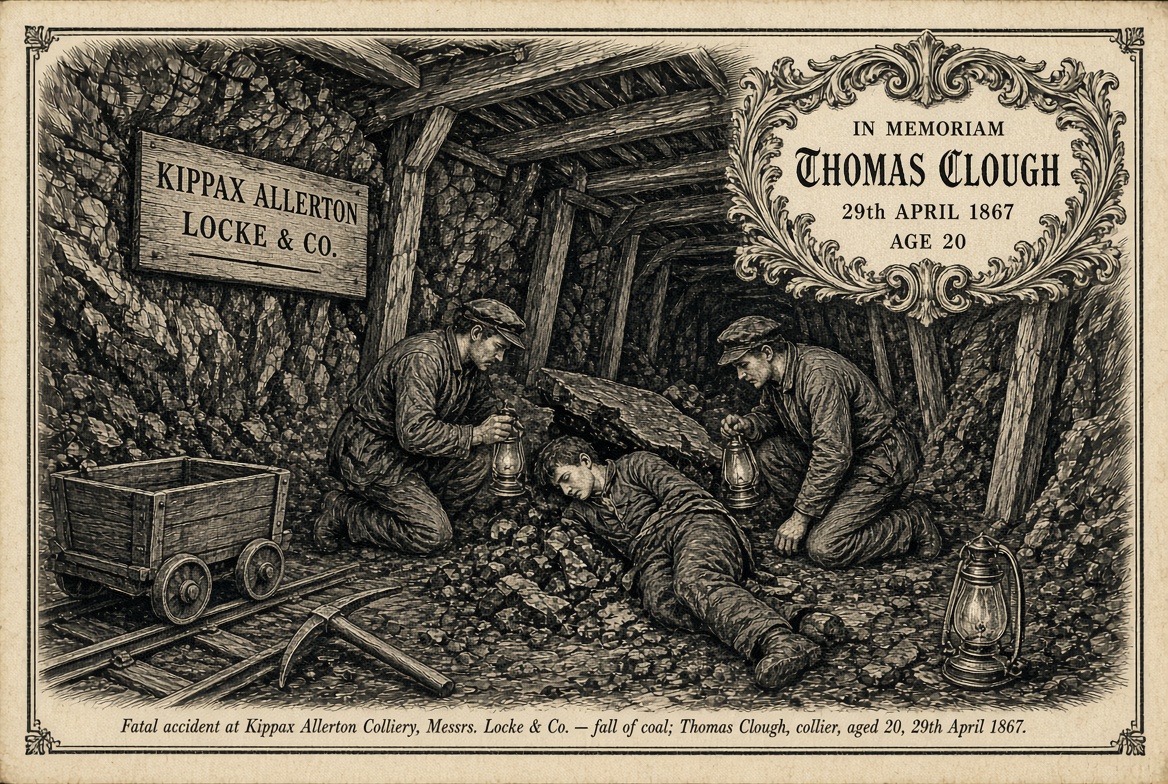
On Monday 29 April 1867 Thomas Clough was killed underground at the Allerton Bywater / Kippax Allerton pit. The compiled mining indexes give the cause as a fall of coal. He was a collier, so the fall was at the working face: a block of coal coming away from the face or from the holing after the coal had been undercut.

The Durham Mining Museum abstract reads: Thomas Clough; age 20; died 29 April 1867; accident 29 April 1867; year born about 1847; colliery Kippax Allerton; company Lock and Co.; occupation collier; notes: fall of coal.

The newspaper of the following Friday does not add the mechanism. It only records that he was killed accidentally whilst at work in the pit. No printed inspector’s narrative for this particular entry has been found in the open abstracts (DMM’s individual page for him does not cite a page in the 1867 Mines Inspectors Report).

3. Newspaper, coroner and conclusion

Leeds Evening Express, Friday 3 May 1867

The paper was No. 548, Vol. IX, published every afternoon at four o’clock, price one halfpenny. In the Local and District column it printed this paragraph:

Thomas Clough, aged 19, miner, residing at Kippax, in the employment of Messrs Lock & Waddington, at Allerton Bywater, has been killed accidentally whilst at work in the pit.

That is a short death notice, not a report of an inquest. It was printed four days after the accident, which is the usual interval after a coroner’s sitting and the release of the body.

Inquest

No full inquest transcript has been found. Inquests on pit deaths around Kippax were normally held by the coroner for the honour or borough of Pontefract. The Express wording — killed accidentally whilst at work in the pit — is the verdict the paper chose to print. The official mining classification is accidental death by a fall of coal.

4. Sources and citations

The Leeds Evening Express, Friday 3 May 1867, No. 548, Vol. IX, Local and District: Thomas Clough, aged 19, miner, residing at Kippax, Messrs Lock & Waddington, Allerton Bywater, killed accidentally whilst at work in the pit.

Durham Mining Museum, individual page: Thomas Clough, age 20, died 29 April 1867, Kippax Allerton, Lock and Co., collier, fall of coal.

UK, Coal Mining Accidents and Deaths Index, 1878–1951: Thomas Clough, age 20, born about 1847, 29 April 1867, Castleford, Lock and Co., collier, Fall of Coal.

UK, Coal Mining Accidents and Deaths Index, 1878–1935: same man; colliery Kippax Allerton; owner Lock and Co.; notes Fall of coal.

Alan Beales, England, Mining Disaster Victims: Thomas Clough, born 1847, age 20, 29 April 1867, Kippax.

Allerton Bywater Parish Council, Kippax Colliery: shafts sunk 1858 by Joseph Locke & Co. at Owl Wood, Haigh Moor seam.

Kelly’s Directory (later Allerton Bywater entry): Locke and Co. among the firms working pits at Allerton.

5. Corrections

Age. The newspaper of 3 May 1867 says 19. The mining indexes and DMM say 20. Both are kept. Neither is an obvious error; they differ by the usual year of age.

Date. 29 April 1867 is consistent across DMM and both commercial indexes. The newspaper is 3 May, the day the notice was printed, not the day he died.

Employer. Use the contemporary newspaper form Messrs Lock & Waddington as well as Locke / Lock and Co. Waddington is dropped in the later compiled lists and should not be deleted from the 1867 notice.

Place. Castleford in the commercial index is the registration town. The pit is Allerton Bywater / Kippax Allerton. He lived at Kippax.

Cause. The newspaper says only killed accidentally in the pit. The inspector-derived indexes specify a fall of coal. Both stand; the more precise cause is the official mining one.

Burial. Still not found.

A GRO death certificate, Castleford or Pontefract district, April–June 1867, would settle age and informant.

William Firth

WILLIAM FIRTH

Allerton Haigh Moor Colliery, Locke and Co.

Killed 11 May 1863  ·  Age not recorded by the inspector

1. Life

No baptism, marriage, census household or burial register has yet been tied to this William Firth with the same certainty as the inspector’s accident entry. Firth was the most common surname in nineteenth-century Kippax. Attaching a particular christening or a particular widow without a burial age, a GRO certificate, or a newspaper naming next of kin would be guesswork. This note therefore records what is proved about the death and leaves the private life open.

What can be said

He was employed at Locke and Co.’s Allerton Haigh Moor Colliery in May 1863. That pit worked the Haigh Moor seam from the shafts sunk in 1858 at Owl Wood, between Kippax and Allerton Bywater. Edward Bickerdike of Kippax had been killed at the same colliery, by a brick falling in the shaft, on 27 January 1863 — fourteen weeks earlier. Both deaths stand on the same page of Charles Morton’s 1863 report (accidents no. 8 and no. 24).

Allerton Bywater was still in Kippax parish until an Order in Council of 1863 created a separate parish; the foundation stone of the new church was laid on 31 August 1863, after William’s death. Men from Kippax village walked or rode to these shafts.

Names that are not this man

Charles Firth, aged about 60, killed in 1886 at a Locke / Kippax pit (run over by corves), is a later death.

William Firth of Rastrick, farmer, buried 3 August 1865 aged 58, is a different parish and a different year.

William Briggs Firth of Leeds, magistrate and ironmaster, who read a paper on coal-cutting machinery in 1863, was still alive in the 1870s.

William Firth, colliery proprietor of Shipley, died 24 March 1884.

Burial

The Durham Mining Museum still prints the burial as not known. No Kippax St Mary burial page for May 1863 was among the documents supplied for this note. St Mary’s remained the parish church for Kippax men; Allerton Bywater’s own church was not yet built.

2. The accident

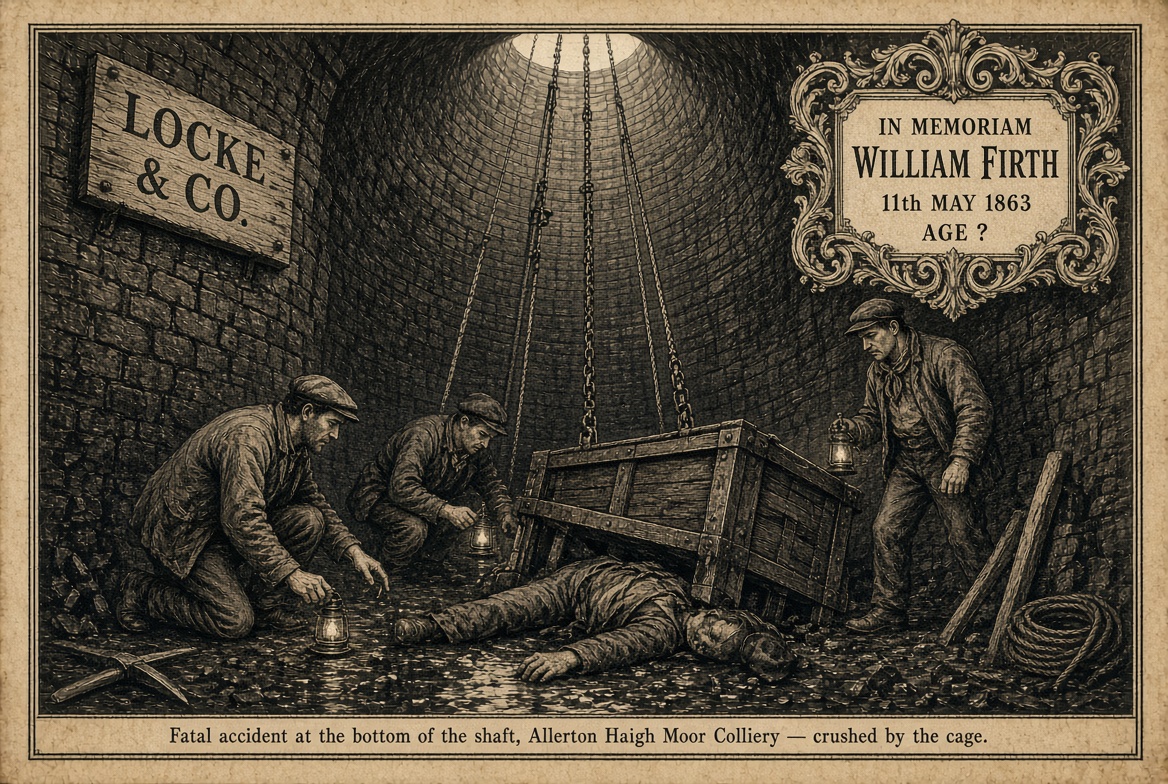
On Monday 11 May 1863 William Firth was killed at Allerton Haigh Moor Colliery, the property of Locke and Co. The official cause is that he was crushed at the bottom of the shaft.

Charles Morton, H.M. Inspector of Mines, entered the case as accident no. 24 in his 1863 report, printed at page 182. The Durham Mining Museum abstract taken from that report reads: William Firth; died 11 May 1863; accident 11 May 1863; colliery Allerton Haigh Moor; company Locke and Co.; notes: crushed at the bottom of the shaft.

Crushing at the shaft bottom usually means the cage, or a loaded tub or baulk descending the shaft, came down on a man who was standing or working in the sump or at the inset. Morton’s printed table does not say whether the cage was lowered onto him, whether a tub left the cage, or whether he was struck by something falling from above. Those particulars are not in the open abstract. The commercial Coal Mining Accidents and Deaths Index uses the same wording: Crushed in the Bottom of the Shaft.

The same commercial index places the accident at Leeds. Leeds is the nearest large town. The pit was Allerton Haigh Moor, in the Kippax / Allerton Bywater township, then in the Pontefract registration district (Castleford sub-district).

3. Coroner, newspaper and conclusion

No inquest transcript and no newspaper report naming this William Firth have been found in the open indexes searched for this note. Inquests on pit deaths around Kippax were normally held by the coroner for the honour or borough of Pontefract, often sitting at a village inn within a day or two of the body being brought up.

What stands in official form is Morton’s classification: accidental death by being crushed at the bottom of the shaft at Allerton Haigh Moor, Locke and Co., 11 May 1863; one life lost — William Firth.

4. Sources and citations

Charles Morton, H.M. Inspector of Mines, 1863 Mines Inspectors Report, p. 182, accident no. 24.

Durham Mining Museum, individual page: William Firth, died 11 May 1863, Allerton Haigh Moor, Locke and Co., crushed at the bottom of the shaft.

UK, Coal Mining Accidents and Deaths Index: William Firth, 11 May 1863, Locke and Co., Crushed in the Bottom of the Shaft; place given as Leeds.

Alan Beales, England, Mining Disaster Victims: William Firth, 11 May 1863, Allerton Haigh Moor.

Charles Morton, same report, p. 182, accident no. 8: Edward Bickerdike, 27 January 1863, same colliery, fall of a brick in the shaft — for the sequence of deaths at this pit.

On Allerton Bywater parish: formed from Kippax by Order in Council, 1863; foundation stone 31 August 1863.

5. Corrections

Date. 11 May 1863 is consistent across Morton, DMM, the Coal Mining Accidents index and Beales. No correction is required.

Place. Leeds in the commercial index is the nearest city. The pit is Allerton Haigh Moor, Locke and Co.

Age. Morton printed no age. Indexes that leave age blank are incomplete, not contradictory. Do not borrow an age from another William Firth.

Identity. Do not attach the Rastrick farmer (d. 1865), the Leeds ironmaster, the Shipley proprietor (d. 1884), or Charles Firth of 1886.

Burial. Still not found. DMM is correct to mark it unknown until a May 1863 Kippax (or Castleford) register page is produced.

A GRO death certificate for Firth, May 1863, Pontefract or Castleford district, would give age and informant’s name and should be the next document sought.

Edward Hesselgrave Bickerdike

EDWARD BICKERDIKE

Edward Hesselgrave Bickerdike, of Kippax

Christened 17 May 1801  ·  Died 27 January 1863, aged 62

1. Life

Birth and christening

Edward Hesselgrave Bickerdike was christened on 17 May 1801 at the parish church of St Mary the Virgin, Kippax. The printed christening index gives the name as Edwd. Haslegrave Bickerdike and names his father Benjamin Bickerdike. Haslegrave / Hesselgrave is a second forename used in the family; later records call him Edward.

The burial register of 30 January 1863 gives his age as 62. That agrees with a birth shortly before the May 1801 christening. He was therefore sixty-one years and about eight months old when he was killed.

Family

The Bickerdikes were a long-settled Kippax mining family. John Bickerdike married in the parish in the 1760s; Thomas Bickerdike married Mary Tate in 1764. Peter Bickerdike, a hewer at Locke and Co.’s Kippax West Main, was named by Charles Morton in 1858 as the man whose failure to set sprags caused the death of the boy Benjamin Pickard. That Peter belongs to the same village kinship, not necessarily the same household.

Edward married Eliza Beeston. Their son Charles was christened at Kippax on 19 December 1841. Edward appears as head of a household in Kippax on the censuses of 1841, 1851 and 1861, living with his wife and children throughout.

Work

By the 1860s Locke and Co. were working the Haigh Moor seam from the shafts sunk in 1858 at Owl Wood, between Kippax and Allerton Bywater. The official name of the pit in the 1863 inspector’s table is Allerton Haigh Moor. Edward was employed there at the time of his death. He was then in his early sixties, still going underground or into the shaft — the accident itself took place in the shaft, not at the face.

Death and burial

Edward was killed on Tuesday 27 January 1863. He was buried at St Mary’s, Kippax, on Friday 30 January 1863. The burial register, page 80, entry no. 338, reads: Edward Bickerdike, abode Kippax, 30 January, age 62, E. D. Bland, Vicar. West Yorkshire Archive Service reference P47/26.

Burial three days after the accident is the usual interval where an inquest had to sit. The same register page records Jane Bickerdike, buried 18 January 1863 aged 73 — an older kinswoman, not his wife. Civil registration of the death falls in the Castleford / Pontefract area; compiled trees give Castleford as the registration place.

DMM still marks the burial as not known. The parish register supplied with this research fills that gap.

2. The accident

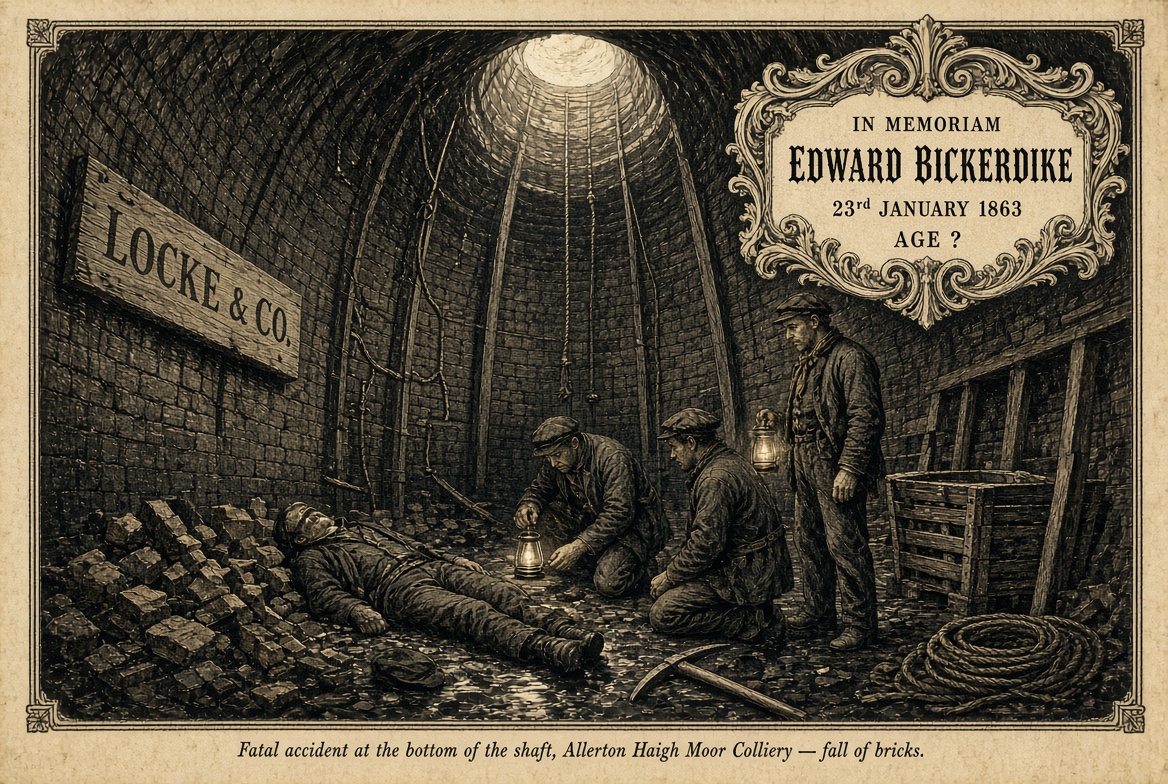
On 27 January 1863 Edward Bickerdike was killed at Allerton Haigh Moor Colliery, the property of Locke and Co. The official cause is the fall of a brick in the shaft.

Charles Morton, H.M. Inspector of Mines, entered the case as accident no. 8 in his 1863 report, printed at page 182. The Durham Mining Museum abstract taken from that report reads: Edward Bickerdike; died 27 January 1863; accident 27 January 1863; colliery Allerton Haigh Moor; company Locke and Co.; notes: fall of a brick in the shaft.

A shaft lining of brick or a brick used in shaft repairs can come away from the wall and fall the full depth of the shaft. A man at the bottom, or riding in the cage, has no cover against it. Morton’s printed table does not add whether Edward was ascending, descending, or standing at the shaft foot, nor whether the brick was loose lining or a brick dropped from the surface. Those particulars are not in the open abstract.

The commercial Coal Mining Accidents and Deaths Index gives the same date, employer (written Lock and Co.) and description, and places the accident at Leeds. Leeds is the nearest large town. The pit was Allerton Haigh Moor, in the Kippax / Allerton Bywater parish, Pontefract then Castleford registration.

3. Coroner, newspaper and conclusion

No inquest transcript and no newspaper report naming Edward Bickerdike have been found in the open indexes searched for this note. Inquests on pit deaths around Kippax were normally held by the coroner for the honour or borough of Pontefract, often sitting at a village inn within a day or two of the body being brought up.

What stands in official form is Morton’s classification: accidental death by the fall of a brick in the shaft at Allerton Haigh Moor, Locke and Co., 27 January 1863; one life lost — Edward Bickerdike.

Burial on 30 January is consistent with an inquest opened on the Wednesday or Thursday and the body then released to the family.

4. Sources and citations

England Births and Christenings, 1538–1975 (FamilySearch): Edwd. Haslegrave Bickerdike, 17 May 1801, Kippax; father Benjamin Bickerdike. FHL film 496,807.

West Yorkshire Archive Service, Leeds: Kippax St Mary burial register, 1863, p. 80, no. 338. Edward Bickerdike, Kippax, 30 January 1863, age 62; E. D. Bland, Vicar. Reference P47/26.

England and Wales Census, 1841: Edward Bickerdike, Kippax. FamilySearch MQGP-NWG.

England and Wales Census, 1851 and 1861: Edward Bickerdike, Kippax, with wife and children. FamilySearch 1861 M7JB-SPT.

England Births and Christenings: Charles Bickerdike, 19 December 1841, son of Edward Bickerdike and Eliza Beeston.

Charles Morton, H.M. Inspector of Mines, 1863 Mines Inspectors Report, p. 182, accident no. 8.

Durham Mining Museum, individual page: Edward Bickerdike, died 27 January 1863, Allerton Haigh Moor, Locke and Co., fall of a brick in the shaft.

UK, Coal Mining Accidents and Deaths Index: Edward Bickerdike, 27 January 1863, Lock and Co., Fall of A Brick in the Shaft.

Alan Beales, England, Mining Disaster Victims: Edward Bickerdike, event date 23 January 1863, Allerton Haigh Moor — date corrected below.

WikiTree Bickerdike-16: Edward Hesselgrave Bickerdike (bef. 17 May 1801 – 27 January 1863), compiled from the parish and census sources above.

5. Corrections

Date of accident. The Beales / MDV transcript gives 23 January 1863. Morton, DMM, the Coal Mining Accidents index and the compiled death date all give 27 January 1863. Burial on 30 January fits a death on the 27th. The 23rd is treated as a copying error.

Burial is not before death. The parish burial is 30 January. The official death is 27 January. There is no contradiction once the 23 January index date is set aside.

Age. Burial age 62 agrees with the christening of 17 May 1801. No correction is required.

Employer spelling. Lock and Co. in the commercial index is Locke and Co.

Place. Leeds in the commercial index is the nearest city. The pit is Allerton Haigh Moor (Owl Wood / Allerton Bywater), Locke and Co. Civil registration is the Castleford / Pontefract area. Abode at burial is Kippax.

DMM burial. DMM still prints burial as not known. The Kippax register, no. 338, 30 January 1863, supplies it.

Jane Bickerdike. Jane, buried 18 January 1863 aged 73, is a separate entry on the same register opening. She is not Edward’s wife Eliza.

If a Pontefract or Leeds newspaper for late January 1863 is later abstracted, the coroner’s wording should be added to section 3.

John Biscomb

JOHN BISCOMB

of Kippax, Yorkshire

Baptised 4 March 1832  ·  Died 9 January 1857, aged about 24

1. Life

Baptism

John Biscomb was baptised on 4 March 1832 at the parish church of St Mary the Virgin, Kippax. The register for 1832, page 143, entry no. 1137, records: John, son of William and Hannah Biscomb, abode Kippax, father’s quality labourer, ceremony performed by the Hon. and Rev. A. H. Cathcart, Vicar. West Yorkshire Archive Service reference P47/8.

Civil registration of births had not yet begun in 1832. A birth shortly before 4 March 1832 makes him about twenty-four years and ten months old on 9 January 1857. Charles Morton’s printed table does not give an age.

Parents and family

His father William Biscomb was a labourer living in Kippax. His mother was Hannah. The Biscombs were already numerous in the parish. William Biscomb of the Lord Nelson appears in Baines’s Directory of 1822; Henry Biscomb, carpenter, was father of Robert Biscomb, killed at the same company’s pit two years earlier. Thomas Biscomb, another Kippax carpenter, had a son Charles baptised in the same church in April 1832. Those are related households, not this baptism.

John must not be confused with Robert Biscomb (baptised 30 March 1823, son of Henry the carpenter), who died on 13 January 1855 when a pit rope broke at Locke and Co., Kippax.

Youth and work

Kippax in John’s boyhood was a growing coal parish east of Leeds. Locke and Co. were working Kippax and Kippax West Main by the mid-1850s. West Main is listed from 1854. The large Haigh Moor shafts at Owl Wood were not sunk until 1858, the year after John’s death.

No school record has been found. The son of a labourer in this parish commonly went to the pit as a boy. By January 1857 John was employed underground at Locke and Co.’s Kippax West Main. No printed 1841 or 1851 census extract has yet been tied to him with certainty.

Marriage — not proved

A John Biscomb married Mary Mosby at Leeds on 27 October 1851. That couple later appear in Kippax; Mary, widowed, married James Farrer in 1865. The dates would fit a man baptised in 1832, but the 1851 marriage register has not been seen for this note, so the identification is not treated as proved. Children attached to that household on later trees are therefore not listed here as his.

Death registration

The civil death of John Biscomb was registered at Pontefract. The national index entry reads: Biscomb, John; superintendent registrar’s district Pontefract; volume 9c, page 60. That is the January–March quarter of 1857, which contains 9 January. No burial register page for January 1857 has been supplied with this research; DMM marks the burial as not known.

2. The accident

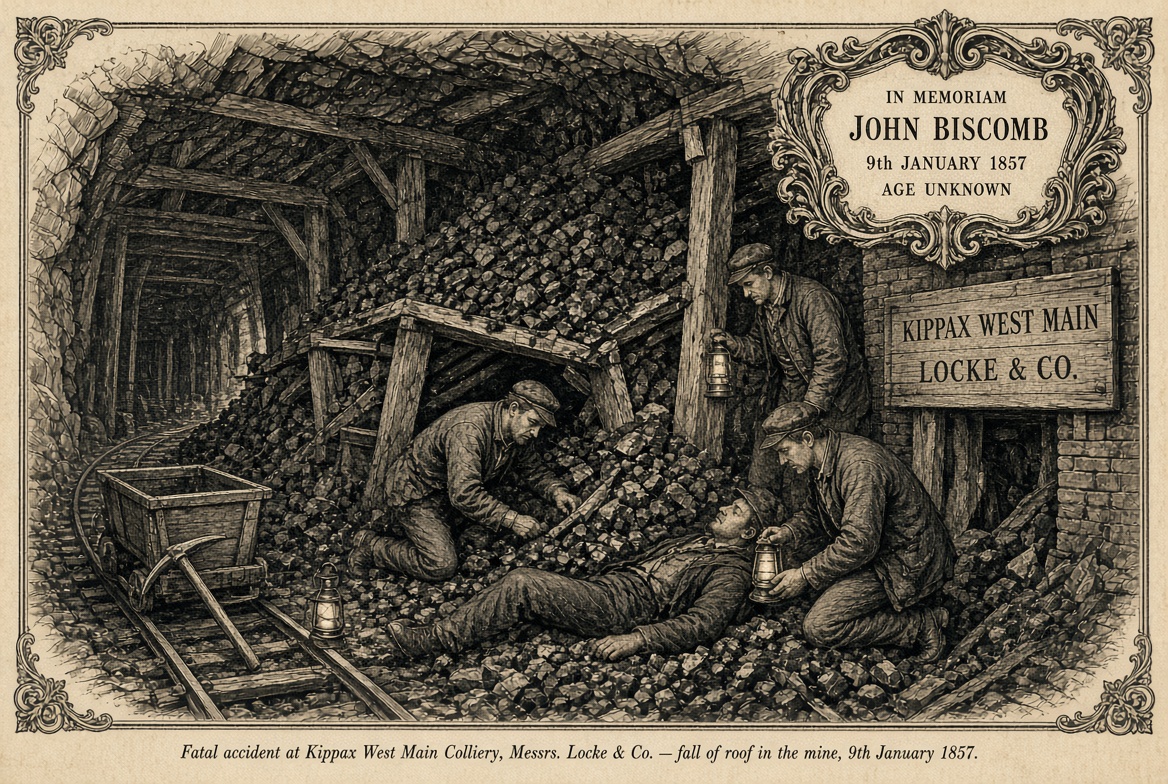
On Friday 9 January 1857 John Biscomb was killed underground at Kippax West Main Colliery, the property of Locke and Co. The official cause is a fall of roof in the mine.

Charles Morton, H.M. Inspector of Mines, entered the case as accident no. 2 in his 1857 report, printed at page 165. The Durham Mining Museum abstract taken from that report reads: John Biscomb; died 9 January 1857; accident 9 January 1857; colliery Kippax West Main; company Locke and Co.; notes: fall of roof in the mine.

A fall of roof is the collapse of stone or coal from the roof of a working place or roadway. Morton printed a longer narrative for some Yorkshire roof-falls in those years; none has been reprinted against this particular entry. The case stands in the table as a single death. It is not grouped with the 1855 rope-break that killed Robert Biscomb and Joseph Pickard, and it is not the 1858 fall of coal that killed the boy Benjamin Pickard at the same West Main pit.

The commercial Coal Mining Accidents and Deaths Index gives the same date, employer and description (Fall of Roof in Mine), and places the accident at Leeds. Leeds is the nearest large town, not the pit. The pit was Kippax West Main, in the Pontefract registration district.

3. Coroner, newspaper and conclusion

No inquest transcript and no newspaper report naming John Biscomb have been found in the open indexes searched for this note. Inquests on pit deaths around Kippax were normally held by the coroner for the honour or borough of Pontefract, often sitting at a village inn within a day or two of the body being brought up. An example from the same year, printed in August 1857, shows Mr Taylor, coroner for the borough of Pontefract, sitting on a roof-fall at another West Riding pit; that sitting is not John’s.

What stands in official form is Morton’s classification: accidental death by a fall of roof at Kippax West Main, Locke and Co., 9 January 1857; one life lost — John Biscomb.

The civil registration at Pontefract (9c 60) is the legal record of that death.

4. Sources and citations

West Yorkshire Archive Service, Leeds: Kippax St Mary baptism register, 1832, p. 143, no. 1137. John, son of William and Hannah Biscomb, Kippax, labourer; 4 March 1832; A. H. Cathcart, Vicar. Reference P47/8.

Charles Morton, H.M. Inspector of Mines, 1857 Mines Inspectors Report, p. 165, accident no. 2.

Durham Mining Museum, individual page: John Biscomb, died 9 January 1857, Kippax West Main, Locke and Co., fall of roof in the mine.

UK, Coal Mining Accidents and Deaths Index: John Biscomb, 9 January 1857, Locke and Co., Fall of Roof in Mine.

Alan Beales, England, Mining Disaster Victims: John Biscomb, 9 January 1857, Kippax.

General Register Office death index: Biscomb, John; Pontefract; vol. 9c, p. 60.

Edward Baines, History, Directory and Gazetteer of the County of York, vol. I (1822), Kippax trades, for the earlier Biscomb and Locke entries.

5. Corrections

Identity. John Biscomb (1832–1857), son of William and Hannah, is not Robert Biscomb (1823–1855), son of Henry the carpenter. They died in different years, by different causes, at Locke pits in the same parish.

Place. The commercial index says Leeds. The inspector says Kippax West Main. Civil registration is Pontefract. Leeds is only the nearest city.

Age. No official age was printed by Morton. About 24 years 10 months follows from the baptism of 4 March 1832. Indexes that leave age blank are not wrong; they are incomplete.

Colliery name. Use Kippax West Main, Locke and Co. Do not substitute Owl Wood (sunk 1858), Medhurst Kippax, or Kippax Sand Co.

Marriage. A Leeds marriage of a John Biscomb to Mary Mosby in 1851 is not attached here until the register is seen.

Burial. DMM records burial as not known. No January 1857 Kippax burial page was among the documents supplied.

If a Pontefract or Leeds newspaper for mid-January 1857 is later abstracted, the coroner’s wording should be added to section 3.

Robert Biscomb

ROBERT BISCOMB

of Kippax, Yorkshire

Baptised 30 March 1823  ·  Died 13 January 1855, aged 32

1. Life

Baptism

Robert Biscomb was baptised on 30 March 1823 at the parish church of St Mary the Virgin, Kippax. The register for that year, page 73, entry no. 579, records: Robert, son of Henry and Mary Biscomb, abode Kippax, father’s quality carpenter, ceremony performed by the Hon. and Rev. A. H. Cathcart, Vicar. West Yorkshire Archive Service reference P47/8.

No separate civil birth certificate exists. Civil registration of births began on 1 July 1837, fourteen years after this baptism. A birth shortly before 30 March 1823 agrees with the burial age of 32 in January 1855.

Parents and family

His father Henry Biscomb was a carpenter living in Kippax. The Biscombs (also written Biscombe, Biscam, Biscom) were already settled in the parish. In 1766 Henry Biscomb of Garforth married Sarah Dodgshon of Kippax; a later Henry Biscomb appears as a marriage witness. Baines’s Directory of 1822 lists William Biscomb as victualler of the Lord Nelson in Kippax. Thomas Biscomb, another Kippax carpenter, was raising a family in the same years, but Robert’s register names Henry and Mary, not Thomas and Abigail.

The Hon. and Rev. A. H. Cathcart, who baptised Robert, is the same vicar named in the 1822 directory. Kippax Park was the seat of T. D. Bland, Esq.; the later vicar E. D. Bland buried Robert in 1855.

Youth and work

Kippax in Robert’s boyhood was a small parish on the Yorkshire coalfield, eight miles east of Leeds. Coal was already being worked on a modest scale; John Locke appears in 1822 as a coal dealer. Locke and Co. were the owners of the Kippax pit by 1855. The large Haigh Moor shafts at Owl Wood were not sunk until 1858, three years after Robert’s death.

No school record has been found. The son of a village carpenter would commonly have been put to a trade or to the pit in his teens. By January 1855 he was employed at Locke and Co.’s Kippax colliery. No printed census extract for 1841 or 1851 has yet been tied to this Robert with certainty, and no marriage for him has been identified in the Kippax registers searched for this note. Later Kippax men named Robert Biscomb belong to other branches and later decades.

Death and burial

Robert was killed at work on Saturday 13 January 1855, the same hour as Joseph Pickard. He was buried at St Mary’s, Kippax, on Monday 15 January 1855. The burial register, page 17, entry no. 136, reads: Robert Biscomb, abode Kippax, 15 January, age 32, E. D. Bland, Vicar. Joseph Pickard, aged 42, was buried from the same church on the same day (entry no. 137). The two men therefore left the pit together and were laid in the same churchyard two days later.

2. The accident

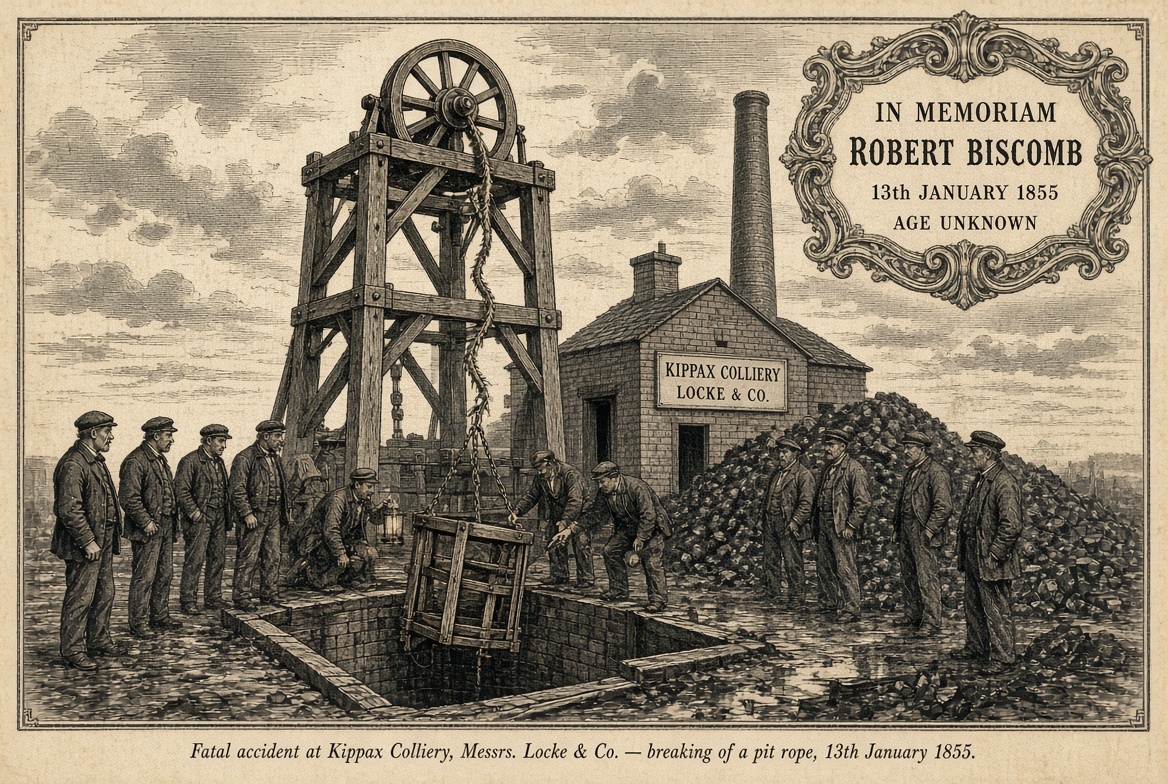
On 13 January 1855 two men were killed at Kippax Colliery, Locke and Co. They were Robert Biscomb, aged 32, and Joseph Pickard, aged 42. Charles Morton, H.M. Inspector of Mines, recorded the cause as the breaking of a pit rope. The case is accident no. 53 in his half-year report for January–June 1855, printed at page 72.

A pit rope is the winding rope that raises and lowers men and coal in the shaft. When it parts, the cage or corf falls. Two deaths on one rope at one time almost always means the two men were riding together, either ascending or descending. Morton’s published table does not add the depth of the shaft, the type of rope (hemp or wire), or whether a splicing-plate or a “mark” on the rope was at fault. Those details appear in his narratives of other Yorkshire rope-breaks in the same decade, but not against this Kippax entry.

The pit of 1855 was Locke and Co.’s existing Kippax working, not the later Owl Wood sinking and not Medhurst or the Kippax Sand Co.

3. Coroner, newspaper and conclusion

No full inquest transcript and no newspaper report of the jury have been found in the open indexes searched for this note. Inquests on pit deaths in this district were normally held by the coroner for the honour of Pontefract, often sitting at a Kippax inn within a day of the bodies being brought up.

What stands in official form is Morton’s classification, which the coroner’s finding would have supported: accidental death by the breaking of a pit rope at Kippax Colliery, Locke and Co., 13 January 1855; two lives lost — Robert Biscomb and Joseph Pickard.

Burial of both men on 15 January is consistent with an inquest opened on the Sunday or Monday and the bodies then released to their families.

A later commercial index describes the same two deaths as “Bursting of an Underground Boiler.” That wording is not in Morton and is treated here as an error. A broken winding rope and a boiler explosion are different events.

4. Sources and citations

West Yorkshire Archive Service, Leeds: Kippax St Mary baptism register, 1823, p. 73, no. 579. Robert, son of Henry and Mary Biscomb, Kippax, carpenter; 30 March 1823; A. H. Cathcart, Vicar. Reference P47/8.

West Yorkshire Archive Service, Leeds: Kippax St Mary burial register, 1855, p. 17, no. 136. Robert Biscomb, Kippax, 15 January 1855, age 32; E. D. Bland, Vicar. Reference P47/26.

Charles Morton, H.M. Inspector of Mines, 1855 (January–June) Mines Inspectors Report, p. 72, accident no. 53.

Durham Mining Museum: Colliery disaster 13 January 1855, Kippax, Locke and Co.; cause, breaking of a pit rope; lives lost, 2 — Biscomb, Robert; Pickard, Joseph.

UK, Coal Mining Accidents and Deaths Index and Alan Beales, England, Mining Disaster Victims: Robert Biscomb, 13 January 1855 — used only with the correction in section 5.

Edward Baines, History, Directory and Gazetteer of the County of York, vol. I (1822), Kippax: William Biscomb, Lord Nelson; John Locke, coal dealer; Hon. and Rev. A. H. Cathcart, vicar.

George Denison Lumb (ed.), The Registers of the Parish Church of Kippax, 1539–1812 (YPRS vol. 10, 1901), for earlier Biscomb marriages in the parish.

5. Corrections

Cause. Commercial indexes attached to this research say “Bursting of an Underground Boiler. 2 Killed” or “Boiler burst underground.” The contemporary inspector, Charles Morton, recorded a broken pit rope. The inspector is followed.

Age. Burial age 32 in January 1855 matches a baptism of 30 March 1823. No correction is required.

Date of death versus burial. The accident was 13 January 1855. The burial was 15 January 1855. The two dates must not be collapsed.

Identity. John Biscomb, killed by a fall of roof at Kippax West Main on 9 January 1857, is a different man. Later Roberts in Kippax census and WikiTree profiles are later generations.

Marriage. No marriage for this Robert has been verified. It would be wrong to attach a wife or children from another Biscomb household.

If a Pontefract or Leeds newspaper for mid-January 1855 is later abstracted, the coroner’s wording should be added to section 3.

error: Content is protected !!