Francis Stoker

IN MEMORIAM

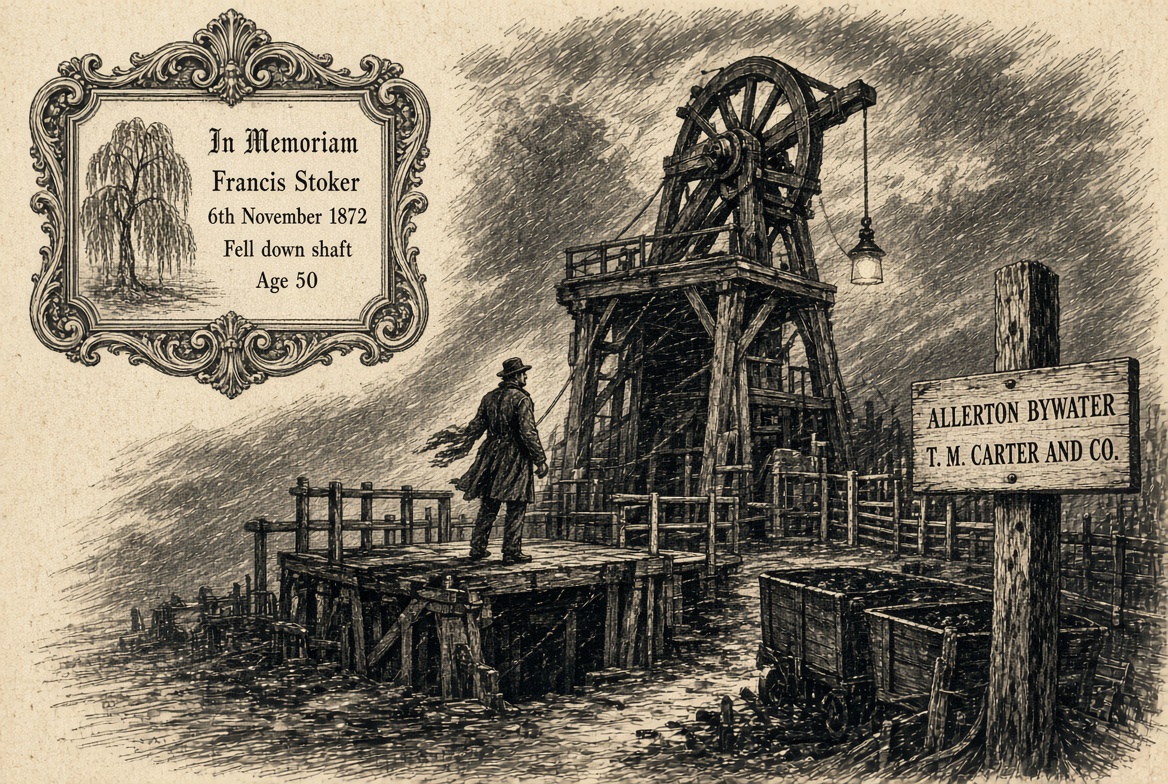
Francis Stoker

6 November 1872  ·  buried 9 November  ·  age 50

Fell down the shaft

Allerton Bywater  ·  T. M. Carter and Co.  ·  banksman

His life

Francis Stoker was a banksman at Allerton Bywater, born in the village about 1822. Age 39 on 7 April 1861, 48 on 2 April 1871, and 50 at burial in November 1872 agree, within a year.

He married Mary Hutchinson at Ledsham on 29 May 1858, after banns, entry 136. He was of full age, a bachelor, a labourer, of Allerton Bywater. His father was Francis Stoker, labourer. Mary was of full age, a spinster, of Fairburn, daughter of George Hutchinson, labourer. The witnesses were Joseph Hutchinson, Harriet Hutchinson and John Holmes. The clergyman was James J. B. London.

On 7 April 1861 he was head of a household at Allerton Bywater, a colliery banksman, with Mary, 27, born Fairburn, and their daughter Elizabeth, 1, born Allerton Bywater. RG 9/3431, schedule 41.

Alice, daughter of Francis and Mary Stoker, of Allerton Bywater, was baptised there on 25 July 1866, entry 45. He was then set down as a labourer. Allerton Bywater parish register P3/1/1.

On 2 April 1871 the household was still at Allerton Bywater. Francis, 48, colliery banksman, born Allerton Bywater; Mary, 38, born Fairburn; Elizabeth, 11; Thomas, 9; Alice, 6; and Francis, 1. The four children were born in the village. RG 10/4637, schedule 57. The Mercury’s “wife and four children” is this household.

A Francis Stoker, widower, 76, sawyer, born Ulleskelf, was head of a separate household in the village that night, schedule 60. The marriage names the father as Francis Stoker, labourer. The ages fit a father and son. They were not in the same house, so the link is likely, not proved.

The supplied 1851 sheet of Allerton Bywater, HO 107/2329, households 38 to 41, does not contain him. He is not placed in a household that year from these papers.

The accident

On Wednesday night, 6 November 1872, in a gale, he was at his usual work at the mouth of the pit. A gust of wind carried him off his feet, and he fell to the bottom of the shaft. Death was instantaneous. The Friday papers say he was cut to pieces, and the Mercury says fearfully mutilated. The plate does not show that.

One Bradford account adds that he was blown down, or fell through the giving way of some tubing at the top of the pit. The Yorkshire Post and the Leeds Mercury do not mention tubing. They agree on the gale, the pit mouth, and the fall. He was buried at Allerton Bywater on Saturday 9 November, entry 178, age 50, abode Allerton Bywater, by G. Winterbotham, vicar. P3/3/1.

Coroner’s report and conclusion

No inquest paper has been traced in this set. The papers of Friday 8 November are the account.

A melancholy and fatal accident happened at Mr Carter’s colliery, Allerton Bywater, near Castleford, on Wednesday night, by which Francis Stoker, the banksman, met a most shocking and painful death. It appears the deceased, whilst engaged in his usual work at the mouth of the pit, was carried by a gust of wind off his feet (the night being very boisterous) and precipitated to the pit bottom. The poor fellow was cut to pieces. He was an old and valued servant, and leaves a widow and four children to bewail his untimely end.

Yorkshire Post and Leeds Intelligencer, Friday 8 November 1872. The Leeds Mercury of the same day is to the same effect, and names the wife and four children.

During the gale of wind on Wednesday night, the banksman at Mr Carter’s colliery, Allerton Bywater, near Castleford, was blown down or fell through the giving way of some tubing at the top of the pit, and he was precipitated to the bottom of the shaft. Death was instantaneous.

Telegraph and Argus, Bradford, Friday 8 November 1872. The Bradford Daily Telegraph of the same day names him, and spells the village Ailerton.

Sources and citations

Ledsham marriage register, 29 May 1858, entry 136. Francis Stoker and Mary Hutchinson.

1861 census, Allerton Bywater, RG 9/3431, schedule 41. 1871 census, Allerton Bywater, RG 10/4637, schedules 57 and 60.

Allerton Bywater baptism register, 25 July 1866, entry 45, Alice Stoker. P3/1/1. Burial register, 9 November 1872, entry 178, age 50. P3/3/1.

Yorkshire Post, 8 November 1872. Leeds Mercury, 8 November 1872. Bradford Daily Telegraph, 8 November 1872. Telegraph and Argus, 8 November 1872.

UK Coal Mining Accidents and Deaths Index: F. Stoker, 50, 6 November 1872, Castleford, T. M. Carter and Co., banksman, fell down shaft.

Corrections

  • Date. Wednesday night before the Friday papers of 8 November is 6 November 1872. The index agrees. Buried 9 November.
  • Age. 50, from the burial and the index. The 1861 age of 39 and the 1871 age of 48 agree.
  • Cause. Fell the shaft from the pit mouth in the gale. One paper adds that tubing at the top gave way. Not an underground fall.
  • Name and place. Francis Stoker, not F. only. Allerton Bywater, not Ailerton. Owner T. M. Carter. Castleford is the registration district. The 1851 sheet supplied does not contain him.
George West

IN MEMORIAM

George West

Hurt 8 July 1869  ·  died 24 August  ·  age 27

Caught by the axle of a waggon

Allerton Bywater  ·  T. M. Carter and Co.

His life

George West was baptised at Castleford on 29 May 1842, entry No. 697, son of Peter West, tailor, and Elizabeth, of Glass Houghton. The officiating minister was R. W. Kempsey. West Yorkshire Archive Service D147/1/3.

On 30 March 1851 the family was at Kemp’s Buildings, Castleford. Peter West, 41, tailor and draper, born Doncaster, was head. Elizabeth, 35, was born at Castleford. With them were Mary Hannah, 14, born Huddersfield; Martha Ann, 11, scholar, born Castleford; George, 9, scholar, born Castleford; and William, 3, born Castleford. HO 107/2330. Age 9 agrees with the baptism.

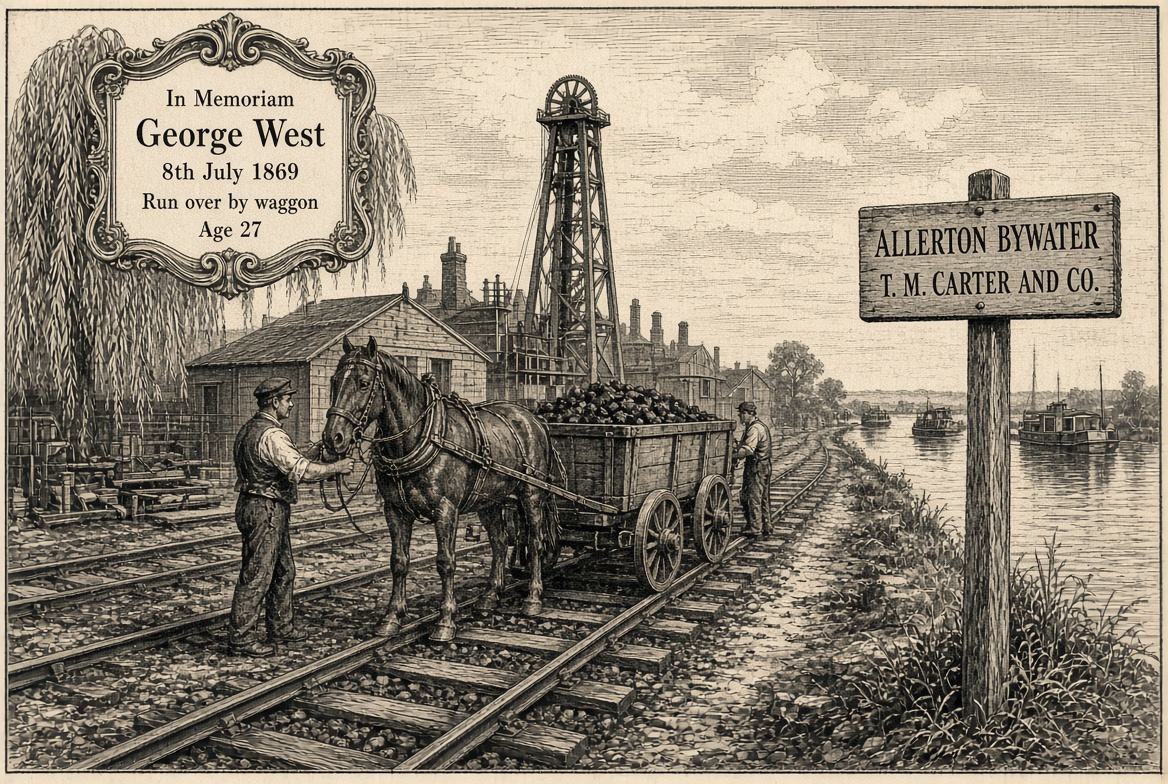
By 1869 he was 27, a collier employed by Mr T. M. Carter at Allerton Bywater, and he lived in the village. He drove a horse and waggon, called a wherry in one report, on the tramway from the pit to the Aire and Calder Canal, where the boats were filled. No marriage has been found in the papers supplied. A wife is not invented. He was buried at Allerton Bywater on 26 August 1869, entry No. 81, age 27, abode Allerton Bywater. Parish register P3/3/1.

The accident

On Thursday 8 July 1869 he was taking a horse and waggon from the colliery to the canal. About ten yards from the bank he unloosed the horse. His foot slipped. He fell under the waggon. It had not stopped. He was caught by the axle, on the back, and bent almost double. The spine was fractured.

He was admitted to the Leeds Infirmary on Saturday 10 July. The Leeds Mercury and the Leeds Evening Express of Monday 12 July both report that admission, and the Mercury dates the slip to the Thursday. He lived seven weeks. He died at the Infirmary on Tuesday morning, 24 August 1869, and was buried on the 26th.

Coroner’s report and conclusion

Mr Emsley, the Leeds coroner, opened the inquest on Tuesday 24 August and adjourned it to Monday 30 August, so that notice could be given to the inspector of mines. The adjourned inquiry returned accidental death. One transcript prints the coroner’s name as Emaley. The other inquests of these years name Mr Emsley.

On Saturday, a collier, named George West, twenty-seven years of age, was admitted into the Leeds Infirmary, suffering from a severe injury to his spine. He was employed at the colliery of Mr. T. M. Carter, Allerton Bywater, where, as he was unloosing a horse from a waggon, on Thursday, his foot slipped, and he was caught by the axle of the waggon and bent almost double. His spine was very seriously hurt.

Leeds Mercury, Monday 12 July 1869. The Leeds Evening Express of the same day prints the admission.

The Leeds coroner held an adjourned inquiry yesterday as to the death of George West (27), who had been employed at Messrs. Carter and Co.’s Colliery, at Allerton-Bywater. On the 10th inst. the deceased was engaged driving a horse and waggon from the colliery to the Aire and Calder Canal, where some boats were being filled with coal. When about ten yards from the canal he unloosed the horse, and while doing so his foot slipped, and he fell under the waggon. The waggon not having ceased moving, he was caught on the back, and sustained a fracture of the spine. He died at the Leeds Infirmary, where he was taken after the occurrence. Verdict, “Accidental death.”

Leeds Mercury, Tuesday 31 August 1869. “The 10th inst.” is a slip. The July paper dates the accident to Thursday 8 July, and the admission to Saturday 10 July. “Inst.” in an August paper would be August.

Sources and citations

Castleford baptism register, 29 May 1842, entry 697. George, son of Peter and Elizabeth West, Glass Houghton, tailor. D147/1/3.

1851 census, Castleford, Kemp’s Buildings, HO 107/2330. Peter West, tailor, and children Mary Hannah, Martha Ann, George and William.

Leeds Mercury, 12 July 1869; Leeds Evening Express, 12 July 1869; Leeds Mercury, 25 August 1869 and 31 August 1869.

Allerton Bywater parish burial register, 1869, page 11, entry 81. George West, Allerton Bywater, 26 August, age 27. P3/3/1.

UK Coal Mining Accidents and Deaths Index: 8 July 1869, Castleford, Tym Carter and Co., labourer, run over by waggon, age 27.

Corrections

  • Dates. Accident Thursday 8 July 1869. Admitted Saturday 10 July. Died Tuesday morning 24 August. Buried 26 August. The August inquest’s “10th inst.” is not 10 August.
  • Cause. Not simply run over. He slipped while unloosing the horse, fell under the moving waggon, and was caught by the axle. Spine fractured. He lived seven weeks.
  • Age. 27, from the papers and the burial. Baptism 29 May 1842 and the 1851 age of 9 agree.
  • Owner. Mr T. M. Carter, Messrs Carter and Co. “Tym Carter” in the index is T. M. Carter. Castleford is the registration district. Home in 1869 was Allerton Bywater.
Amos Jackson

IN MEMORIAM

Amos Jackson

Hurt about October 1867  ·  died 19 April 1868  ·  age 25

Fall of roof while preparing a blast

Allerton Bywater  ·  T. R. Carter, Wakefield  ·  of Glass Houghton

His life

Amos Jackson was baptised at Castleford on 20 March 1843, entry No. 778, son of Robert Jackson, coal miner, and Ann, of Glass Houghton. The curate was R. H. Kempsey. West Yorkshire Archive Service D147/1/3.

On 30 March 1851 the family was at Glass Houghton, in the ecclesiastical district of Castleford. Robert Jackson, 52, agricultural labourer, born Glass Houghton, was head. With him were George, 18, coal miner; William, 13, coal miner; David, 10, agricultural labourer; and Amos, 7, at home. All born Glass Houghton. HO 107/2330, folio 224. The census age is a year light. Baptised in March 1843, he was eight that week.

On 7 April 1861 he was a lodger in the house of John Hepworth, coal miner, 24, of Glass Houghton, in Castleford township. Amos was unmarried, a coal miner, born Glass Houghton. The schedule gives him 17. He was 18. RG 9/3438, folio 89, schedule 25. No marriage has been found. A wife is not invented.

By 1867 he was employed in the Allerton Bywater pit of Mr T. R. Carter, of Wakefield. That is the owner named by the Leeds Times. The older indexes often print the firm as Carter and Co.

The accident

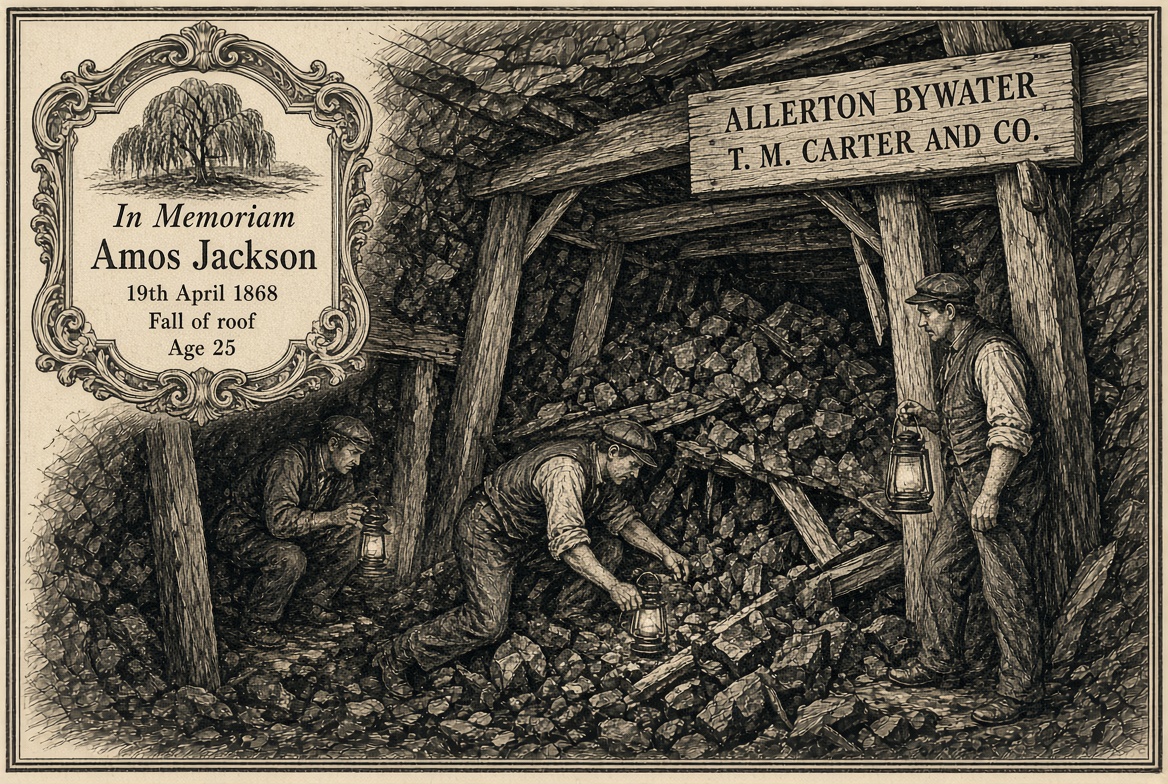
No paper gives the day of the fall. The Leeds Times of 25 April 1868 says it was about six months before the inquest, so about October 1867. He was preparing a blast. A portion of the roof fell on him and fractured his spine.

He was taken to the Infirmary and remained there eighteen weeks. He was then removed to his friends. He lingered, completely paralysed, until Sunday 19 April 1868, when he died. The inquest sat on Friday 24 April. “Sunday” in a Saturday paper of the 25th is the 19th, not the 26th.

The Leeds Mercury of the same day says he died from injuries received through a fall from the roof of a pit at Allerton Bywater, some six months ago. “Fall from the roof” is the Mercury’s phrase. The Times is the fuller account, and it says the roof fell upon him.

Coroner’s report and conclusion

Mr Emsley, borough coroner of Leeds, held the inquest. It had been adjourned so that the Government inspector might be present. The jury’s verdict was accidental death.

Yesterday, an inquest was held at Leeds, by Mr. Emsley, on the body of Amos Jackson, a coal miner. Deceased had been employed in the Allerton Bywater Pit, of Mr. T. R. Carter, (Wakefield), and about six months ago while preparing a blast, a portion of the roof fell upon him and fractured his spine. He was taken to the Infirmary, where he remained for eighteen weeks, at the expiration of which period he was removed to his friends. He lingered in a completely paralysed condition until Sunday, when death resulted. A verdict of “Accidental death” was recorded by the jury.

Leeds Times, Saturday 25 April 1868, page 5. “Yesterday” is Friday 24 April. “Sunday” is 19 April.

An adjourned inquest was held yesterday before the Leeds borough coroner, on the body of a man named Amos Jackson, who died recently from injuries he had received through a fall from the roof of a pit at Allerton Bywater, some six months ago. The jury returned a verdict of “Accidental death.” The inquest had been adjourned that the Government inspector might be present.

Leeds Mercury, Saturday 25 April 1868, page 8.

Sources and citations

Castleford parish baptism register, 20 March 1843, entry 778. Amos, son of Robert and Ann Jackson, Glass Houghton, coal miner. D147/1/3.

1851 census, Glass Houghton, HO 107/2330, folio 224. Robert Jackson and sons George, William, David and Amos.

1861 census, Castleford, Glass Houghton, RG 9/3438, folio 89. Amos Jackson, lodger, unmarried, coal miner, in the house of John Hepworth.

Leeds Times, 25 April 1868, page 5. Leeds Mercury, 25 April 1868, page 8.

Corrections

  • Date. 19 April 1868 is the day he died, not the day of the fall. The fall was about six months earlier, about October 1867. No exact day has been found.
  • Age. 25, from the baptism of 20 March 1843. The 1851 age of 7 and the 1861 age of 17 are each a year light.
  • Cause. Fall of roof while preparing a blast, spine fractured. He was not killed on the spot. Eighteen weeks in the Infirmary, then at home, paralysed, until 19 April.
  • Owner. The Times names Mr T. R. Carter, of Wakefield. Home was Glass Houghton, not Allerton Bywater.
Samuel Coates

IN MEMORIAM

Samuel Coates

5 January 1868  ·  buried 8 January  ·  age 35

Fall of roof

Allerton Bywater  ·  T. M. Carter and Co.  ·  of Adwalton

His life

Samuel Coates was a coal miner, of Adwalton, in the township of Drighlington. The name is Coates on the 1861 schedule and on the burial. He was born at Leeds. Age 28 on 7 April 1861, and 35 at burial in January 1868, put the birth about 1833, which is the year the accidents index prints.

On 7 April 1861 he was head of a household on Wakefield Road, Drighlington, in the ecclesiastical district of Adwalton. Schedule 55, RG 9/3308. With him were his wife Sarah, 21, and their son Albert, one month old, born at Adwalton. Sarah’s birthplace is written on the schedule as Eddesone. That place has not been identified, and is not guessed. No baptism or marriage has been matched in the papers supplied. Parents are not invented.

He was working at Allerton Bywater, some eight miles from Adwalton, for T. M. Carter and Co. The index spells the colliery Allerton Byewater, and the place of death Castleford. Castleford is the registration district. The pit was Allerton Bywater. Home was Adwalton.

The accident

The accidents index is the only account of the death. It says Samuel Coates, collier, aged 35, died on 5 January 1868 at Allerton Bywater, T. M. Carter and Co., by a fall of roof. No newspaper cutting and no inspector’s narrative have been found. The day of the week fits the burial. 5 January 1868 was a Sunday. He was buried at the district church of Drighlington on Wednesday 8 January, entry No. 984, abode Adwalton, age 35, ceremony by J. Horsfall, incumbent. West Yorkshire Archive Service D124/10.

Nothing more is known of the place in the pit, the hour, or whether he died on the spot. The index does not say.

Coroner’s report and conclusion

No coroner’s paper and no newspaper report have been traced. The burial three days after the indexed date of death is the check on that date. Verdict not known.

Sources and citations

1861 census, Drighlington, Wakefield Road, ecclesiastical district of Adwalton, RG 9/3308, schedule 55. Samuel Coates, 28, coal miner, born Leeds; Sarah, 21; Albert, 1 month, born Adwalton.

Drighlington district church burial register, 1868, page 172, entry No. 984. Samuel Coates, Adwalton, 8 January, age 35. J. Horsfall, incumbent. D124/10.

UK Coal Mining Accidents and Deaths Index: Samuel Coates, 35, born about 1833, 5 January 1868, Castleford, collier, Allerton Byewater, T. M. Carter and Co., fall of roof.

Corrections

  • Name. Samuel Coates, as the census and the burial both write it.
  • Age. 35, from the burial and the index. The 1861 age of 28 agrees, within a year.
  • Place. The pit was Allerton Bywater. Allerton Byewater is a misspelling. Castleford is the registration district. Home was Adwalton.
  • Owner. T. M. Carter and Co., as the index prints it. The firm is the Carter pit.
  • Dates. Death 5 January 1868, from the index. Burial 8 January, from the register. No inquest paper has been found to confirm the hour or the verdict.
John Wright

IN MEMORIAM

John Wright

Accident 3 June 1867  ·  died 6 June  ·  age 34

Caught between the piston rod and the wall

Allerton Bywater  ·  Carter and Co.  ·  of Beeston

His life

John Wright lived at Beeston and worked as engineman, or engine tenter, at Messrs Carter and Co.’s colliery at Allerton Bywater. The mining indexes call him a brakesman. At a colliery of this date the two words often name the same man, the one who tended the winding engine. The papers, which knew his work, say engineman and engine tenter.

He was 34. The Leeds parish burial register, Beeston, 9 June 1867, entry No. 120, gives that age. The Leeds Mercury, reporting the opening of the inquest, also says 34. The Yorkshire Post says 35. The accidents indexes say 37, and birth about 1830. Age 34 puts birth about 1833, which is the year on the Find a Grave entry for Beeston Cemetery. The burial and the Mercury are preferred.

No 1851 or 1861 household has been tied to him in the open indexes. Parents, wife and children are not invented. He was buried at Beeston on Sunday 9 June 1867, ceremony by G. Hillbank. Durham Mining Museum still prints burial as not known.

The accident

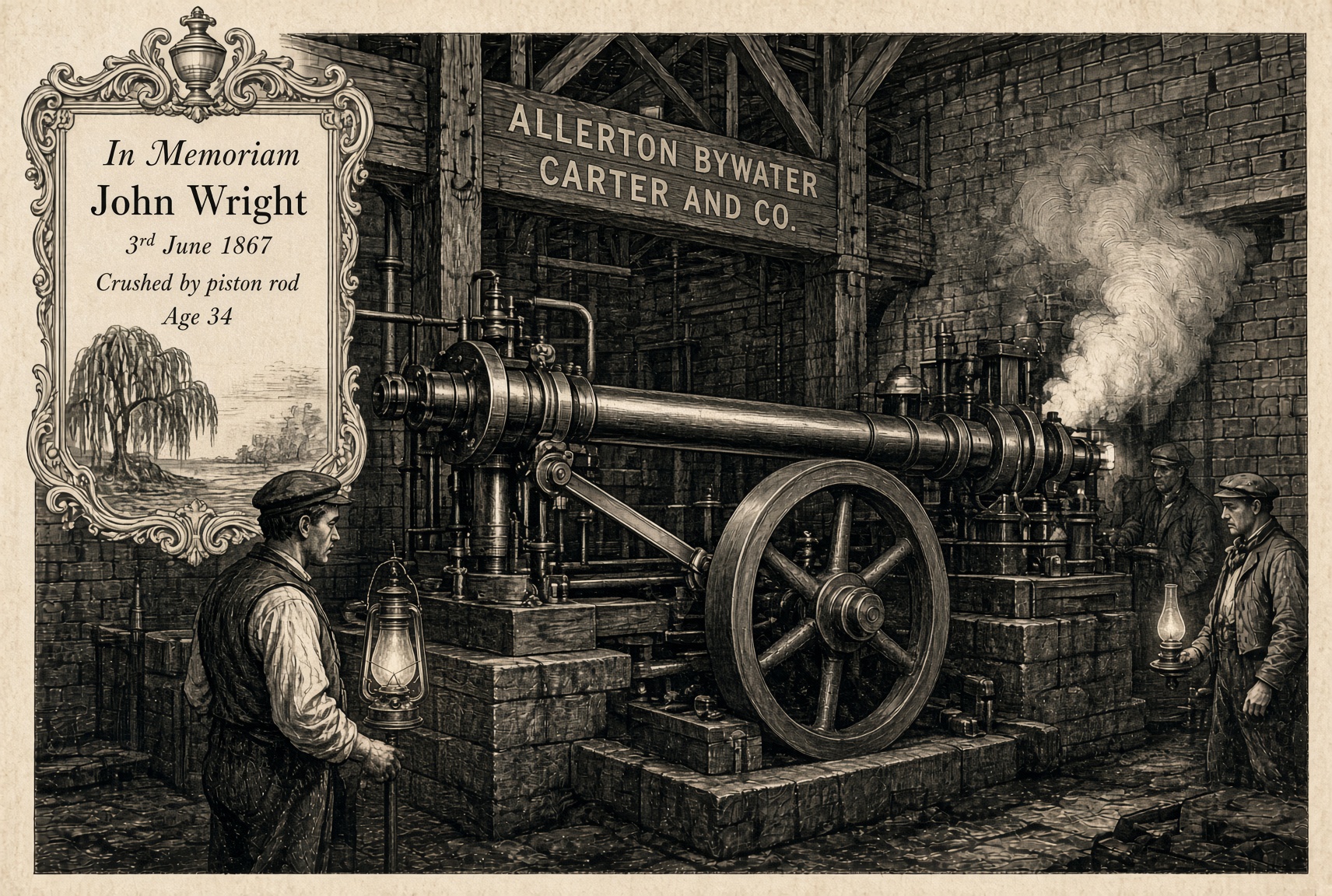
On Monday night, 3 June 1867, between eleven and twelve, Wright was at the engine at Allerton Bywater. The piston rod worked close to the wall of the building. While stepping over part of the engine, or trying to pass between the rod and the wall, his left leg was caught. The thigh was shattered.

He was taken to the Leeds Infirmary the same night, in a shattered and enfeebled state. The Leeds Mercury of Wednesday 5 June, and the Leeds Evening Express of the same day, said little hope was entertained of his recovery. He died at the Infirmary on Thursday morning, 6 June. The Express of Friday 7 June records that death. He was buried at Beeston on the 9th.

The Yorkshire Post of 8 June says the accident was on Monday morning, and that he died yesterday morning. The Monday-night reports of 5 June are the earlier ones, and they agree with each other. “Yesterday morning” in the Friday Express is 6 June. The Post’s “yesterday” is written from the Saturday paper and does not override that.

Coroner’s report and conclusion

Mr Emsley, borough coroner of Leeds, opened the inquest on Friday 7 June and adjourned it to Thursday 13 June. The Leeds Mercury of Saturday 15 June reports the result.

At an adjourned inquest held on Thursday by Mr. Emsley, the borough coroner, on the body of John Wright, engineman, Beeston, who had died at the Leeds Infirmary from injuries received while engaged at work at Allerton Bywater, the jury returned a verdict of “Accidental death.”

Leeds Mercury, Saturday 15 June 1867.

Opening reports, for the facts of the injury:

Between eleven and twelve o’clock on Monday night an engineman, named John Wright, living at Beeston, but employed at Allerton-Bywater, was admitted into the Leeds Infirmary in a terribly shattered and enfeebled condition from injuries which he had received a few hours previously. The unfortunate man was employed by Messrs. Carter and Co., at their colliery at the above-named place, and it appears that while stepping over some portion of the engine his left leg was caught between the piston rod and the wall, and his thigh shockingly shattered.

Leeds Mercury, Wednesday 5 June 1867. The Leeds Evening Express of the same day prints the same account.

The unfortunate man John Wright, who was crushed at Messrs Carter’s colliery, at Allerton Bywater, on Monday night, died yesterday morning at the Leeds Infirmary.

Leeds Evening Express, Friday 7 June 1867. The printed “Nessrs” is Messrs.

Sources and citations

Leeds Mercury, Wednesday 5 June 1867, page 2. Serious accident at Allerton-Bywater.

Leeds Evening Express, Wednesday 5 June 1867, page 2, and Friday 7 June 1867, page 2.

Yorkshire Post and Leeds Intelligencer, Saturday 8 June 1867, page 5. Inquest opened. Age given as 35. Monday morning.

Leeds Mercury, Saturday 8 June 1867. Inquest opened on John Wright (34), of Beeston, engineman, adjourned to Thursday next.

Leeds Mercury, Saturday 15 June 1867. Adjourned inquest. Verdict, accidental death.

Leeds parish burial register, Beeston, 1867, page 15, entry No. 120. John Wright, Beeston, 9 June, age 34. West Yorkshire Archive Service P9/4/3.

UK Coal Mining Accidents and Deaths Index, and Durham Mining Museum: age 37, death and accident both 3 June 1867, brakesman, crushed by piston, burial not known. Colliery spelled Allerton Byewater in one index.

Corrections

  • Age. 34, from the burial and the Leeds Mercury. Not 37, as in the indexes, and not 35, as in the Yorkshire Post.
  • Dates. Accident Monday night, 3 June 1867. Death Thursday morning, 6 June, at the Leeds Infirmary. Burial Sunday 9 June, Beeston. The indexes put death on the day of the accident.
  • Trade. Engineman, or engine tenter, as the papers say. Brakesman is the index word for the same work.
  • Place. The pit was Allerton Bywater, Carter and Co. Castleford is the registration district. Home was Beeston. Allerton Byewater is a misspelling.
  • Cause. Not killed on the spot. Left leg caught between the piston rod and the wall, thigh shattered. He lived three days. Verdict, accidental death.
Thomas Wilby

IN MEMORIAM

Thomas Wilby

23 July 1861  ·  age 47

Fall of roof while drawing props

Allerton Bywater  ·  Carter and Co.  ·  of Soothill

His life

Thomas Wilby was a coal miner, aged 47, belonging to Soothill. That is the whole of what the contemporary paper says of him. Soothill was a township in the parish of Dewsbury, on the high ground north of Hanging Heaton and about a mile and a half from Dewsbury town. Age 47 in July 1861 puts his birth about 1814.

The 1861 census was taken on 7 April, three months before he was killed, so he should appear in a Soothill or Dewsbury household. No schedule that can be tied to this man has been found in the open indexes. No baptism, marriage or burial entry has been matched either. Durham Mining Museum still prints burial as not known. Parents, wife and children are not invented.

He was working away from home. Soothill is some fifteen miles from Allerton Bywater. The paper calls the working “Mr. Carter’s new pit.” Carter’s Haigh Moor shafts beside the Aire had been sunk from 1840. “New” may mean a fresh district, or a pit newly in his work, rather than the later Silkstone sinking of 1875, which had not begun.

The accident

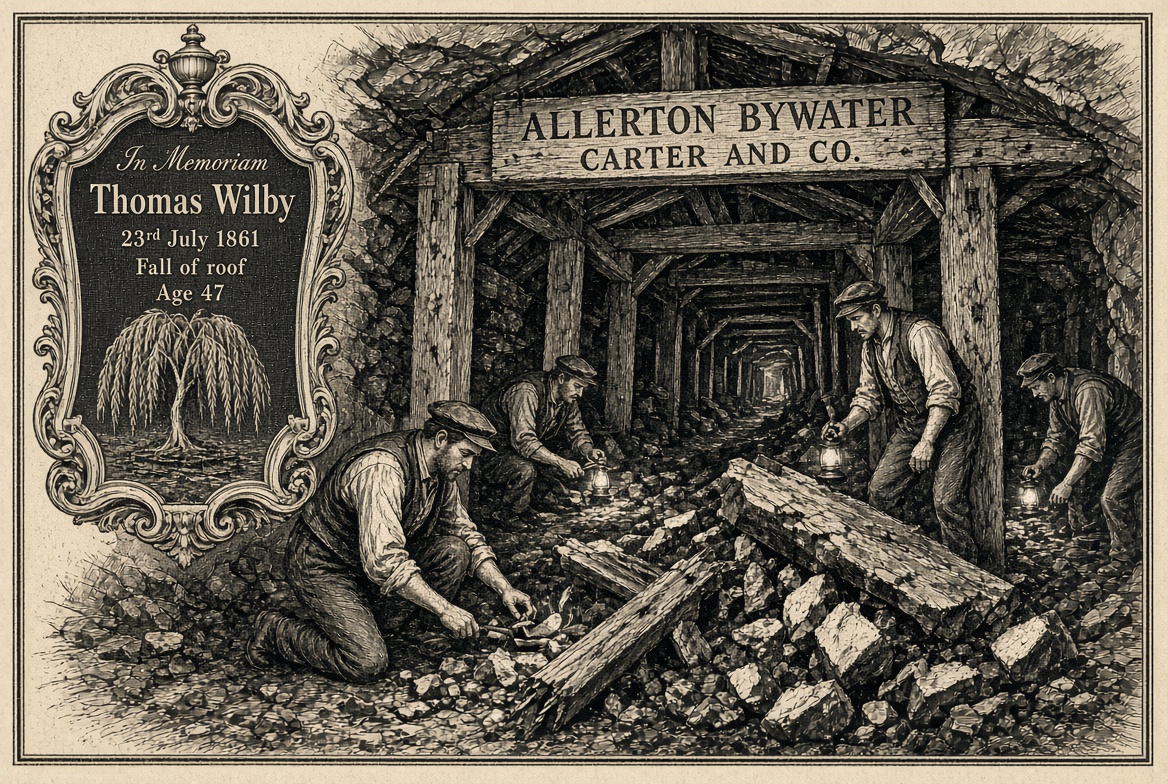
On Tuesday evening, 23 July 1861, Wilby was underground in Mr Carter’s pit at Allerton Bywater. He was drawing props. A portion of the roof fell on him and killed him on the spot.

The Leeds and West Riding Express printed that on Saturday 27 July, in the local news, without a heading of its own. Charles Morton, H.M. Inspector, entered the death as Accident No. 41 in his 1861 tabular list, page 155, and described it only as a fall of roof in the mine. He wrote no narrative. The accidents index shortens the cause to “fall of coal.” The paper is the fuller account, and it says roof, not coal.

Newspaper report and conclusion

No coroner’s inquest paper has been traced. The paper does not give a verdict. It says he was killed on the spot.

On Tuesday evening, a coal miner named Thomas Wilby, aged 47, belonging to Soothill, was working in Mr. Carter’s new pit at Allerton Bywater, and whilst in the act of removing some props, a portion of the roof fell upon him, killing the poor fellow on the spot.

Leeds and West Riding Express, Saturday 27 July 1861, vol. IV, no. 189, page 2. The printed word is “spot.” A typed copy of the cutting reads “spct.”

1861 Mines Inspectors Report, Charles Morton, page 155, Accident No. 41. Thomas Wilby, Allerton Bywater, Carter and Co., fall of roof in the mine, 23 July 1861. No age. No narrative. Burial not stated.

Sources and citations

Leeds and West Riding Express, Saturday 27 July 1861, page 2. Thomas Wilby, aged 47, of Soothill, Mr Carter’s new pit, Allerton Bywater, killed on the spot while removing props.

1861 Mines Inspectors Report, Charles Morton, page 155, Accident No. 41. Cited by the Durham Mining Museum: died 23 July 1861, Allerton Bywater, Carter and Co., fall of roof in the mine, burial not known, age blank.

UK Coal Mining Accidents and Deaths Index: Thomas Wilby, 23 July 1861, place given as Normanton, employer Carter and Co, fall of coal in the mine.

Alan Beales, Database of Fatalities in the Coal Fields: Thomas Wilby, Allerton Bywater, 23 July 1861. No age.

Corrections

  • Date. Tuesday evening before the Saturday paper of 27 July is 23 July 1861. The indexes and the paper agree.
  • Cause. Fall of roof while drawing props, as the paper says, and as Morton’s table says. The accidents index’s “fall of coal” is the shorter and wrong form.
  • Place. The pit was Allerton Bywater. Normanton, in the accidents index, is dropped. Home was Soothill, in Dewsbury parish.
  • Age. 47, from the paper. The mining indexes leave it blank.
  • Burial and family. Still not verified. Not filled in.
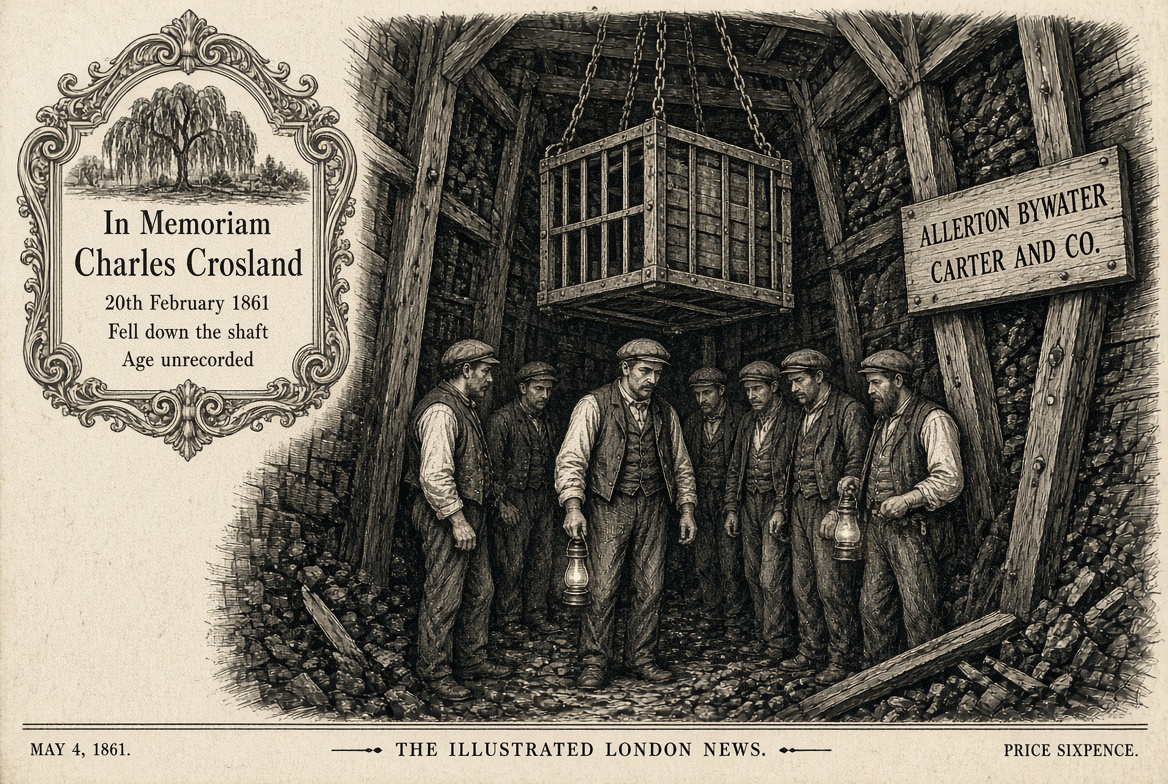
Charles Crosland

IN MEMORIAM

Charles Crosland

20 February 1861  ·  age not known

Fell down the shaft

Allerton Bywater Colliery  ·  Carter and Co.

His life

Almost nothing of Charles Crosland’s life is on the public record. The mining indexes give a name, a colliery, an owner and a date. They do not give an age, a birth year, a trade, a residence or a burial.

The name in the inspector’s list, and in the Durham Mining Museum and the Coal Mining Accidents and Deaths Index, is Crosland. Alan Beales’s Database of Fatalities prints Crossland. Both spellings were used in the West Riding, often for the same family. Crosland is the form taken from the 1861 inspector’s table, so that is the form used here.

No 1851 or 1861 census household has been tied to this man. No baptism and no burial entry has been found in the Allerton Bywater, Kippax, Castleford or Rothwell registers that are indexed online. Durham Mining Museum still prints burial as not known. That gap is real. Parents, wife and children are not invented.

He died on Wednesday 20 February 1861 at Carter’s colliery, Allerton Bywater, the Haigh Moor pit sunk from 1840 beside the River Aire. The later Silkstone sinking was not yet begun.

The accident

The whole of the contemporary official note is four words: falling down the shaft. Charles Morton, H.M. Inspector of Coal Mines, entered it as Accident No. 7 in his tabular list for 1861, page 154. Unlike George Hepworth’s death in 1856, Morton wrote no narrative. There is no account of whether Crosland fell from the bank, from a cage, or while riding the shaft, and no account of the depth.

Carter’s Haigh Moor shafts of that date went about 140 yards to a seam four feet six inches thick, between the present Victoria Street and Robinson Street. That is the pit, not a measured fall.

No Leeds, Pontefract or Castleford newspaper report of this death has been found in the papers indexed online.

Inspector’s report and conclusion

No coroner’s inquest paper, and no newspaper verdict, has been traced. The official record is the inspector’s table only.

1861 Mines Inspectors Report, Charles Morton, H.M. Inspector of Mines, page 154, Accident No. 7. Charles Crosland, Allerton Bywater, Carter and Co., falling down the shaft, 20 February 1861. No age. No occupation. No narrative.

There is nothing further to quote.

Sources and citations

1861 Mines Inspectors Report, Charles Morton, H.M. Inspector of Mines, page 154, Accident Number 7. Cited by the Durham Mining Museum, Charles Crosland individual page: died 20 February 1861, Allerton Bywater, Carter and Co., falling down the shaft, burial not known, age blank.

UK Coal Mining Accidents and Deaths Index: Charles Crosland, 20 February 1861, place given as Normanton, employer Carter and Co, falling down the shaft.

Alan Beales, Database of Fatalities in the Coal Fields: Charles Crossland, Allerton Bywater, 20 February 1861. Spelling differs. No age.

Allerton Bywater Parish Council, coal-mining history: Carter’s Haigh Moor, leased from 1840, two shafts near the River Aire, seam four feet six inches at about 140 yards, worked to 1875.

Corrections

  • Spelling. Crosland, as in the inspector’s list, the Durham Mining Museum and the accidents index. Crossland, on the Beales database and on an earlier plate in this series, is the variant. The plate now reads Crosland.
  • Place. The accidents index gives Normanton. That is not the pit. The colliery was Allerton Bywater. Normanton is a neighbouring registration place and is dropped.
  • Age. Not stated in any source checked. Left as not known. It is not guessed from a census that has not been matched.
  • Burial. Still not known. No parish entry has been verified.
  • Owner. Carter and Co., the 1861 form. Not the later T. M. Carter and Co. used on the plates after 1867.
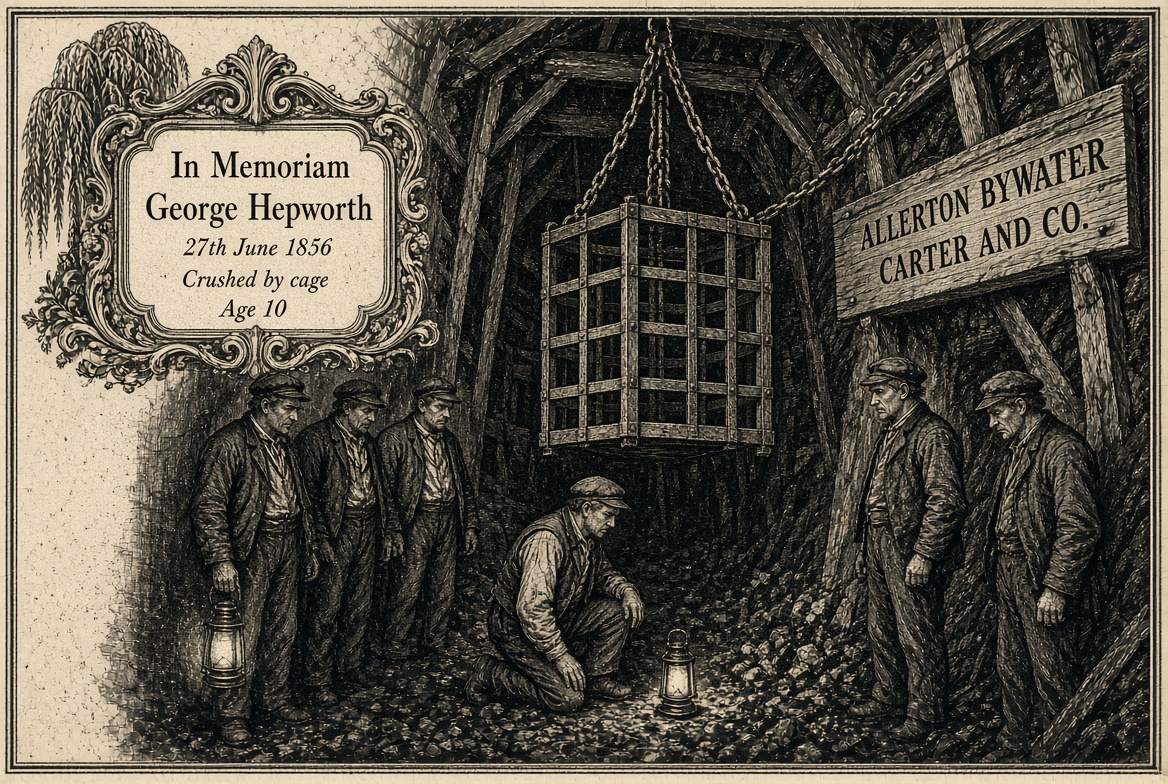
George Hepworth

IN MEMORIAM

George Hepworth

27 June 1856  ·  age 10

Crushed by the descending cage at the shaft bottom

Allerton Bywater Colliery, near Pontefract  ·  Carter and Co.

His life

George Hepworth was a boy of Lofthouse, in the ancient parish of Rothwell, in the West Riding. The burial register is the only record that fixes his age. He was ten years old when he was killed, so he was born about 1846.

No baptism, and no 1851 household, has been tied to him with certainty. Lofthouse-with-Carlton was a colliery township on the Rothwell side of the Aire, a short walk from Carter’s Haigh Moor workings at Allerton Bywater. Several Hepworth families lived in that parish. None of the published census extracts names a George of about five at Lofthouse in 1851, and the online indexes do not either. Parents’ names are not on the burial entry. They are not invented here.

By the Coal Mines Act of 1842, no boy under ten was to be employed underground. George was at the legal minimum. The inspector calls him only “a young boy.” The indexes call him a boy and give no trade. He was almost certainly a hurrier or a pit-bottom lad, crossing the shaft eye in the course of his work. That is an inference from the place of the accident, not a statement in the report.

He was killed on Friday 27 June 1856 and buried two days later.

The accident

On 27 June 1856, at Allerton Bywater Colliery, near Pontefract, worked by Carter and Co., George was underground at the shaft bottom. He was crossing from one side of the shaft to the other. There was no separate road cut alongside the pit bottom, so anyone passing had to cross the shaft eye itself, in the path of the cage and of anything falling in the shaft.

The cage was coming down. He did not see it. He was crushed and killed on the spot.

Charles Morton, H.M. Inspector of Coal Mines for the Yorkshire district, entered the case as Accident No. 26 in his tabular list for 1856, and wrote it up in the narrative report printed for Parliament in 1857. He did not treat it as a boy’s carelessness alone. He wrote that a road “should have been” excavated beside the pit bottom, so that people could pass without standing under the shaft. He told the agent to make that alteration at once. The agent agreed.

No contemporary newspaper report of this death has been found in the Leeds, Pontefract or Wakefield papers that are indexed online. The inspector’s account is the contemporary narrative.

Inspector’s report and conclusion

No coroner’s inquest paper, and no newspaper report of a verdict, has been traced. The official conclusion is Morton’s.

Accident No. 26 in the Tabular List.

At Allerton Bywater Colliery, near Pontefract, a young boy was imprudently crossing from one side of the shaft to the other, underground, when he was crushed unaware by the descending cage, and killed on the spot.

There was not a road excavated along side this pit bottom, (as there should have been,) to enable persons to pass unexposed to the danger attendant on falling substances in shafts; I therefore advised the agent forthwith to make such alterations as would tend to obviate the recurrence of similar mishaps in future; and he readily consented to carry my suggestions into effect.

Burial, parish of Rothwell, county of York, 1856, page 105, entry No. 837: George Hepworth, abode Lofthouse, buried 29 June, age 10. Ceremony by John Bell, station minister. West Yorkshire Archive Service reference P9/1/4/3.

The word “imprudently” is the inspector’s. The same paragraph says the road that would have kept him clear of the shaft had not been cut, and that it should have been.

Sources and citations

Rothwell parish burial register, 1856, page 105, entry No. 837. West Yorkshire Archive Service, P9/1/4/3. George Hepworth, Lofthouse, 29 June 1856, age 10, John Bell, station minister.

Reports of the Inspectors of Coal Mines to Her Majesty’s Secretary of State, to December 1856. London: Eyre and Spottiswoode, 1857. Charles Morton, Yorkshire district. Narrative of Accident No. 26; tabular list, pages 60 and 67.

Durham Mining Museum, George Hepworth individual page, colliery Allerton Bywater, company Carter and Co., died 27 June 1856, crushed by cage at bottom of the shaft. Source cited: 1856 Mines Inspectors Report, Charles Morton, pages 60 and 67, Accident No. 26. Burial given as not known. Year of birth given as about 1856.

UK Coal Mining Accidents and Deaths Index: George Hepworth, 27 June 1856, Pontefract, Allerton Bywater, Carter and Co., crushed by the cage at the bottom of the shaft, a boy.

Alan Beales, Database of Fatalities in the Coal Fields, England, Mining Disaster Victims: George Hepworth, Allerton Bywater, 27 June 1856, age recorded as boy.

Coal Mines Act 1842, 5 & 6 Vict. c. 99: females, and boys under ten, not to be employed underground.

Corrections

  • Age. The indexes say only “boy.” The burial register says 10. The plate and this account use 10.
  • Birth year. Durham Mining Museum prints “about 1856.” That is the year of death, not of birth. Age 10 in June 1856 puts birth about 1846.
  • Burial. Durham Mining Museum prints burial not known. He was buried at Rothwell on 29 June 1856, entry No. 837, abode Lofthouse.
  • Place. The accident indexes give Pontefract. That is the registration and reporting district. The colliery was Allerton Bywater. Home was Lofthouse.
  • Owner. Contemporary form is Carter and Co., not the later “T. M. Carter and Co.” used on the 1860s plates. The sign on this plate follows the 1856 indexes.
  • No parents, trade, or 1851 household is stated. None has been verified. They are left blank.
error: Content is protected !!