

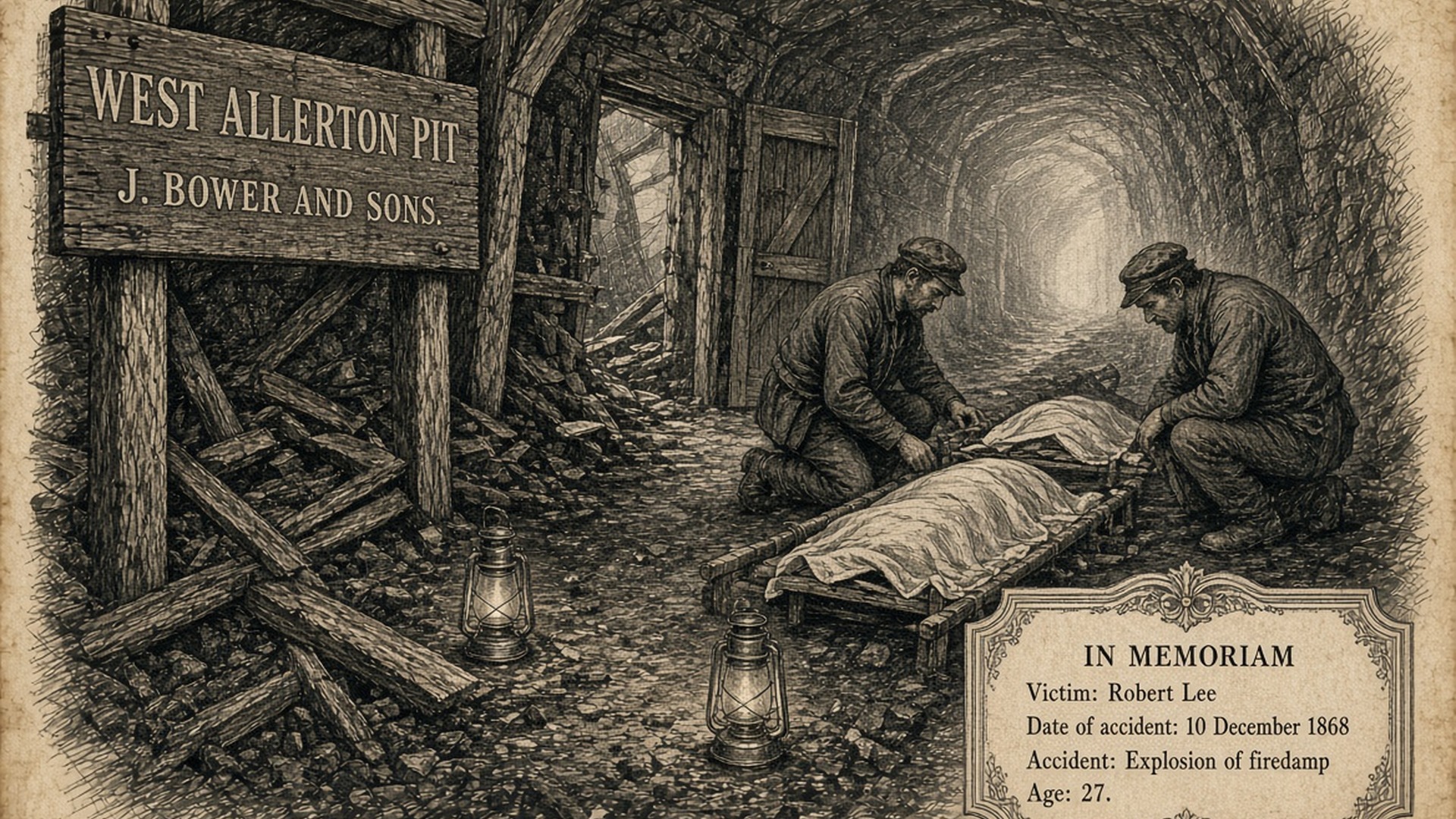
Robert Lee
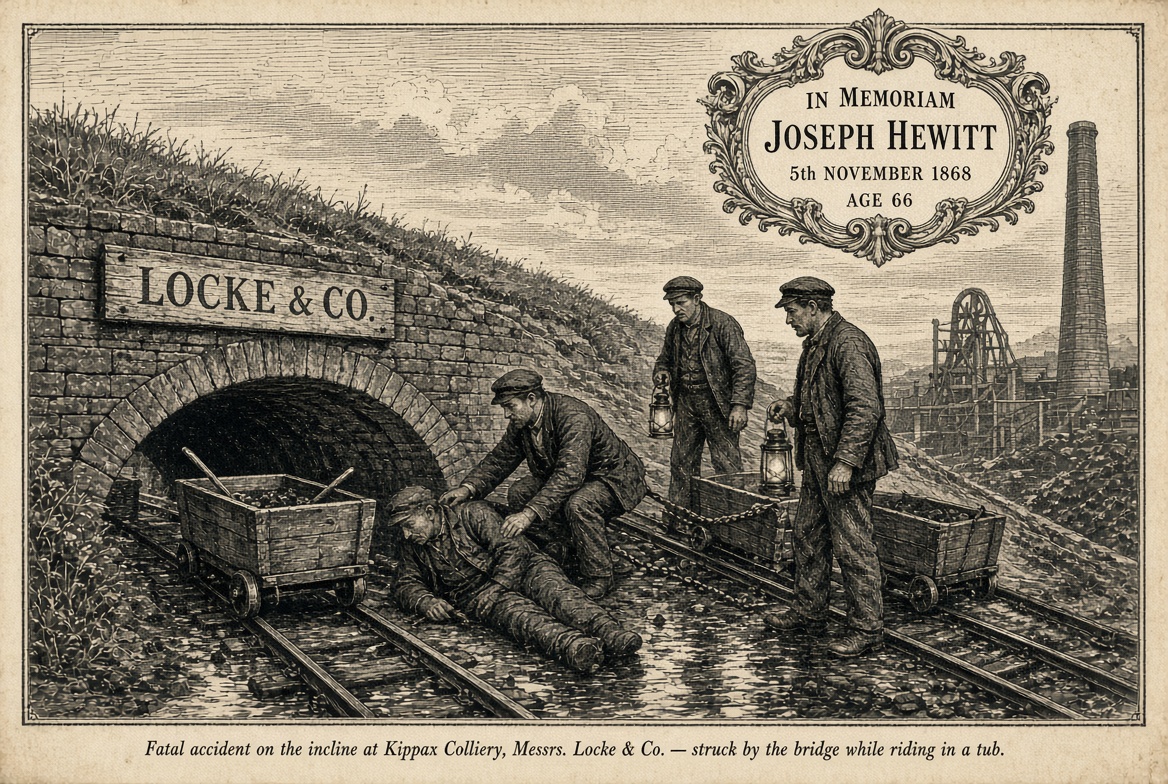
JOSEPH HEWITT
Staithman, Locke and Co., Kippax Colliery
Died 5 November 1868 · Buried 8 November 1868
Frank N. Wardell, the Yorkshire inspector of mines, recorded Joseph Hewitt as aged 66 in November 1868, which implies a birth about 1802. The burial register at St Mary’s, Kippax, three days later, gives age 60. Alan Beales’s compiled list gives birth year 1803 and age 65. The three figures are not reconciled without a baptism or a GRO certificate. What is certain is that he was an elderly surface worker living at Kippax.
The burial entry is no. 347 on page 130 of the Kippax register for 1868: Joseph Hewitt, abode Kippax, buried 8 November, age 60, E. D. Bland, Vicar. West Yorkshire Archive Service reference P47/26. DMM still prints the burial as not known; the register supplied with this research fills that gap.
He was a staithman for Locke and Co. at Kippax Colliery. A staithman worked the coal staithe — the riverside or canal-side wharf where tubs were tipped into barges. From 1858 coal from the Owl Wood / Haigh Moor shafts was carried south on a tramway over the road to the coal staithe on the Aire and Calder Navigation. That tramway is the line on which he was killed.
He is not the same man as Robert Hewitt of Kippax (baptised 1803, coal miner, buried 1877), nor John Locke Hewitt who heads a Kippax household in 1871. No baptism naming Joseph’s parents has been produced for this note, so the household is not reconstructed.
On Thursday 5 November 1868 Joseph Hewitt was killed on the surface incline that joined the Kippax Colliery staiths to the pit. He was not underground. He was not killed by a fall of roof.
Wardell printed the case as accident no. 67 in his 1868 Yorkshire report (narrative at page 155; table at page 161). The Durham Mining Museum transcript of that narrative is as follows.
There is a tramway connecting the staiths with Kippax Colliery, on which this accident occurred. The colliery is the property of Messrs. Locke and Co., and is situated near Normanton. The deceased, Joseph Hewitt, was riding up to the pit in one of the tubs on this incline, — the men having permission so to do, — when he lost his stick into the tub next that in which he was seated, and during his attempt to regain it his head came in contact with a bridge, thereby dislocating his neck. The tramway at this bridge passes under the highway. There was no violation of any rule, and the accident can only be attributable to the poor man’s forgetfulness of the danger, he having constantly travelled in the same way before.
My opinion was that if men were allowed to travel in this manner, they should only do so at stated times, and then under the charge of one steady and careful man who would be responsible for their taking proper precautions to avoid similar accidents.
The short DMM note on the individual page is the same event in one line: while riding in a tub on an incline his head came against a bridge underneath which the tubs ran. Occupation: staithman. Age: 66.
The commercial Coal Mining Accidents index and Beales both print Fall of Roof. That is a classification error. Wardell’s own words are the authority.
No separate coroner’s transcript and no Leeds or Pontefract newspaper paragraph naming Joseph Hewitt have been found in the open indexes searched for this note. Wardell’s printed opinion, written after he had seen the place, stands in place of those missing texts.
Conclusion. Accidental death. Joseph Hewitt, staithman, Locke and Co., Kippax, 5 November 1868. He was riding in a permitted tub on the staith-to-pit incline, reached for a dropped stick, and struck his head on the highway bridge that the tramway passed under. His neck was dislocated. No rule of the colliery was broken. Wardell thought the practice of riding the incline should be confined to set times and placed under one responsible man.
He was buried at St Mary’s, Kippax, on Sunday 8 November 1868.
West Yorkshire Archive Service, Leeds: Kippax St Mary burial register, 1868, p. 130, no. 347. Joseph Hewitt, Kippax, 8 November 1868, age 60; E. D. Bland, Vicar. Reference P47/26.
Frank N. Wardell, H.M. Inspector of Mines, 1868 Mines Inspectors Report, Yorkshire District, p. 155 (narrative) and p. 161, accident no. 67.
Durham Mining Museum, individual page and disaster page: Joseph Hewitt, age 66, died 5 November 1868, Kippax, Locke and Co., staithman; riding a tub on the incline, head against a bridge.
UK, Coal Mining Accidents and Deaths Index: Joseph Hewitt, age 66, born about 1802, 5 November 1868, Normanton, Locke and Co., staithman — description Fall of Roof (corrected from Wardell).
Alan Beales, England, Mining Disaster Victims: Joseph Hewitt, born 1803, age 65, 5 November 1868, Kippax, fall of roof (corrected from Wardell).
Allerton Bywater Parish Council, Kippax Colliery: from 1858 coal carried south on a tramway over the road to the coal staithe on the Aire and Calder Navigation.
Cause. Not a fall of roof. That wording in CMA&DI and in Beales is wrong. Wardell: riding a tub on the staith incline; head struck the highway bridge; neck dislocated.
Place of work. Surface / incline, not underground. Occupation staithman is the clue the compiled indexes kept while mis-labelling the cause.
Age. Burial register 60; inspector and CMA 66; Beales 65. All three are recorded. The inspector’s 66 is the figure used in the official table.
Place-name. Normanton in the commercial index is Wardell’s nearest town. The pit and the burial are Kippax. The tramway ran from the Aire staithe up to Kippax Colliery and passed under the highway.
Burial. DMM “not known” is filled by Kippax no. 347, 8 November 1868.
Identity. Not Robert Hewitt (d. 1877) and not John Locke Hewitt of the 1871 census.
A GRO death certificate would settle the age given to the registrar.

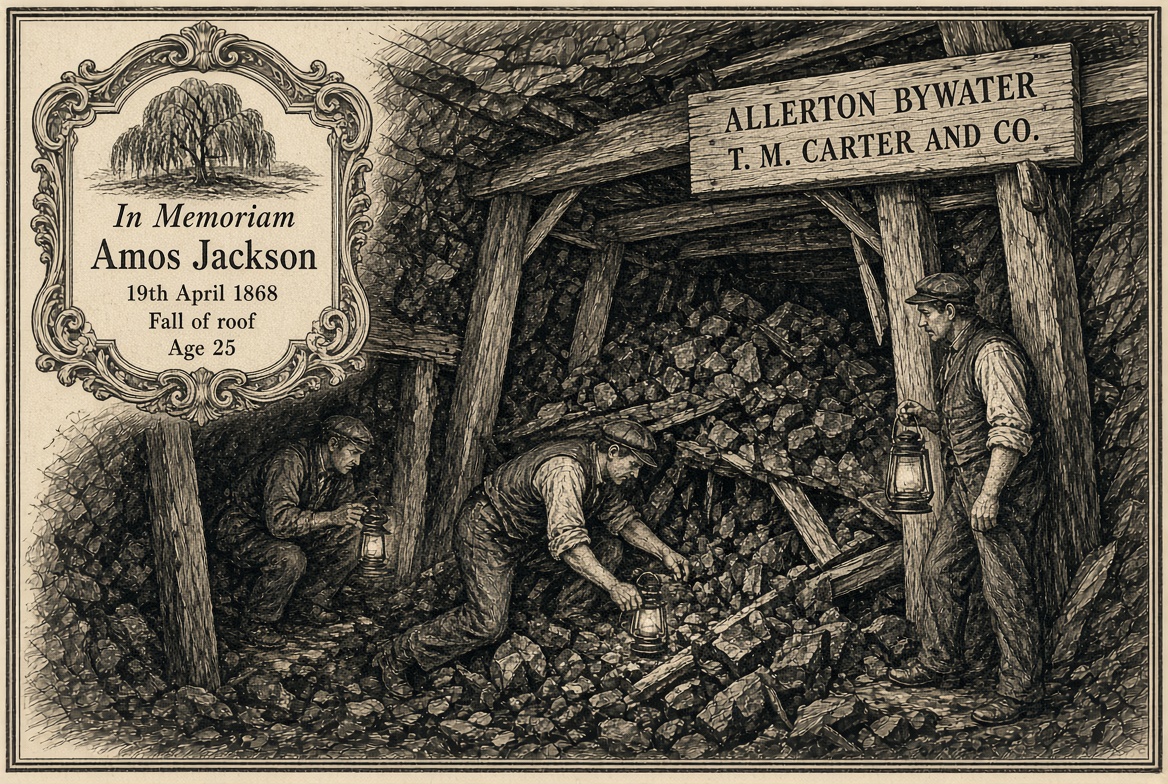
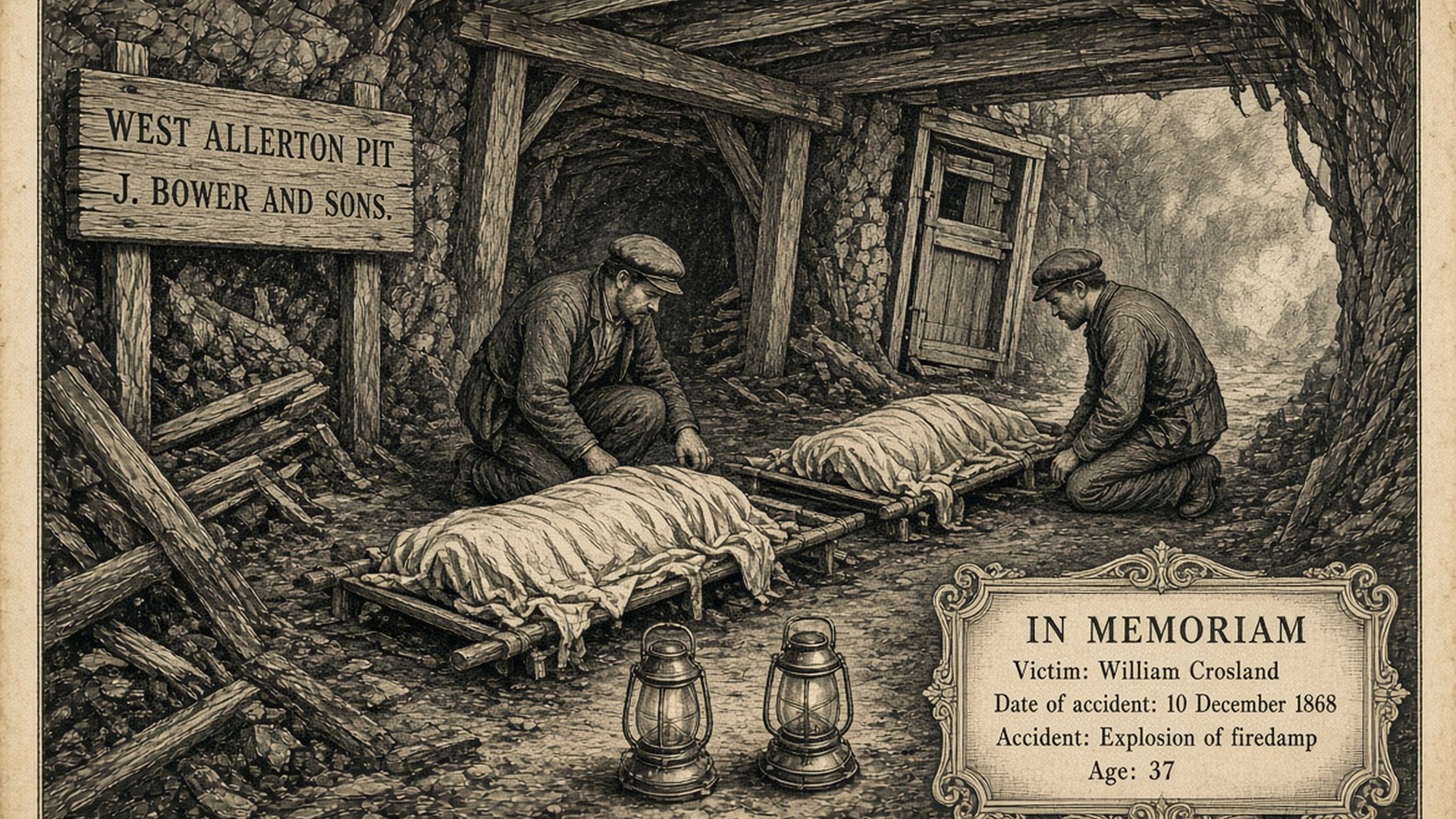
IN MEMORIAM
Amos Jackson
Hurt about October 1867 · died 19 April 1868 · age 25
Fall of roof while preparing a blast
Allerton Bywater · T. R. Carter, Wakefield · of Glass Houghton
Amos Jackson was baptised at Castleford on 20 March 1843, entry No. 778, son of Robert Jackson, coal miner, and Ann, of Glass Houghton. The curate was R. H. Kempsey. West Yorkshire Archive Service D147/1/3.
On 30 March 1851 the family was at Glass Houghton, in the ecclesiastical district of Castleford. Robert Jackson, 52, agricultural labourer, born Glass Houghton, was head. With him were George, 18, coal miner; William, 13, coal miner; David, 10, agricultural labourer; and Amos, 7, at home. All born Glass Houghton. HO 107/2330, folio 224. The census age is a year light. Baptised in March 1843, he was eight that week.
On 7 April 1861 he was a lodger in the house of John Hepworth, coal miner, 24, of Glass Houghton, in Castleford township. Amos was unmarried, a coal miner, born Glass Houghton. The schedule gives him 17. He was 18. RG 9/3438, folio 89, schedule 25. No marriage has been found. A wife is not invented.
By 1867 he was employed in the Allerton Bywater pit of Mr T. R. Carter, of Wakefield. That is the owner named by the Leeds Times. The older indexes often print the firm as Carter and Co.
No paper gives the day of the fall. The Leeds Times of 25 April 1868 says it was about six months before the inquest, so about October 1867. He was preparing a blast. A portion of the roof fell on him and fractured his spine.
He was taken to the Infirmary and remained there eighteen weeks. He was then removed to his friends. He lingered, completely paralysed, until Sunday 19 April 1868, when he died. The inquest sat on Friday 24 April. “Sunday” in a Saturday paper of the 25th is the 19th, not the 26th.
The Leeds Mercury of the same day says he died from injuries received through a fall from the roof of a pit at Allerton Bywater, some six months ago. “Fall from the roof” is the Mercury’s phrase. The Times is the fuller account, and it says the roof fell upon him.
Mr Emsley, borough coroner of Leeds, held the inquest. It had been adjourned so that the Government inspector might be present. The jury’s verdict was accidental death.
Yesterday, an inquest was held at Leeds, by Mr. Emsley, on the body of Amos Jackson, a coal miner. Deceased had been employed in the Allerton Bywater Pit, of Mr. T. R. Carter, (Wakefield), and about six months ago while preparing a blast, a portion of the roof fell upon him and fractured his spine. He was taken to the Infirmary, where he remained for eighteen weeks, at the expiration of which period he was removed to his friends. He lingered in a completely paralysed condition until Sunday, when death resulted. A verdict of “Accidental death” was recorded by the jury.
Leeds Times, Saturday 25 April 1868, page 5. “Yesterday” is Friday 24 April. “Sunday” is 19 April.
An adjourned inquest was held yesterday before the Leeds borough coroner, on the body of a man named Amos Jackson, who died recently from injuries he had received through a fall from the roof of a pit at Allerton Bywater, some six months ago. The jury returned a verdict of “Accidental death.” The inquest had been adjourned that the Government inspector might be present.
Leeds Mercury, Saturday 25 April 1868, page 8.
Castleford parish baptism register, 20 March 1843, entry 778. Amos, son of Robert and Ann Jackson, Glass Houghton, coal miner. D147/1/3.
1851 census, Glass Houghton, HO 107/2330, folio 224. Robert Jackson and sons George, William, David and Amos.
1861 census, Castleford, Glass Houghton, RG 9/3438, folio 89. Amos Jackson, lodger, unmarried, coal miner, in the house of John Hepworth.
Leeds Times, 25 April 1868, page 5. Leeds Mercury, 25 April 1868, page 8.

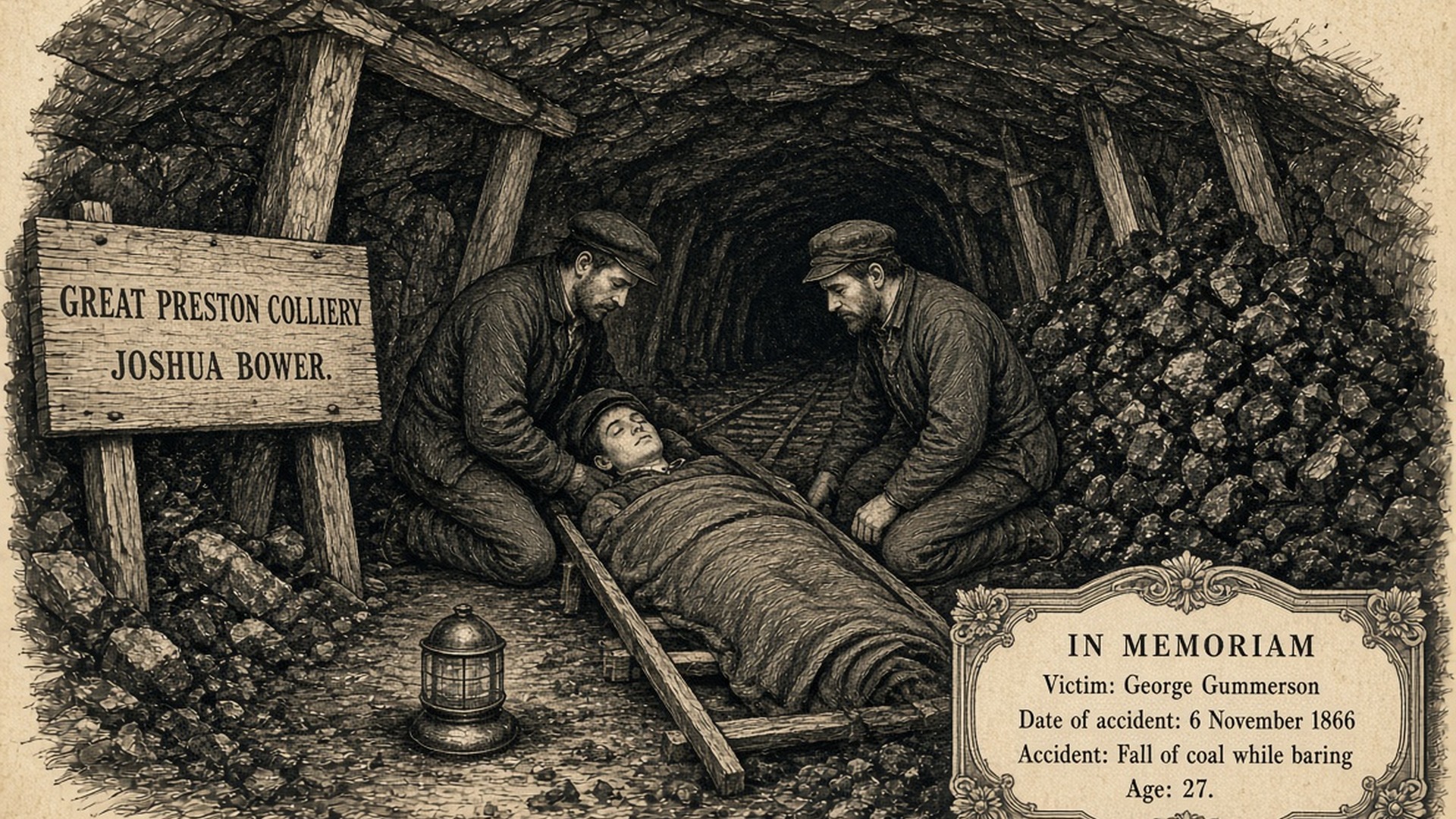
IN MEMORIAM
Samuel Coates
5 January 1868 · buried 8 January · age 35
Fall of roof
Allerton Bywater · T. M. Carter and Co. · of Adwalton
Samuel Coates was a coal miner, of Adwalton, in the township of Drighlington. The name is Coates on the 1861 schedule and on the burial. He was born at Leeds. Age 28 on 7 April 1861, and 35 at burial in January 1868, put the birth about 1833, which is the year the accidents index prints.
On 7 April 1861 he was head of a household on Wakefield Road, Drighlington, in the ecclesiastical district of Adwalton. Schedule 55, RG 9/3308. With him were his wife Sarah, 21, and their son Albert, one month old, born at Adwalton. Sarah’s birthplace is written on the schedule as Eddesone. That place has not been identified, and is not guessed. No baptism or marriage has been matched in the papers supplied. Parents are not invented.
He was working at Allerton Bywater, some eight miles from Adwalton, for T. M. Carter and Co. The index spells the colliery Allerton Byewater, and the place of death Castleford. Castleford is the registration district. The pit was Allerton Bywater. Home was Adwalton.
The accidents index is the only account of the death. It says Samuel Coates, collier, aged 35, died on 5 January 1868 at Allerton Bywater, T. M. Carter and Co., by a fall of roof. No newspaper cutting and no inspector’s narrative have been found. The day of the week fits the burial. 5 January 1868 was a Sunday. He was buried at the district church of Drighlington on Wednesday 8 January, entry No. 984, abode Adwalton, age 35, ceremony by J. Horsfall, incumbent. West Yorkshire Archive Service D124/10.
Nothing more is known of the place in the pit, the hour, or whether he died on the spot. The index does not say.
No coroner’s paper and no newspaper report have been traced. The burial three days after the indexed date of death is the check on that date. Verdict not known.
1861 census, Drighlington, Wakefield Road, ecclesiastical district of Adwalton, RG 9/3308, schedule 55. Samuel Coates, 28, coal miner, born Leeds; Sarah, 21; Albert, 1 month, born Adwalton.
Drighlington district church burial register, 1868, page 172, entry No. 984. Samuel Coates, Adwalton, 8 January, age 35. J. Horsfall, incumbent. D124/10.
UK Coal Mining Accidents and Deaths Index: Samuel Coates, 35, born about 1833, 5 January 1868, Castleford, collier, Allerton Byewater, T. M. Carter and Co., fall of roof.
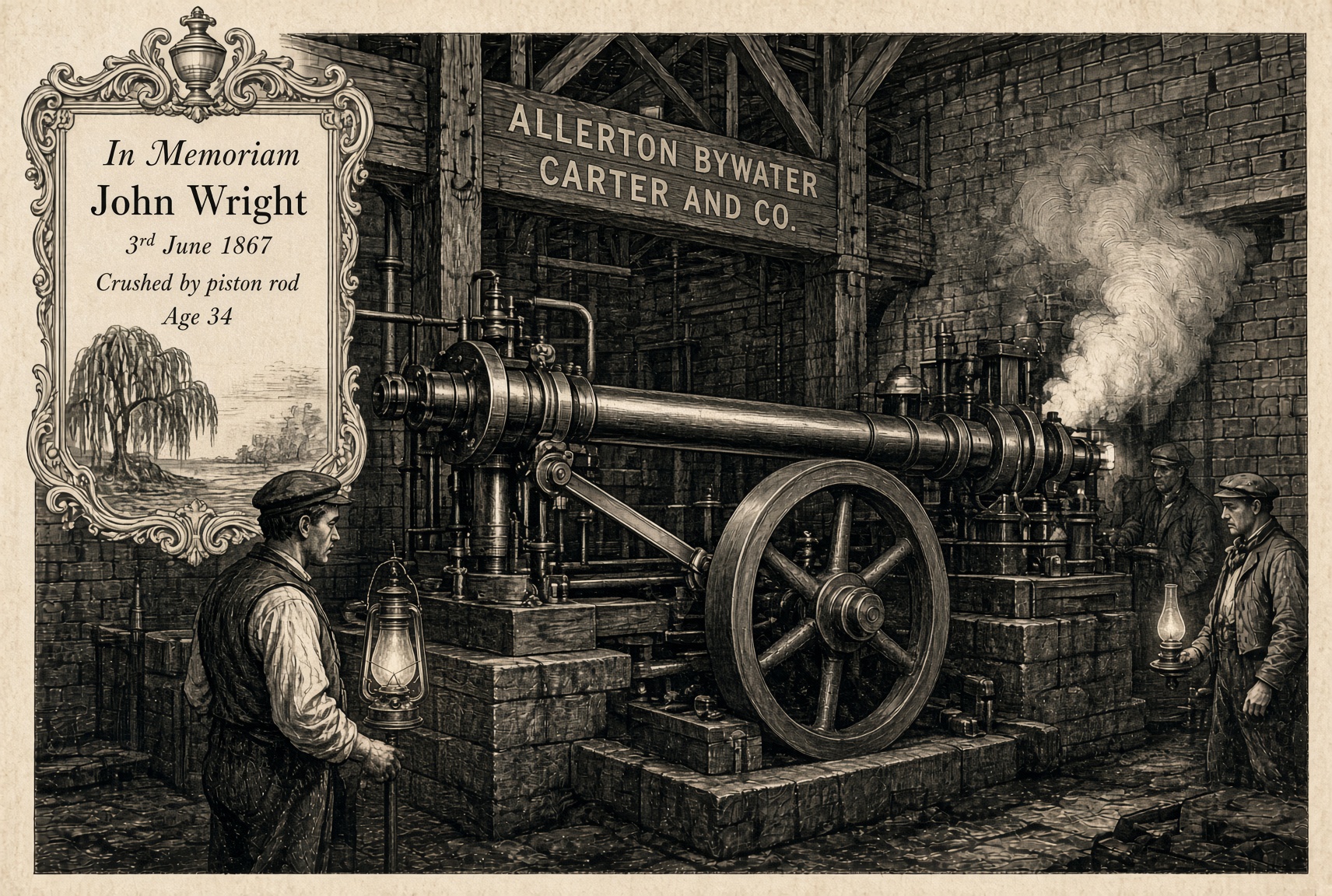
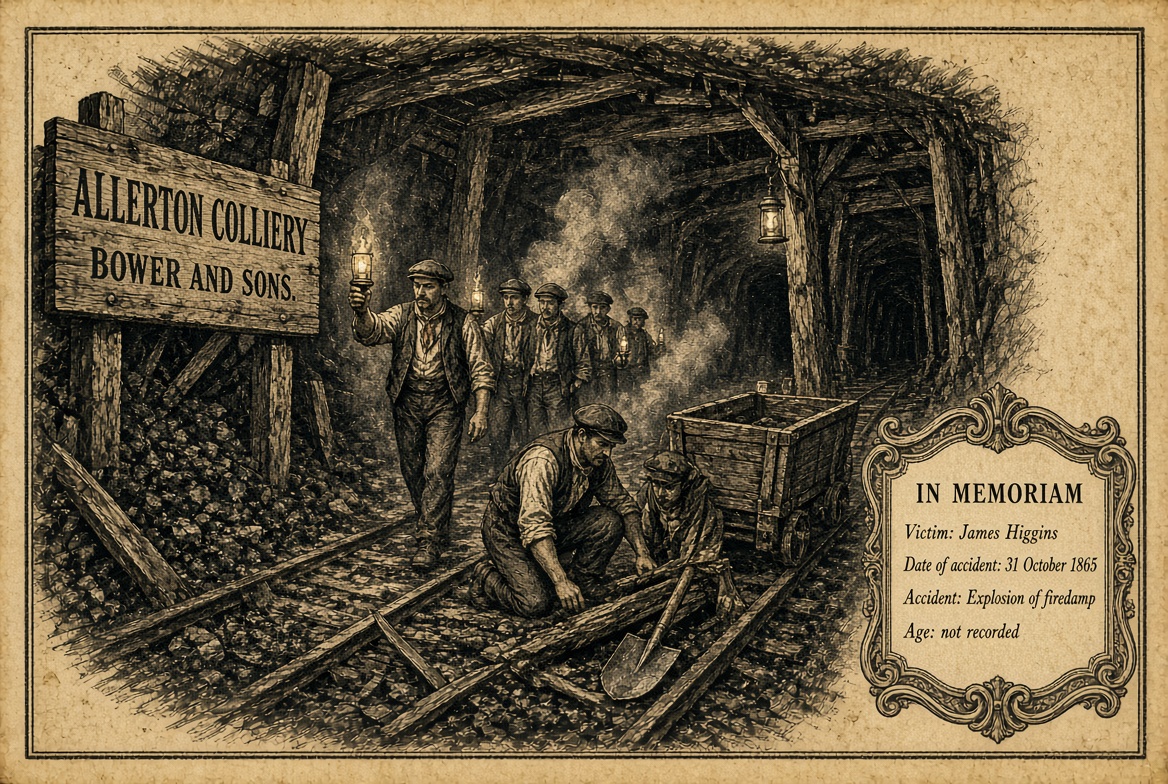
IN MEMORIAM
John Wright
Accident 3 June 1867 · died 6 June · age 34
Caught between the piston rod and the wall
Allerton Bywater · Carter and Co. · of Beeston
John Wright lived at Beeston and worked as engineman, or engine tenter, at Messrs Carter and Co.’s colliery at Allerton Bywater. The mining indexes call him a brakesman. At a colliery of this date the two words often name the same man, the one who tended the winding engine. The papers, which knew his work, say engineman and engine tenter.
He was 34. The Leeds parish burial register, Beeston, 9 June 1867, entry No. 120, gives that age. The Leeds Mercury, reporting the opening of the inquest, also says 34. The Yorkshire Post says 35. The accidents indexes say 37, and birth about 1830. Age 34 puts birth about 1833, which is the year on the Find a Grave entry for Beeston Cemetery. The burial and the Mercury are preferred.
No 1851 or 1861 household has been tied to him in the open indexes. Parents, wife and children are not invented. He was buried at Beeston on Sunday 9 June 1867, ceremony by G. Hillbank. Durham Mining Museum still prints burial as not known.
On Monday night, 3 June 1867, between eleven and twelve, Wright was at the engine at Allerton Bywater. The piston rod worked close to the wall of the building. While stepping over part of the engine, or trying to pass between the rod and the wall, his left leg was caught. The thigh was shattered.
He was taken to the Leeds Infirmary the same night, in a shattered and enfeebled state. The Leeds Mercury of Wednesday 5 June, and the Leeds Evening Express of the same day, said little hope was entertained of his recovery. He died at the Infirmary on Thursday morning, 6 June. The Express of Friday 7 June records that death. He was buried at Beeston on the 9th.
The Yorkshire Post of 8 June says the accident was on Monday morning, and that he died yesterday morning. The Monday-night reports of 5 June are the earlier ones, and they agree with each other. “Yesterday morning” in the Friday Express is 6 June. The Post’s “yesterday” is written from the Saturday paper and does not override that.
Mr Emsley, borough coroner of Leeds, opened the inquest on Friday 7 June and adjourned it to Thursday 13 June. The Leeds Mercury of Saturday 15 June reports the result.
At an adjourned inquest held on Thursday by Mr. Emsley, the borough coroner, on the body of John Wright, engineman, Beeston, who had died at the Leeds Infirmary from injuries received while engaged at work at Allerton Bywater, the jury returned a verdict of “Accidental death.”
Leeds Mercury, Saturday 15 June 1867.
Opening reports, for the facts of the injury:
Between eleven and twelve o’clock on Monday night an engineman, named John Wright, living at Beeston, but employed at Allerton-Bywater, was admitted into the Leeds Infirmary in a terribly shattered and enfeebled condition from injuries which he had received a few hours previously. The unfortunate man was employed by Messrs. Carter and Co., at their colliery at the above-named place, and it appears that while stepping over some portion of the engine his left leg was caught between the piston rod and the wall, and his thigh shockingly shattered.
Leeds Mercury, Wednesday 5 June 1867. The Leeds Evening Express of the same day prints the same account.
The unfortunate man John Wright, who was crushed at Messrs Carter’s colliery, at Allerton Bywater, on Monday night, died yesterday morning at the Leeds Infirmary.
Leeds Evening Express, Friday 7 June 1867. The printed “Nessrs” is Messrs.
Leeds Mercury, Wednesday 5 June 1867, page 2. Serious accident at Allerton-Bywater.
Leeds Evening Express, Wednesday 5 June 1867, page 2, and Friday 7 June 1867, page 2.
Yorkshire Post and Leeds Intelligencer, Saturday 8 June 1867, page 5. Inquest opened. Age given as 35. Monday morning.
Leeds Mercury, Saturday 8 June 1867. Inquest opened on John Wright (34), of Beeston, engineman, adjourned to Thursday next.
Leeds Mercury, Saturday 15 June 1867. Adjourned inquest. Verdict, accidental death.
Leeds parish burial register, Beeston, 1867, page 15, entry No. 120. John Wright, Beeston, 9 June, age 34. West Yorkshire Archive Service P9/4/3.
UK Coal Mining Accidents and Deaths Index, and Durham Mining Museum: age 37, death and accident both 3 June 1867, brakesman, crushed by piston, burial not known. Colliery spelled Allerton Byewater in one index.
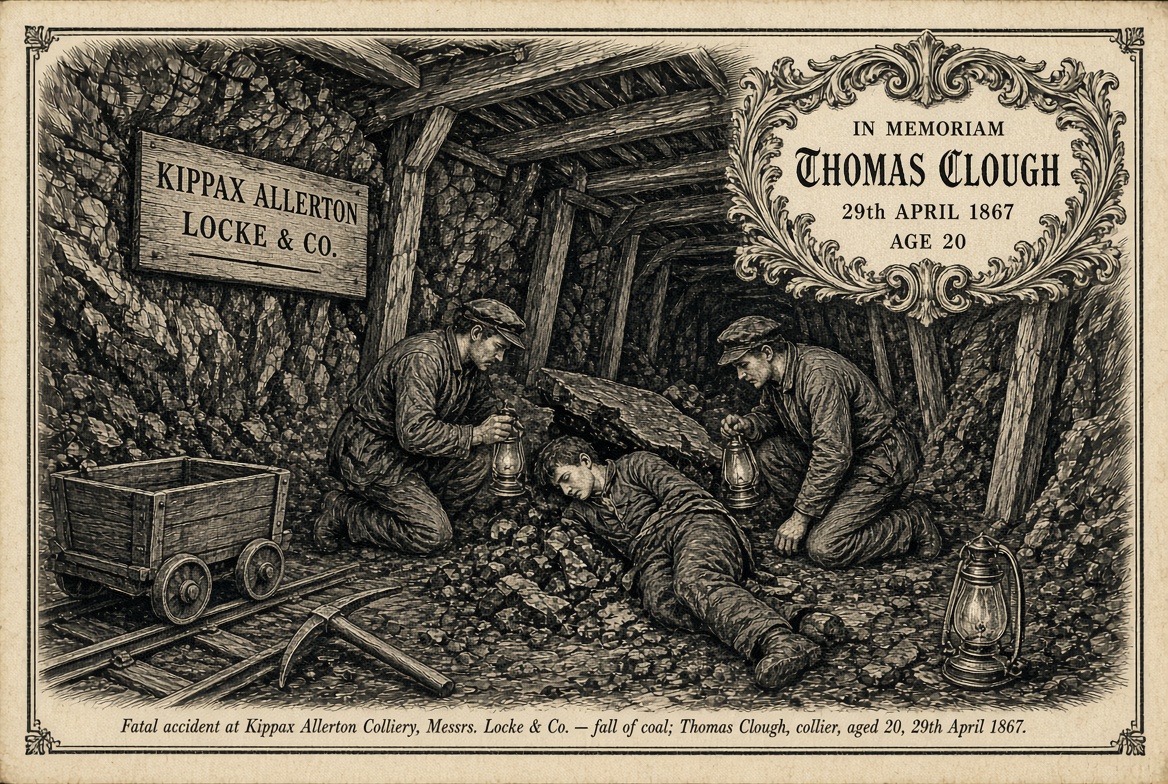
THOMAS CLOUGH
of Kippax, miner at Allerton Bywater
Born about 1847 · Died 29 April 1867, aged 19 or 20
The Leeds Evening Express of Friday 3 May 1867 described Thomas Clough as aged 19, a miner, residing at Kippax. The Coal Mining Accidents indexes and the Durham Mining Museum give age 20 and a birth year of about 1847. Both figures are compatible with a birth in 1847 or early 1848. No Kippax baptism page naming his parents has been produced for this note, so the household is not reconstructed.
He was still living in Kippax while working at the Allerton Bywater pit. Allerton Bywater had been taken out of Kippax parish by Order in Council in 1863; the new church of St Mary the Less was consecrated in 1865. Men from the old village continued to walk or ride to the shafts at Owl Wood and Allerton.
The newspaper names his employers as Messrs Lock & Waddington, at Allerton Bywater. The later compiled indexes shorten that to Lock and Co. or Locke and Co., and the pit to Kippax Allerton. Joseph Locke & Co. had sunk the Haigh Moor shafts at Owl Wood in 1858. By the mid-1860s the style Lock & Waddington appears in the local press for the same concern. Thomas was employed there as a collier — a face worker, not a surface boy.
Edward Bickerdike (January 1863) and William Firth (May 1863) had already been killed at Allerton Haigh Moor, Locke and Co. Thomas’s death four years later is a separate fall of coal at the face.
DMM still prints the burial as not known. No Kippax or Allerton Bywater burial page for late April or early May 1867 was among the documents supplied.
On Monday 29 April 1867 Thomas Clough was killed underground at the Allerton Bywater / Kippax Allerton pit. The compiled mining indexes give the cause as a fall of coal. He was a collier, so the fall was at the working face: a block of coal coming away from the face or from the holing after the coal had been undercut.
The Durham Mining Museum abstract reads: Thomas Clough; age 20; died 29 April 1867; accident 29 April 1867; year born about 1847; colliery Kippax Allerton; company Lock and Co.; occupation collier; notes: fall of coal.
The newspaper of the following Friday does not add the mechanism. It only records that he was killed accidentally whilst at work in the pit. No printed inspector’s narrative for this particular entry has been found in the open abstracts (DMM’s individual page for him does not cite a page in the 1867 Mines Inspectors Report).
The paper was No. 548, Vol. IX, published every afternoon at four o’clock, price one halfpenny. In the Local and District column it printed this paragraph:
Thomas Clough, aged 19, miner, residing at Kippax, in the employment of Messrs Lock & Waddington, at Allerton Bywater, has been killed accidentally whilst at work in the pit.
That is a short death notice, not a report of an inquest. It was printed four days after the accident, which is the usual interval after a coroner’s sitting and the release of the body.
No full inquest transcript has been found. Inquests on pit deaths around Kippax were normally held by the coroner for the honour or borough of Pontefract. The Express wording — killed accidentally whilst at work in the pit — is the verdict the paper chose to print. The official mining classification is accidental death by a fall of coal.
The Leeds Evening Express, Friday 3 May 1867, No. 548, Vol. IX, Local and District: Thomas Clough, aged 19, miner, residing at Kippax, Messrs Lock & Waddington, Allerton Bywater, killed accidentally whilst at work in the pit.
Durham Mining Museum, individual page: Thomas Clough, age 20, died 29 April 1867, Kippax Allerton, Lock and Co., collier, fall of coal.
UK, Coal Mining Accidents and Deaths Index, 1878–1951: Thomas Clough, age 20, born about 1847, 29 April 1867, Castleford, Lock and Co., collier, Fall of Coal.
UK, Coal Mining Accidents and Deaths Index, 1878–1935: same man; colliery Kippax Allerton; owner Lock and Co.; notes Fall of coal.
Alan Beales, England, Mining Disaster Victims: Thomas Clough, born 1847, age 20, 29 April 1867, Kippax.
Allerton Bywater Parish Council, Kippax Colliery: shafts sunk 1858 by Joseph Locke & Co. at Owl Wood, Haigh Moor seam.
Kelly’s Directory (later Allerton Bywater entry): Locke and Co. among the firms working pits at Allerton.
Age. The newspaper of 3 May 1867 says 19. The mining indexes and DMM say 20. Both are kept. Neither is an obvious error; they differ by the usual year of age.
Date. 29 April 1867 is consistent across DMM and both commercial indexes. The newspaper is 3 May, the day the notice was printed, not the day he died.
Employer. Use the contemporary newspaper form Messrs Lock & Waddington as well as Locke / Lock and Co. Waddington is dropped in the later compiled lists and should not be deleted from the 1867 notice.
Place. Castleford in the commercial index is the registration town. The pit is Allerton Bywater / Kippax Allerton. He lived at Kippax.
Cause. The newspaper says only killed accidentally in the pit. The inspector-derived indexes specify a fall of coal. Both stand; the more precise cause is the official mining one.
Burial. Still not found.
A GRO death certificate, Castleford or Pontefract district, April–June 1867, would settle age and informant.