
JOSEPH HEWITT
Staithman, Locke and Co., Kippax Colliery
Died 5 November 1868 · Buried 8 November 1868
1. Life
Age and residence
Frank N. Wardell, the Yorkshire inspector of mines, recorded Joseph Hewitt as aged 66 in November 1868, which implies a birth about 1802. The burial register at St Mary’s, Kippax, three days later, gives age 60. Alan Beales’s compiled list gives birth year 1803 and age 65. The three figures are not reconciled without a baptism or a GRO certificate. What is certain is that he was an elderly surface worker living at Kippax.
The burial entry is no. 347 on page 130 of the Kippax register for 1868: Joseph Hewitt, abode Kippax, buried 8 November, age 60, E. D. Bland, Vicar. West Yorkshire Archive Service reference P47/26. DMM still prints the burial as not known; the register supplied with this research fills that gap.
Work
He was a staithman for Locke and Co. at Kippax Colliery. A staithman worked the coal staithe — the riverside or canal-side wharf where tubs were tipped into barges. From 1858 coal from the Owl Wood / Haigh Moor shafts was carried south on a tramway over the road to the coal staithe on the Aire and Calder Navigation. That tramway is the line on which he was killed.
He is not the same man as Robert Hewitt of Kippax (baptised 1803, coal miner, buried 1877), nor John Locke Hewitt who heads a Kippax household in 1871. No baptism naming Joseph’s parents has been produced for this note, so the household is not reconstructed.
2. The accident
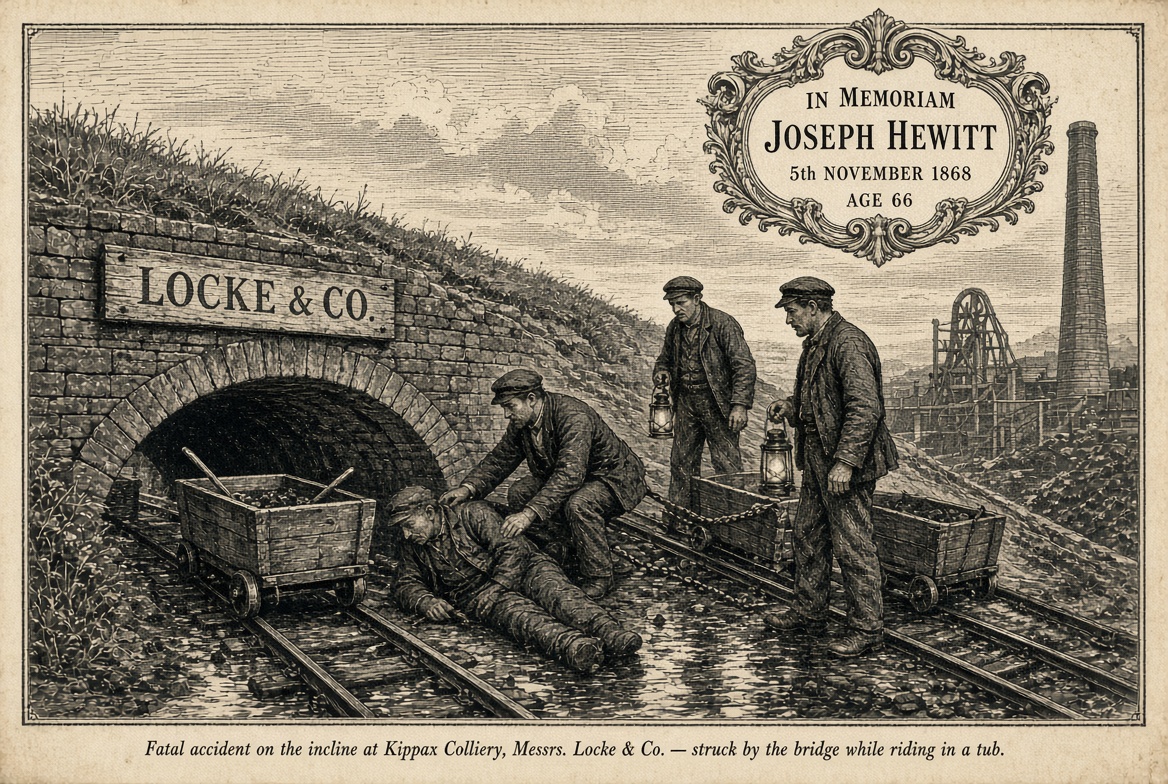
On Thursday 5 November 1868 Joseph Hewitt was killed on the surface incline that joined the Kippax Colliery staiths to the pit. He was not underground. He was not killed by a fall of roof.
Wardell printed the case as accident no. 67 in his 1868 Yorkshire report (narrative at page 155; table at page 161). The Durham Mining Museum transcript of that narrative is as follows.
There is a tramway connecting the staiths with Kippax Colliery, on which this accident occurred. The colliery is the property of Messrs. Locke and Co., and is situated near Normanton. The deceased, Joseph Hewitt, was riding up to the pit in one of the tubs on this incline, — the men having permission so to do, — when he lost his stick into the tub next that in which he was seated, and during his attempt to regain it his head came in contact with a bridge, thereby dislocating his neck. The tramway at this bridge passes under the highway. There was no violation of any rule, and the accident can only be attributable to the poor man’s forgetfulness of the danger, he having constantly travelled in the same way before.
My opinion was that if men were allowed to travel in this manner, they should only do so at stated times, and then under the charge of one steady and careful man who would be responsible for their taking proper precautions to avoid similar accidents.
The short DMM note on the individual page is the same event in one line: while riding in a tub on an incline his head came against a bridge underneath which the tubs ran. Occupation: staithman. Age: 66.
The commercial Coal Mining Accidents index and Beales both print Fall of Roof. That is a classification error. Wardell’s own words are the authority.
3. Coroner, newspaper and conclusion
No separate coroner’s transcript and no Leeds or Pontefract newspaper paragraph naming Joseph Hewitt have been found in the open indexes searched for this note. Wardell’s printed opinion, written after he had seen the place, stands in place of those missing texts.
Conclusion. Accidental death. Joseph Hewitt, staithman, Locke and Co., Kippax, 5 November 1868. He was riding in a permitted tub on the staith-to-pit incline, reached for a dropped stick, and struck his head on the highway bridge that the tramway passed under. His neck was dislocated. No rule of the colliery was broken. Wardell thought the practice of riding the incline should be confined to set times and placed under one responsible man.
He was buried at St Mary’s, Kippax, on Sunday 8 November 1868.
4. Sources and citations
West Yorkshire Archive Service, Leeds: Kippax St Mary burial register, 1868, p. 130, no. 347. Joseph Hewitt, Kippax, 8 November 1868, age 60; E. D. Bland, Vicar. Reference P47/26.
Frank N. Wardell, H.M. Inspector of Mines, 1868 Mines Inspectors Report, Yorkshire District, p. 155 (narrative) and p. 161, accident no. 67.
Durham Mining Museum, individual page and disaster page: Joseph Hewitt, age 66, died 5 November 1868, Kippax, Locke and Co., staithman; riding a tub on the incline, head against a bridge.
UK, Coal Mining Accidents and Deaths Index: Joseph Hewitt, age 66, born about 1802, 5 November 1868, Normanton, Locke and Co., staithman — description Fall of Roof (corrected from Wardell).
Alan Beales, England, Mining Disaster Victims: Joseph Hewitt, born 1803, age 65, 5 November 1868, Kippax, fall of roof (corrected from Wardell).
Allerton Bywater Parish Council, Kippax Colliery: from 1858 coal carried south on a tramway over the road to the coal staithe on the Aire and Calder Navigation.
5. Corrections
Cause. Not a fall of roof. That wording in CMA&DI and in Beales is wrong. Wardell: riding a tub on the staith incline; head struck the highway bridge; neck dislocated.
Place of work. Surface / incline, not underground. Occupation staithman is the clue the compiled indexes kept while mis-labelling the cause.
Age. Burial register 60; inspector and CMA 66; Beales 65. All three are recorded. The inspector’s 66 is the figure used in the official table.
Place-name. Normanton in the commercial index is Wardell’s nearest town. The pit and the burial are Kippax. The tramway ran from the Aire staithe up to Kippax Colliery and passed under the highway.
Burial. DMM “not known” is filled by Kippax no. 347, 8 November 1868.
Identity. Not Robert Hewitt (d. 1877) and not John Locke Hewitt of the 1871 census.
A GRO death certificate would settle the age given to the registrar.