

Thomas Wright
WILLIAM FIRTH
Allerton Haigh Moor Colliery, Locke and Co.
Killed 11 May 1863 · Age not recorded by the inspector
No baptism, marriage, census household or burial register has yet been tied to this William Firth with the same certainty as the inspector’s accident entry. Firth was the most common surname in nineteenth-century Kippax. Attaching a particular christening or a particular widow without a burial age, a GRO certificate, or a newspaper naming next of kin would be guesswork. This note therefore records what is proved about the death and leaves the private life open.
He was employed at Locke and Co.’s Allerton Haigh Moor Colliery in May 1863. That pit worked the Haigh Moor seam from the shafts sunk in 1858 at Owl Wood, between Kippax and Allerton Bywater. Edward Bickerdike of Kippax had been killed at the same colliery, by a brick falling in the shaft, on 27 January 1863 — fourteen weeks earlier. Both deaths stand on the same page of Charles Morton’s 1863 report (accidents no. 8 and no. 24).
Allerton Bywater was still in Kippax parish until an Order in Council of 1863 created a separate parish; the foundation stone of the new church was laid on 31 August 1863, after William’s death. Men from Kippax village walked or rode to these shafts.
Charles Firth, aged about 60, killed in 1886 at a Locke / Kippax pit (run over by corves), is a later death.
William Firth of Rastrick, farmer, buried 3 August 1865 aged 58, is a different parish and a different year.
William Briggs Firth of Leeds, magistrate and ironmaster, who read a paper on coal-cutting machinery in 1863, was still alive in the 1870s.
William Firth, colliery proprietor of Shipley, died 24 March 1884.
The Durham Mining Museum still prints the burial as not known. No Kippax St Mary burial page for May 1863 was among the documents supplied for this note. St Mary’s remained the parish church for Kippax men; Allerton Bywater’s own church was not yet built.
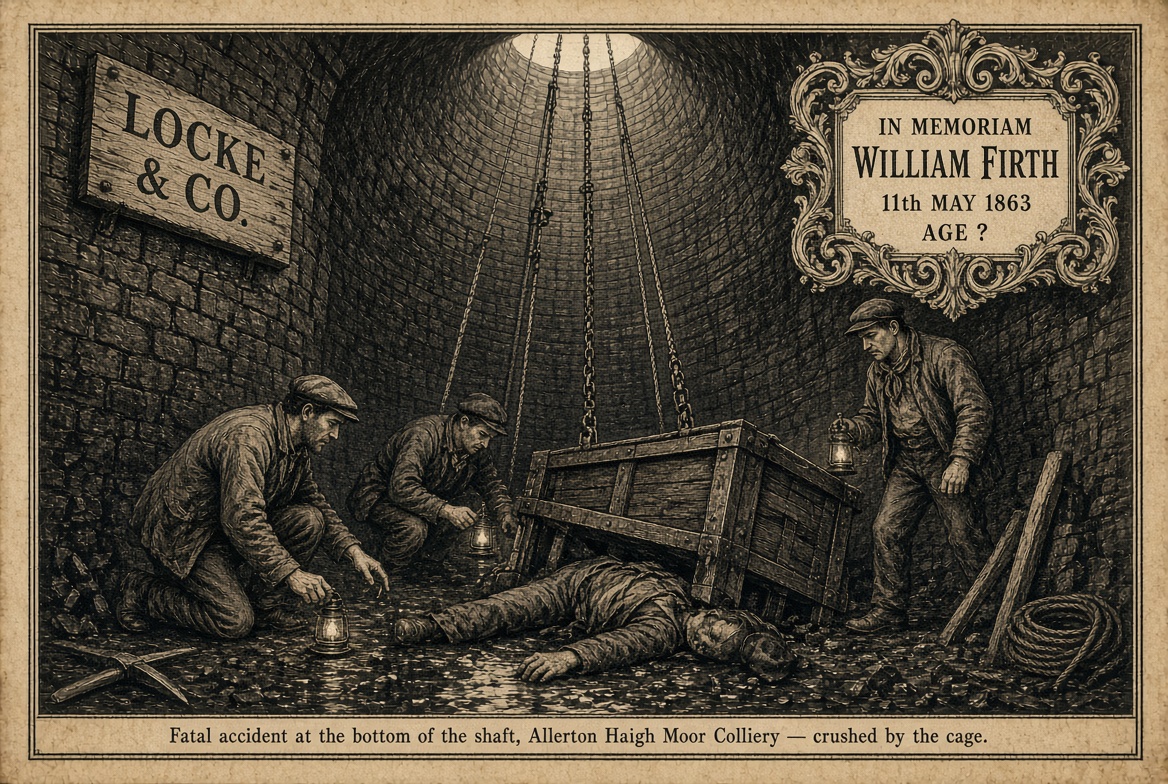
On Monday 11 May 1863 William Firth was killed at Allerton Haigh Moor Colliery, the property of Locke and Co. The official cause is that he was crushed at the bottom of the shaft.
Charles Morton, H.M. Inspector of Mines, entered the case as accident no. 24 in his 1863 report, printed at page 182. The Durham Mining Museum abstract taken from that report reads: William Firth; died 11 May 1863; accident 11 May 1863; colliery Allerton Haigh Moor; company Locke and Co.; notes: crushed at the bottom of the shaft.
Crushing at the shaft bottom usually means the cage, or a loaded tub or baulk descending the shaft, came down on a man who was standing or working in the sump or at the inset. Morton’s printed table does not say whether the cage was lowered onto him, whether a tub left the cage, or whether he was struck by something falling from above. Those particulars are not in the open abstract. The commercial Coal Mining Accidents and Deaths Index uses the same wording: Crushed in the Bottom of the Shaft.
The same commercial index places the accident at Leeds. Leeds is the nearest large town. The pit was Allerton Haigh Moor, in the Kippax / Allerton Bywater township, then in the Pontefract registration district (Castleford sub-district).
No inquest transcript and no newspaper report naming this William Firth have been found in the open indexes searched for this note. Inquests on pit deaths around Kippax were normally held by the coroner for the honour or borough of Pontefract, often sitting at a village inn within a day or two of the body being brought up.
What stands in official form is Morton’s classification: accidental death by being crushed at the bottom of the shaft at Allerton Haigh Moor, Locke and Co., 11 May 1863; one life lost — William Firth.
Charles Morton, H.M. Inspector of Mines, 1863 Mines Inspectors Report, p. 182, accident no. 24.
Durham Mining Museum, individual page: William Firth, died 11 May 1863, Allerton Haigh Moor, Locke and Co., crushed at the bottom of the shaft.
UK, Coal Mining Accidents and Deaths Index: William Firth, 11 May 1863, Locke and Co., Crushed in the Bottom of the Shaft; place given as Leeds.
Alan Beales, England, Mining Disaster Victims: William Firth, 11 May 1863, Allerton Haigh Moor.
Charles Morton, same report, p. 182, accident no. 8: Edward Bickerdike, 27 January 1863, same colliery, fall of a brick in the shaft — for the sequence of deaths at this pit.
On Allerton Bywater parish: formed from Kippax by Order in Council, 1863; foundation stone 31 August 1863.
Date. 11 May 1863 is consistent across Morton, DMM, the Coal Mining Accidents index and Beales. No correction is required.
Place. Leeds in the commercial index is the nearest city. The pit is Allerton Haigh Moor, Locke and Co.
Age. Morton printed no age. Indexes that leave age blank are incomplete, not contradictory. Do not borrow an age from another William Firth.
Identity. Do not attach the Rastrick farmer (d. 1865), the Leeds ironmaster, the Shipley proprietor (d. 1884), or Charles Firth of 1886.
Burial. Still not found. DMM is correct to mark it unknown until a May 1863 Kippax (or Castleford) register page is produced.
A GRO death certificate for Firth, May 1863, Pontefract or Castleford district, would give age and informant’s name and should be the next document sought.

EDWARD BICKERDIKE
Edward Hesselgrave Bickerdike, of Kippax
Christened 17 May 1801 · Died 27 January 1863, aged 62
Edward Hesselgrave Bickerdike was christened on 17 May 1801 at the parish church of St Mary the Virgin, Kippax. The printed christening index gives the name as Edwd. Haslegrave Bickerdike and names his father Benjamin Bickerdike. Haslegrave / Hesselgrave is a second forename used in the family; later records call him Edward.
The burial register of 30 January 1863 gives his age as 62. That agrees with a birth shortly before the May 1801 christening. He was therefore sixty-one years and about eight months old when he was killed.
The Bickerdikes were a long-settled Kippax mining family. John Bickerdike married in the parish in the 1760s; Thomas Bickerdike married Mary Tate in 1764. Peter Bickerdike, a hewer at Locke and Co.’s Kippax West Main, was named by Charles Morton in 1858 as the man whose failure to set sprags caused the death of the boy Benjamin Pickard. That Peter belongs to the same village kinship, not necessarily the same household.
Edward married Eliza Beeston. Their son Charles was christened at Kippax on 19 December 1841. Edward appears as head of a household in Kippax on the censuses of 1841, 1851 and 1861, living with his wife and children throughout.
By the 1860s Locke and Co. were working the Haigh Moor seam from the shafts sunk in 1858 at Owl Wood, between Kippax and Allerton Bywater. The official name of the pit in the 1863 inspector’s table is Allerton Haigh Moor. Edward was employed there at the time of his death. He was then in his early sixties, still going underground or into the shaft — the accident itself took place in the shaft, not at the face.
Edward was killed on Tuesday 27 January 1863. He was buried at St Mary’s, Kippax, on Friday 30 January 1863. The burial register, page 80, entry no. 338, reads: Edward Bickerdike, abode Kippax, 30 January, age 62, E. D. Bland, Vicar. West Yorkshire Archive Service reference P47/26.
Burial three days after the accident is the usual interval where an inquest had to sit. The same register page records Jane Bickerdike, buried 18 January 1863 aged 73 — an older kinswoman, not his wife. Civil registration of the death falls in the Castleford / Pontefract area; compiled trees give Castleford as the registration place.
DMM still marks the burial as not known. The parish register supplied with this research fills that gap.
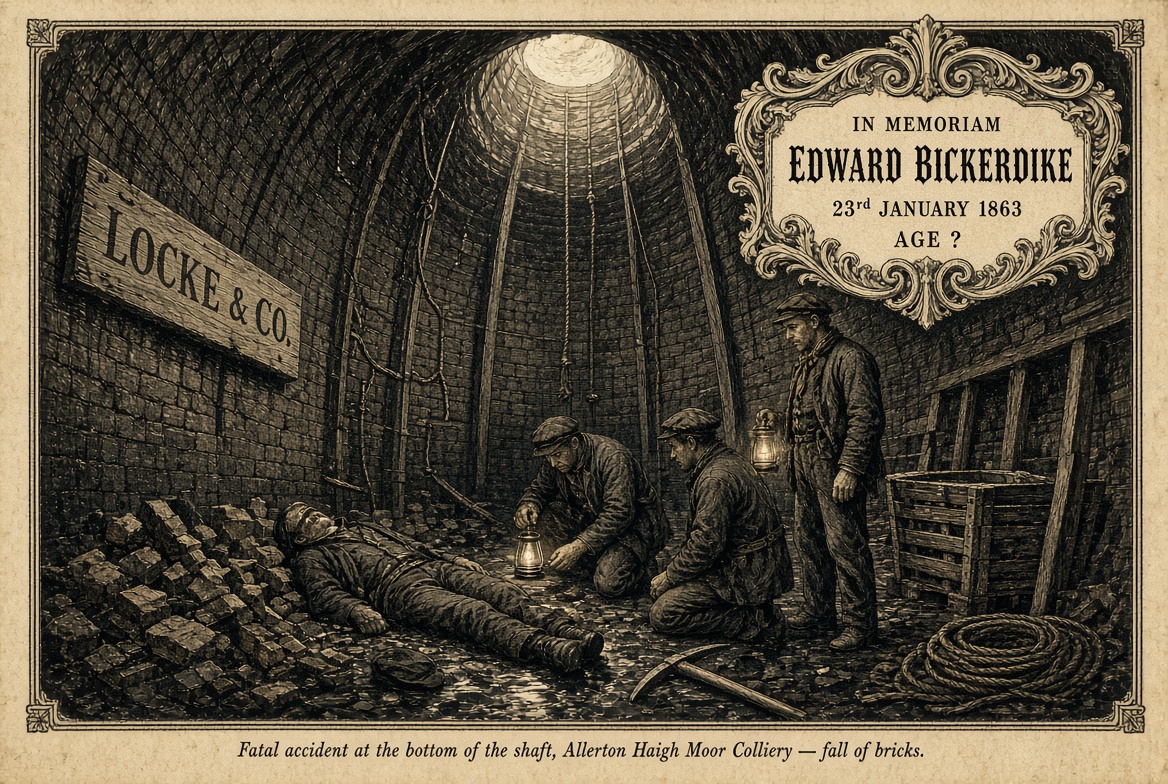
On 27 January 1863 Edward Bickerdike was killed at Allerton Haigh Moor Colliery, the property of Locke and Co. The official cause is the fall of a brick in the shaft.
Charles Morton, H.M. Inspector of Mines, entered the case as accident no. 8 in his 1863 report, printed at page 182. The Durham Mining Museum abstract taken from that report reads: Edward Bickerdike; died 27 January 1863; accident 27 January 1863; colliery Allerton Haigh Moor; company Locke and Co.; notes: fall of a brick in the shaft.
A shaft lining of brick or a brick used in shaft repairs can come away from the wall and fall the full depth of the shaft. A man at the bottom, or riding in the cage, has no cover against it. Morton’s printed table does not add whether Edward was ascending, descending, or standing at the shaft foot, nor whether the brick was loose lining or a brick dropped from the surface. Those particulars are not in the open abstract.
The commercial Coal Mining Accidents and Deaths Index gives the same date, employer (written Lock and Co.) and description, and places the accident at Leeds. Leeds is the nearest large town. The pit was Allerton Haigh Moor, in the Kippax / Allerton Bywater parish, Pontefract then Castleford registration.
No inquest transcript and no newspaper report naming Edward Bickerdike have been found in the open indexes searched for this note. Inquests on pit deaths around Kippax were normally held by the coroner for the honour or borough of Pontefract, often sitting at a village inn within a day or two of the body being brought up.
What stands in official form is Morton’s classification: accidental death by the fall of a brick in the shaft at Allerton Haigh Moor, Locke and Co., 27 January 1863; one life lost — Edward Bickerdike.
Burial on 30 January is consistent with an inquest opened on the Wednesday or Thursday and the body then released to the family.
England Births and Christenings, 1538–1975 (FamilySearch): Edwd. Haslegrave Bickerdike, 17 May 1801, Kippax; father Benjamin Bickerdike. FHL film 496,807.
West Yorkshire Archive Service, Leeds: Kippax St Mary burial register, 1863, p. 80, no. 338. Edward Bickerdike, Kippax, 30 January 1863, age 62; E. D. Bland, Vicar. Reference P47/26.
England and Wales Census, 1841: Edward Bickerdike, Kippax. FamilySearch MQGP-NWG.
England and Wales Census, 1851 and 1861: Edward Bickerdike, Kippax, with wife and children. FamilySearch 1861 M7JB-SPT.
England Births and Christenings: Charles Bickerdike, 19 December 1841, son of Edward Bickerdike and Eliza Beeston.
Charles Morton, H.M. Inspector of Mines, 1863 Mines Inspectors Report, p. 182, accident no. 8.
Durham Mining Museum, individual page: Edward Bickerdike, died 27 January 1863, Allerton Haigh Moor, Locke and Co., fall of a brick in the shaft.
UK, Coal Mining Accidents and Deaths Index: Edward Bickerdike, 27 January 1863, Lock and Co., Fall of A Brick in the Shaft.
Alan Beales, England, Mining Disaster Victims: Edward Bickerdike, event date 23 January 1863, Allerton Haigh Moor — date corrected below.
WikiTree Bickerdike-16: Edward Hesselgrave Bickerdike (bef. 17 May 1801 – 27 January 1863), compiled from the parish and census sources above.
Date of accident. The Beales / MDV transcript gives 23 January 1863. Morton, DMM, the Coal Mining Accidents index and the compiled death date all give 27 January 1863. Burial on 30 January fits a death on the 27th. The 23rd is treated as a copying error.
Burial is not before death. The parish burial is 30 January. The official death is 27 January. There is no contradiction once the 23 January index date is set aside.
Age. Burial age 62 agrees with the christening of 17 May 1801. No correction is required.
Employer spelling. Lock and Co. in the commercial index is Locke and Co.
Place. Leeds in the commercial index is the nearest city. The pit is Allerton Haigh Moor (Owl Wood / Allerton Bywater), Locke and Co. Civil registration is the Castleford / Pontefract area. Abode at burial is Kippax.
DMM burial. DMM still prints burial as not known. The Kippax register, no. 338, 30 January 1863, supplies it.
Jane Bickerdike. Jane, buried 18 January 1863 aged 73, is a separate entry on the same register opening. She is not Edward’s wife Eliza.
If a Pontefract or Leeds newspaper for late January 1863 is later abstracted, the coroner’s wording should be added to section 3.