
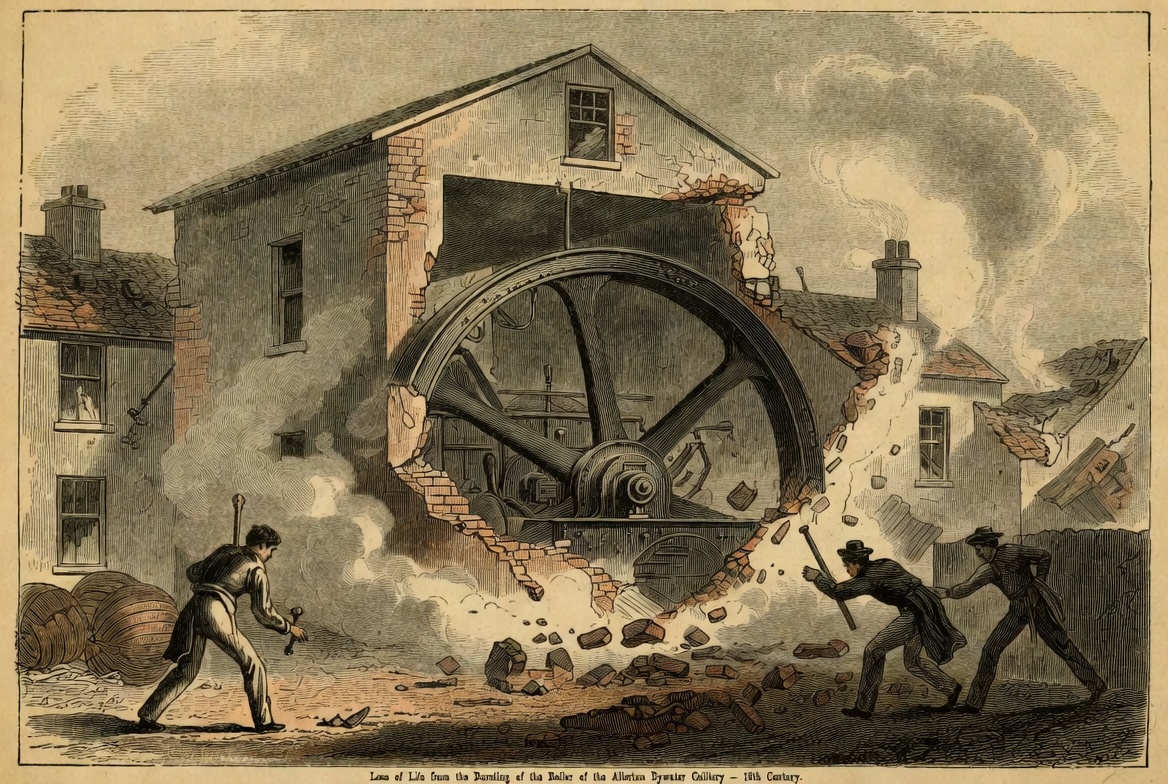
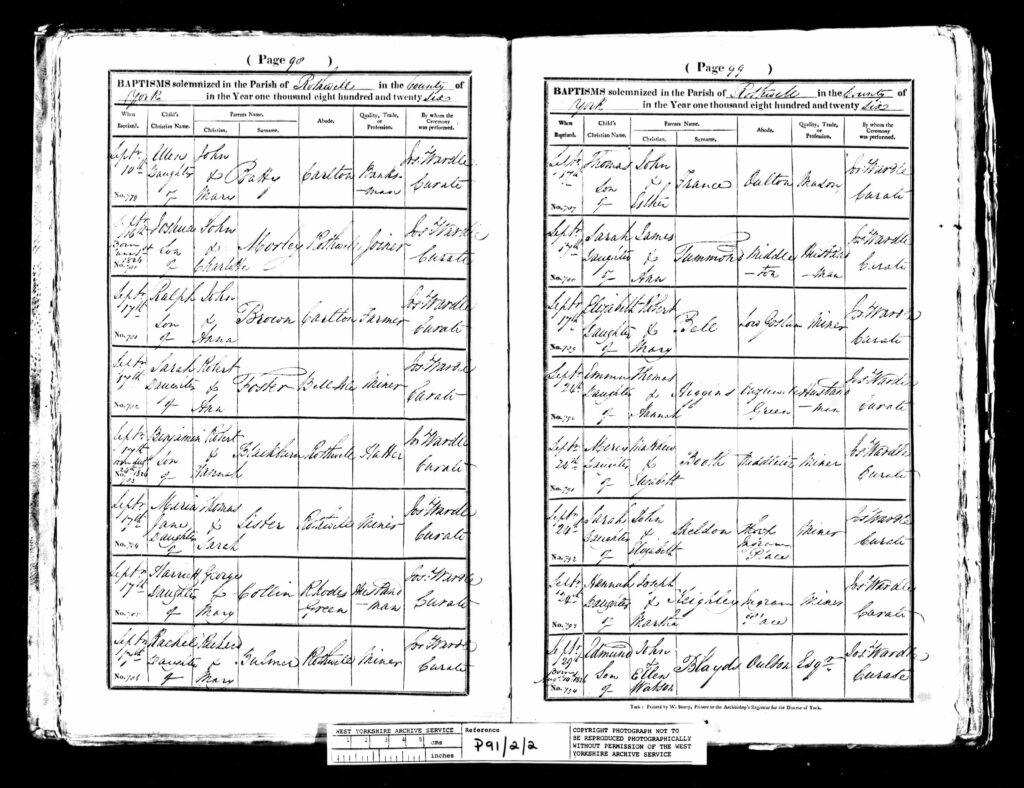
Ralph Brown was born in 1826 to John & Anna, farmers from Carlton
Baptism Register – September 17th 1826 at Rothwell church
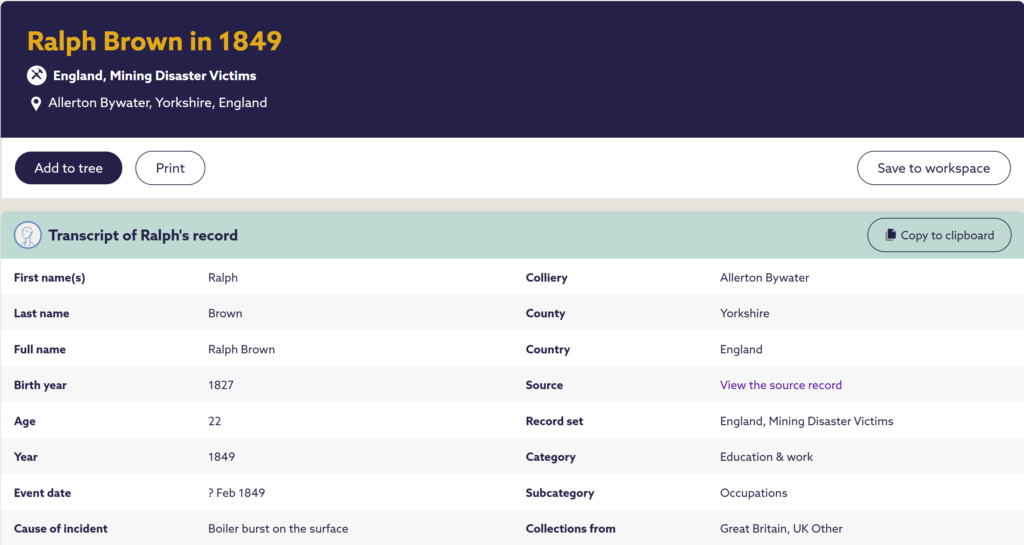
Leeds Intelligencer March 3rd 1849

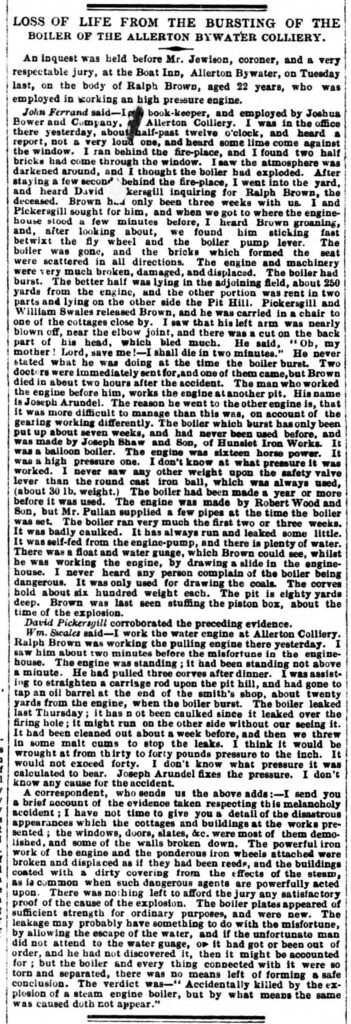
Transcript of acrticle
LOSS OF LIFE FROM THE BURSTING OF THE
BOILER OF THE ALLERTON BYWATER COLLIERY.
An inquest was held before Mr. Jewison, coroner, and a very
respectable jury, at the Boat Inn, Allerton Bywater, on Tuesday
last, on the body of Ralph Brown, aged 22 years, who was
employed in working an high pressure engine.
John Ferrand said – I am a book-keeper, and employed by Joshua
Bower and Company at Allerton Colliery. I was in the office
there yesterday, about half-past twelve o’clock, and heard a
report, not a very loud one, and heard some lime come against
the window. I ran behind the fire-place, and I found two half
bricks had come through the window. I saw the atmosphere was
darkened around, and I thought the boiler had exploded. After
staying a few seconds behind the fire-place, I went into the yard,
and heard David Pickersgill inquiring for Ralph Brown, the
deceased. Brown had only been three weeks with us. I and
Pickersgill sought for him, and when we got to where the engine-
house stood a few minutes before, I heard Brown groaning,
and, after looking about, we found him sticking fast
betwixt the fly wheel and the boiler pump lever. The
boiler was gone, and the bricks which formed the seat
were scattered in all directions. The engine and machinery
were very much broken, damaged, and displaced. The boiler had
burst. The better half was lying in the adjoining field, about 250
yards from the engine, and the other portion was rent in two
parts and lying on the other side the Pit Hill. Pickersgill and
William Swales released Brown, and he was carried in a chair to
one of the cottages close by. I saw that his left arm was nearly
blown off, near the elbow joint, and there was a cut on the back
part of bis head, which bled much. He said, “Oh, my
mother! Lord, save me! – I shall die in two minutes.” He never
stated what he was doing at the time the boiler burst. Two
doctors were immediately sent for, and one of them came, but Brown
died in about two bours after the accident. The man who worked
the engine before him, works the engine at another pit. His name
is Joseph Arundel. The reason he went to the other engine is, that
it was more difficult to manage than this was, on account of the
gearing working differently. The boiler which burst has only been
put up about seven weeks, and had never been used before, and
was made by Joseph Shaw and Son, of Hunslet Iron Works. It
was a balloon boiler. The engine was sixteen horse power. It
was a high pressure one. I don’t know at what pressure it was
worked. I never saw any other weight upon the safety valve
lever than the round cast iron ball, which was always used,
(about 30 1b. weight.) The boiler had been made 8 year or more
before it was used. The engine was made by Robert Wood and
Son, but Mr. Pullan supplied a few pipes at the time the boiler
was set. The boiler ran very much the first two or three weeks.
It was badly caulked. It was always run and leaked some little.
It was self-fed from the engine-pump, and there is plenty of water.
There was a float and water guage, which Brown could see, whilst
be was working the engine, by drawing a slide in the engine-
house. I never heard any person complain of the boiler being
dangerous. It was only used for drawing the coals. The corves
hold about six hundred weight each. The pit is eighty yards
deep. Brown was last seen stuffing the piston box, about the
time of the explosion.
David Pickersgill corroborated the preceding evidence.
Wm. Swales said – I work the water engine at Allerton Colliery.
Ralph Brown was working the pulling engine there yesterday. I
saw him about two minutes before the misfortune in the engine-
house. The engine was standing it had been standing not above
a minute. He had pulled three corves after dinner. I was assist-
ing to straighten a carriage rod upon the pit hill, and had gone to
tap an oil barrel at the end of the smith’s shop, about twenty
yards from the engine, when the boiler burst. The boiler leaked
last Thursday ; it has not been caulked since it leaked over the
firing hole it might run on the other side without our seeing it.
It bad been cleaned out about a week before, and then we threw
in some malt cums to stop the leaks. I think It would be
wrought at from thirty to forty pounds pressure to the inch. It
would not exceed forty. I don’t know what pressure it was
calculated to bear. Joseph Arundel fixes the pressure. I don’t
know any cause for the accident.
A correspondent, who sends us the above adds: – I send you
a brief account of the evidence taken respecting this melancholy
accident ; I have not time to give you a detail of the disastrous
appearances which the cottages and buildings at the works pre-
sented ; the windows, doors, slates,etc. were most of them demo-
lished, and some of the wails broken down. The powerful iron
work of the engine and the ponderous iron wheels attached were
broken and displaced as if they bad been reeds, and the buildings
coated with a dirty covering from the effects of the steam,
as is Common when such dangerous agents are powerfully acted
upon. There was nothing left to afford the jury any satisfactory
proof of the cause of the explosion.
The boiler plates appeared of
sufficient strength for ordinary purposes, and were new. The
leakage may probably have something to do with the misfortune,
by allowing the escape of the water, and if the unfortunate man
did not attend to the water guage, or it had got or been out of
order, and he had not discovered it, then it might be accounted
for but the boiler and every thing connected with it were so
torn and separated, there was no means left of forming a safe
conclusion. The Verdict was – “Accidentally killed by the ex-
plosion of a steam engine boiler, but by what means the same
was caused doth not appear.”