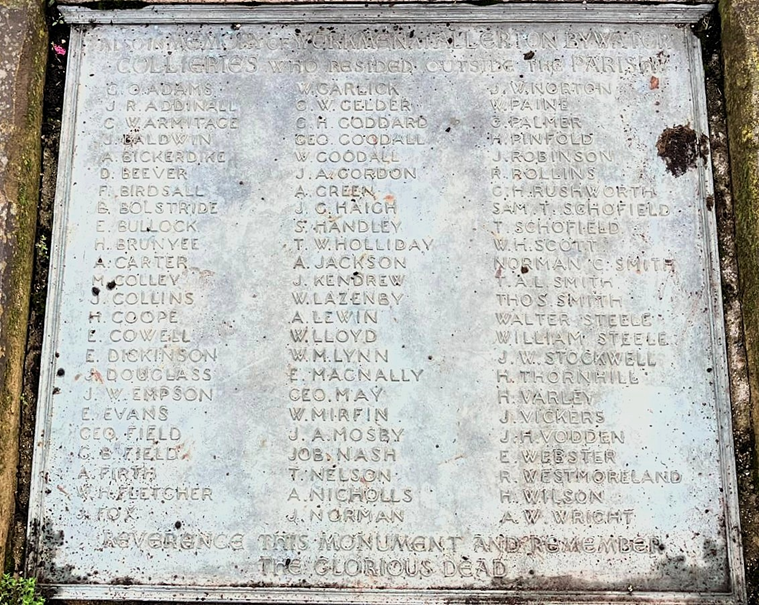
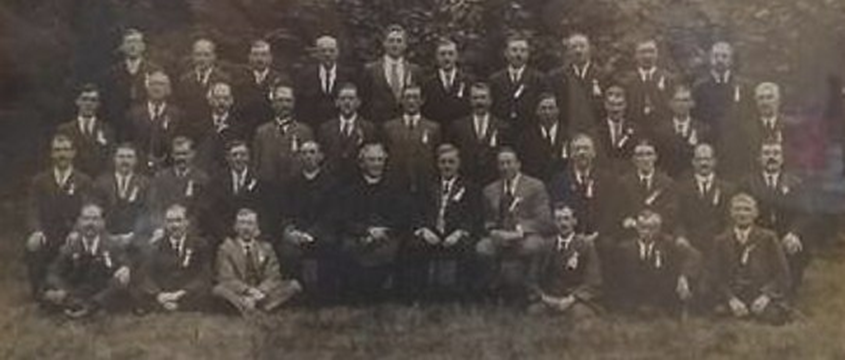
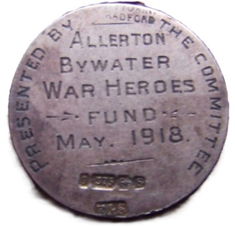
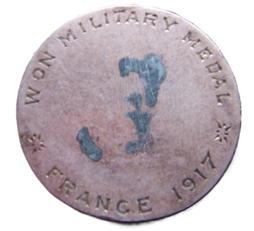
NOTE :- Some of this information may relate to LOCK LANE as this was classed as ALLERTON BYWATER – pubs such as The Griffin – Navigation Inn – Lord Nelson – Junction – are all listed as Allerton Bywater. Some calculated assumptions therefore, have been made as to the premises.
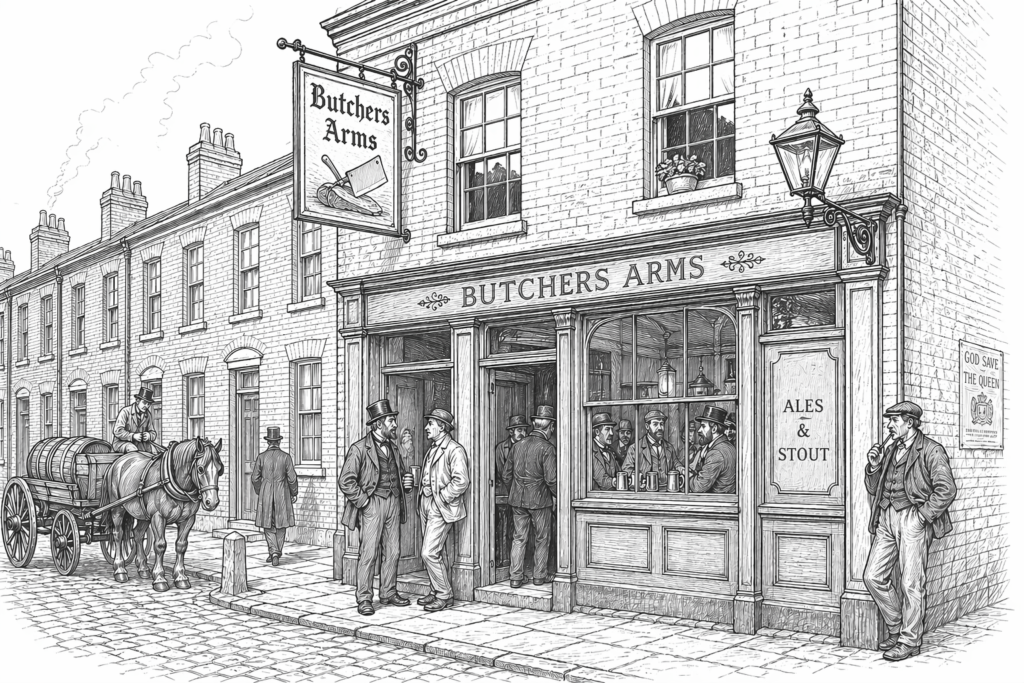
THE BUTCHERS ARMS
AS THE INTRODUCTION EXPLAINS, THIS CURIOUS JOURNEY BEGAN WITH THE DISCOVERY OF THE BUTCHER’S ARMS LOCATED IN ALLERTON BYWATER
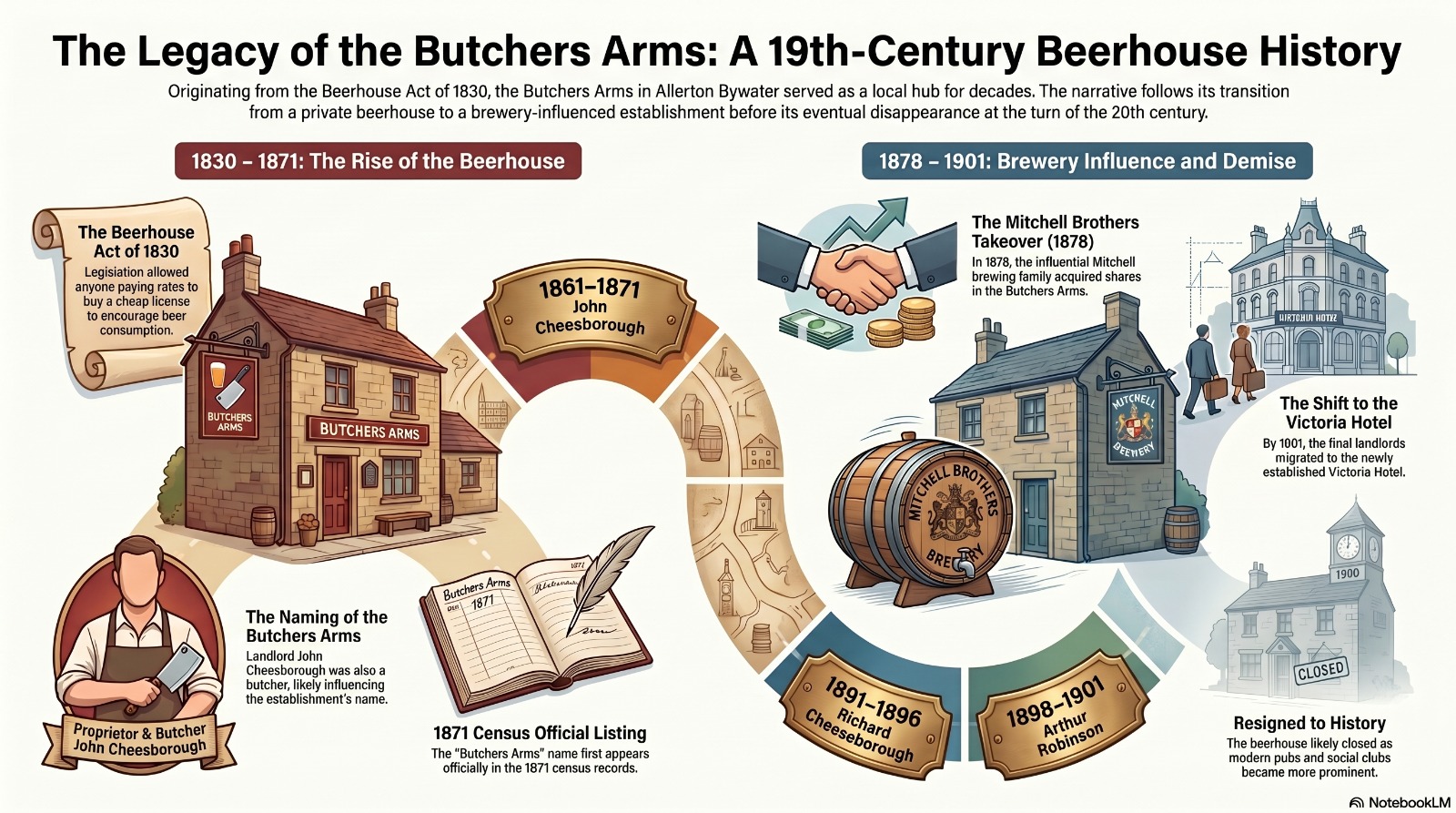
Beerhouses were a type of British drinking establishment created by the Beerhouse Act 1830 to encourage beer consumption over spirits. By allowing anyone paying rates to buy a cheap licence for two guineas, it sparked a boom, with 45,500 licenses issued by 1841. They were often converted private homes, initially enabling a competitive “free market” for beer.
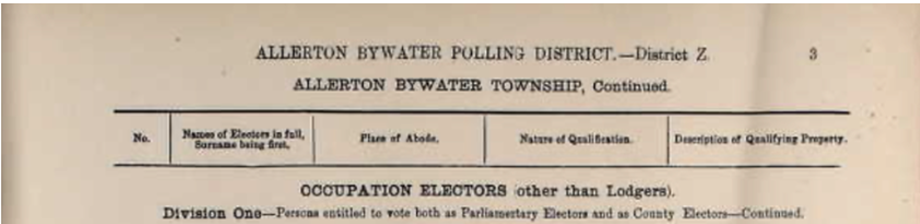
THE BUTCHERS ARMS APPEARS ON THE CENSUS OF 1871 and other recognisable names begin to appear.
Thomas Hutchinson – Anchor Inn
Samuel Atkinson – Angel Inn
Thomas Watson – Boat Inn
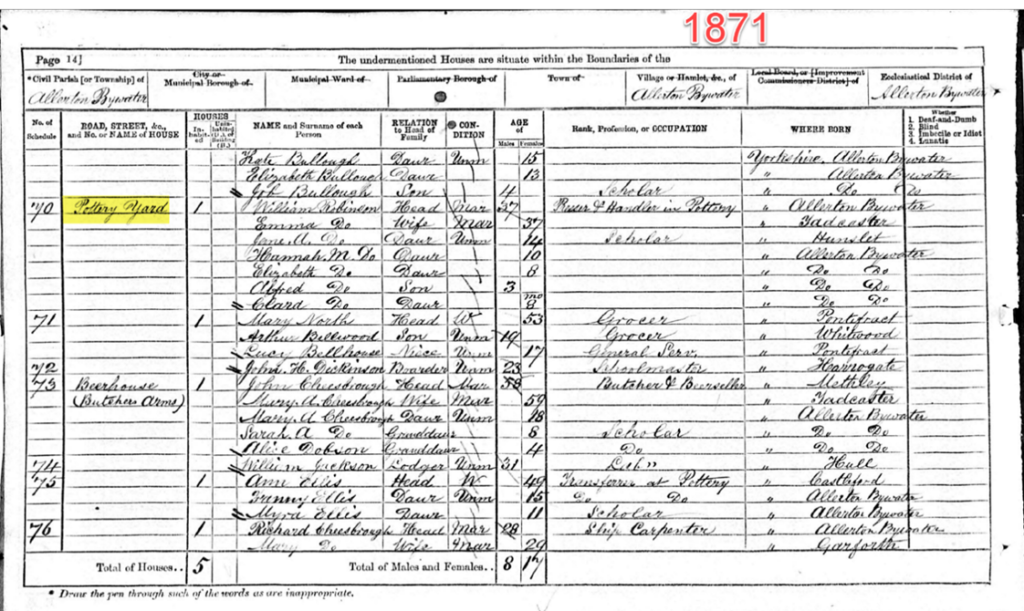
John Cheesborough – Butchers Arms – John Cheesborough, Wife Mary and Mary their daughter, also appear on the 1861 CENSUS, probably the same place. Notably, he is also a Butcher– could this have influenced the name ?
1878 – Electoral Registers The Mitchell Brothers, Benjamin, John and William have a share in the Butchers Arms
The Mitchell Brothers are from Castleford and own the Malt Kiln Brewery in Whitwood Mere.
They also have a sister Eliza Mitchell, who marries William Pickersgill, another brewer from Pontefract ( see The VICTORIA Inn )
NOTE – it is not surprising to find :- All these Mitchells are born in Bentley`s Brewery Buildings, Woodlesford where their father is a Master Brewer.
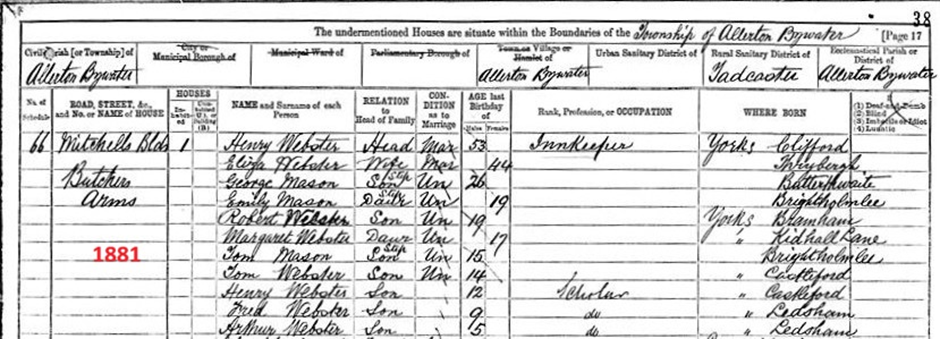
1881 CENSUS
The Inn Keeper at The Butchers Arms has Changed and it appears,the Mitchell Brothers, have had an influence on its residence — “ Mitchells Buildings “ – is this purely a name change, has it moved, are these NEW BUILT PREMISES? at this time it is unsure. MAYBE LATER it will be solved. However, it does appear that the Mitchell Family are quite affluent and influential ?
Henry Webster
Rhodes Steele
John Atkinson
Samuel Atkinson
1886 – Electoral Registers John Mitchell is still a shareholder in The Butchers Arms. Now living in Ledsham
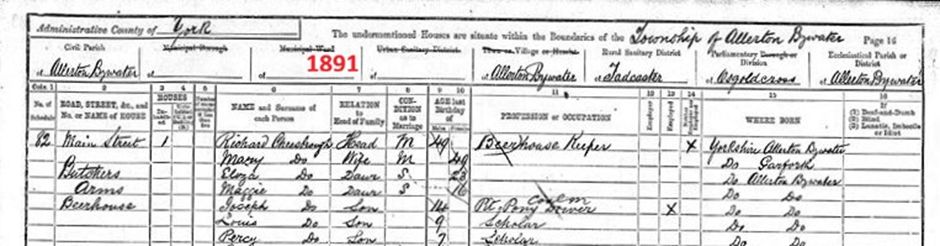
1891 CENSUS and Electoral Registers.
Richard Cheeseborough is the Beerhouse keeper of the Butchers Arms on Main Street, Allerton Bywater. — Beerhouse Keeper.
On the Electoral Registers, he also has an address at Pickersgill Cottages ( Butchers Arms Inn and Pickersgill Cottages )
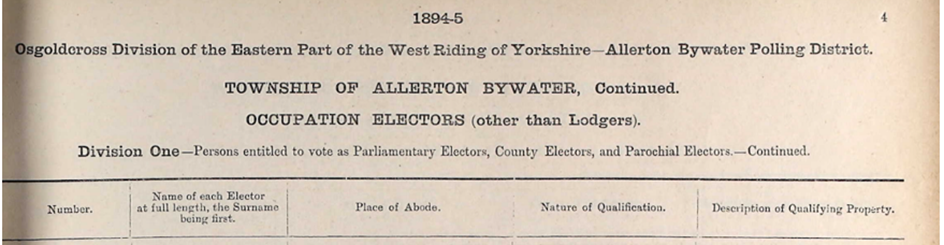
1894 Electoral Registers
On the electoral register of 1894 – Richard Cheeseborough is still at the Butcher’s Arms
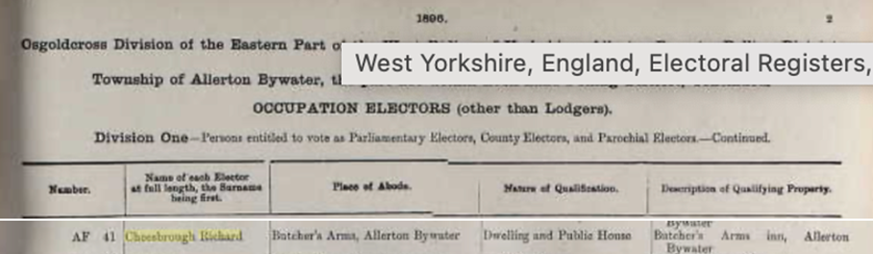
1896 – Electoral Registers
Richard Cheeseborough the Butcher’s Arms Inn
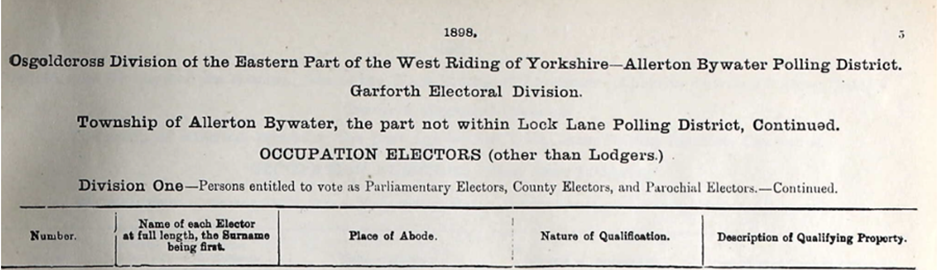
1898 Electoral Registers
Arthur Robinson is the occupant of Butcher’s Arms.
1901 CENSUS
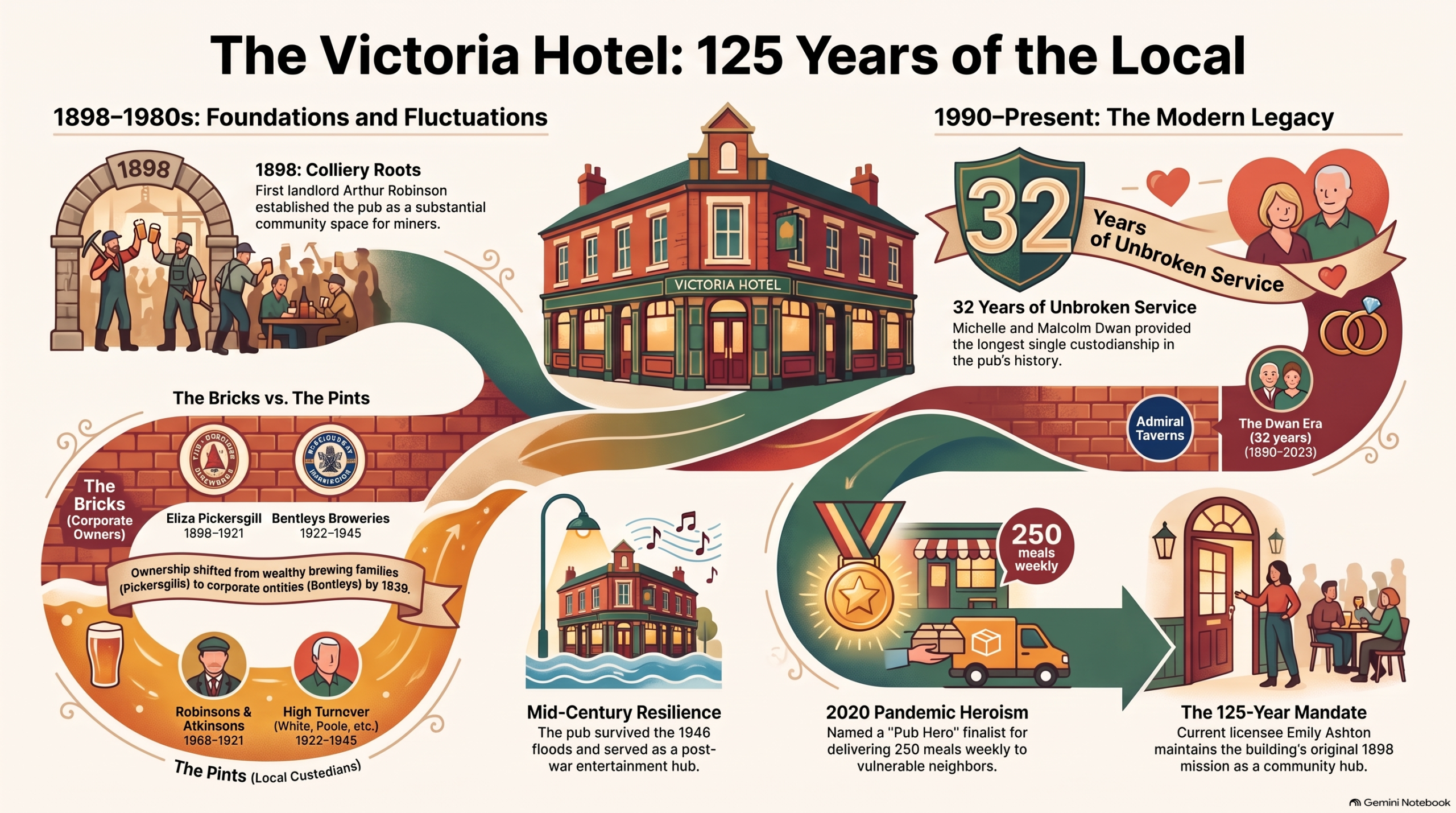
In the 1901 Census Arthur Robinson has moved to the Victoria Hotel established in 1898, he was probably the first landlord here.
1901 LICENSING ACT
1901 to 1902 On the 3rd of August 1901 Samuel and Mary Robinson have taken over as Licencees of the VICTORIA HOTEL and once again the Mitchell Family appear.
Eliza Mitchell has married William Pickersgill, a brewer from Pontefract and is now registered as the owner of the VICTOTIA HOTEL
This research has found no further information at this time.
It has to be assumed that as the PUBs and CLUBs manifested, the BEERHOUSEs met their demise and were resigned to history.
———————-
NOTE :- Limited information during this period is vague, it was gathered from available sources and local knowledge and recollection. Some calculated assumptions have been made.
******************************
( please contact if you have any proven information the following web site ) Allerton Bowers History
*******************************
Note: This report is an open historical documentary based on the most current and comprehensive sources available as of April 2026. Further research, particularly in local archives and through community engagement, may yield additional information and insights.
Readers and researchers are encouraged to contribute `proven` new findings to the ongoing documentation of the BUTCHERS ARMS history.
The River Aire was once an essential transport route.
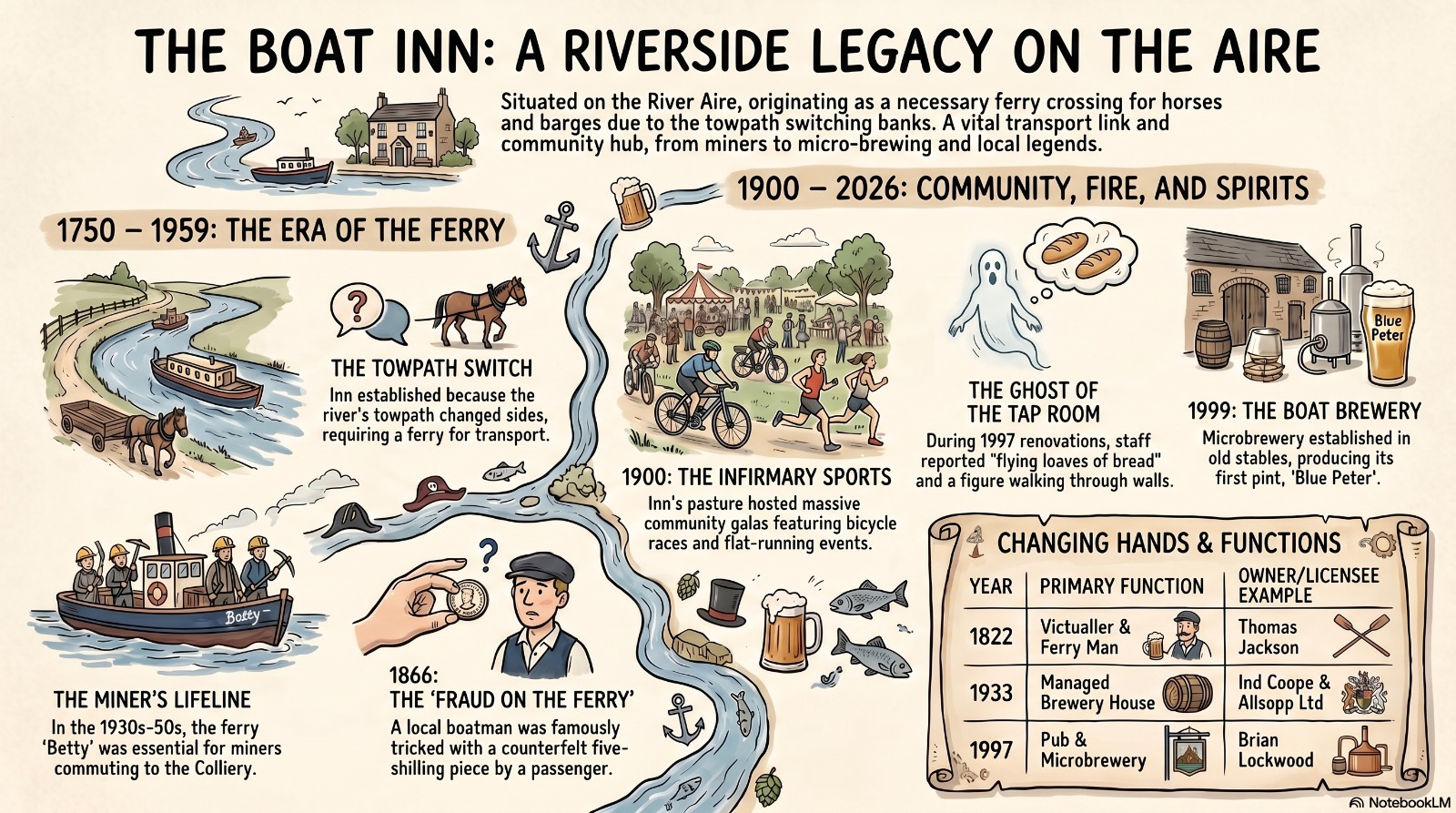
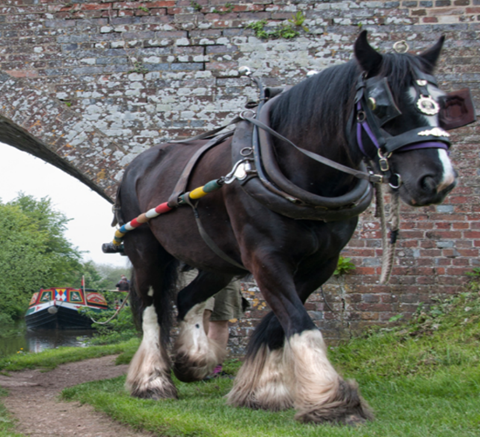
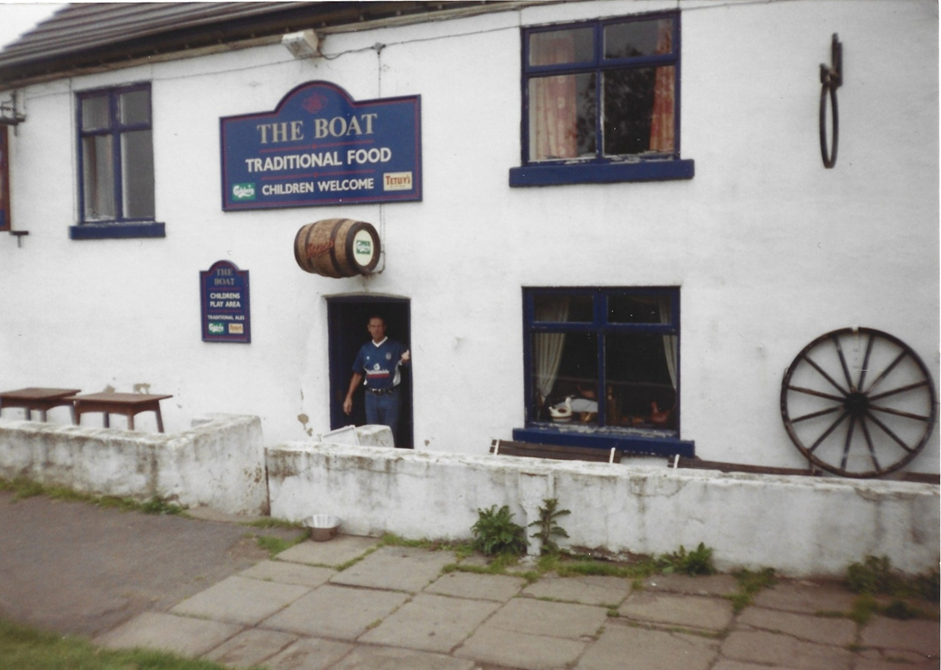
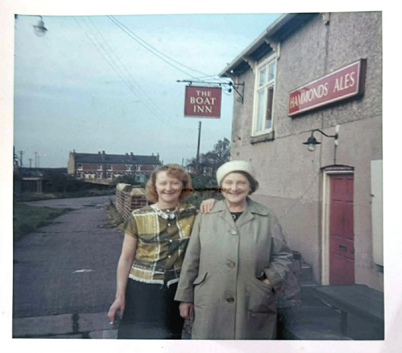
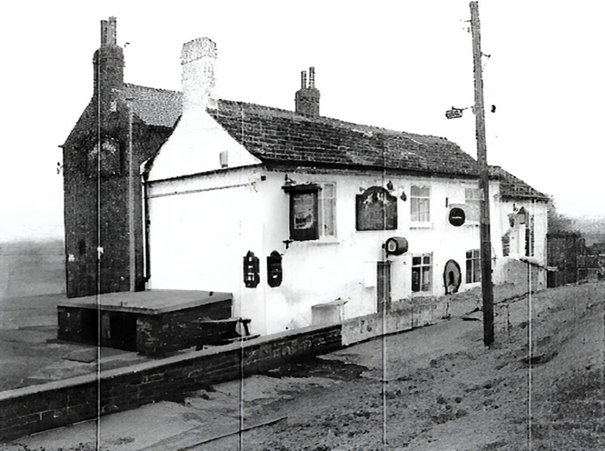
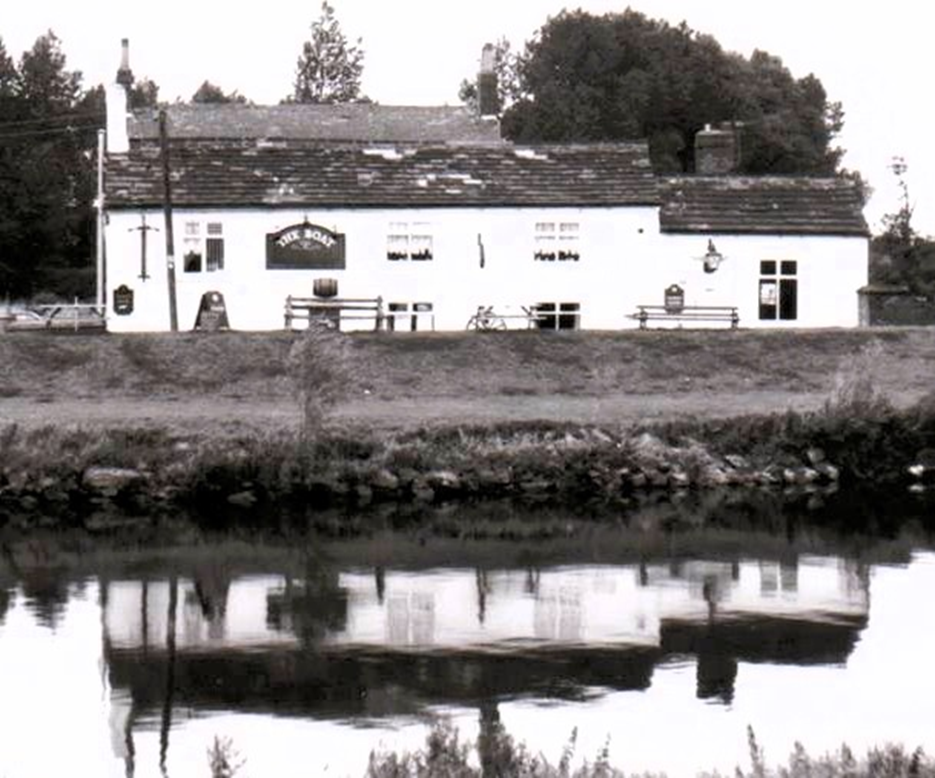
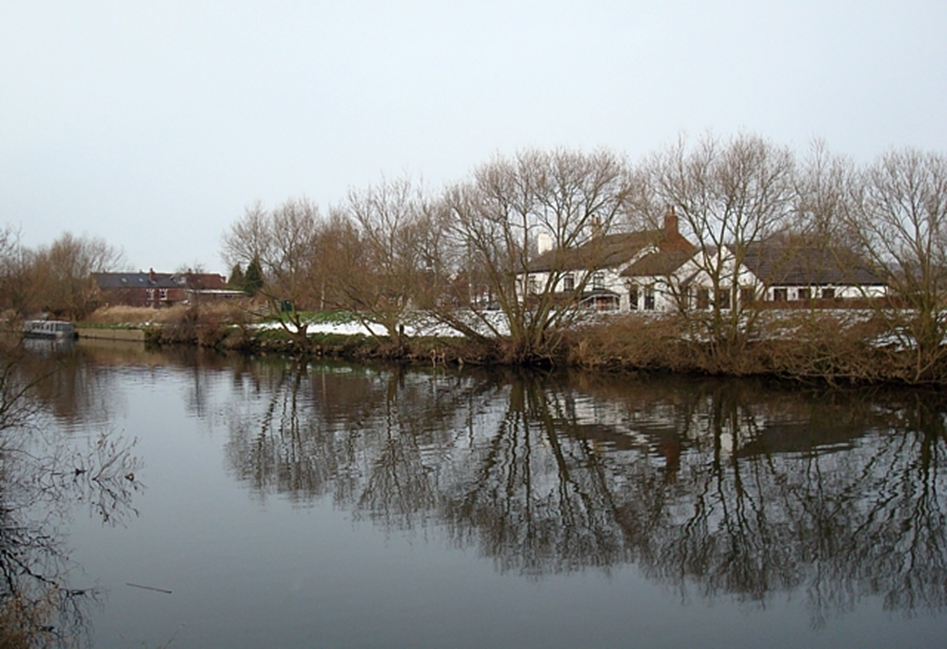
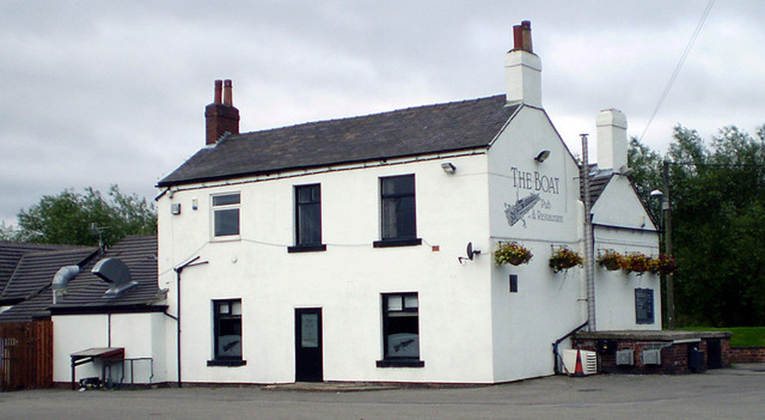
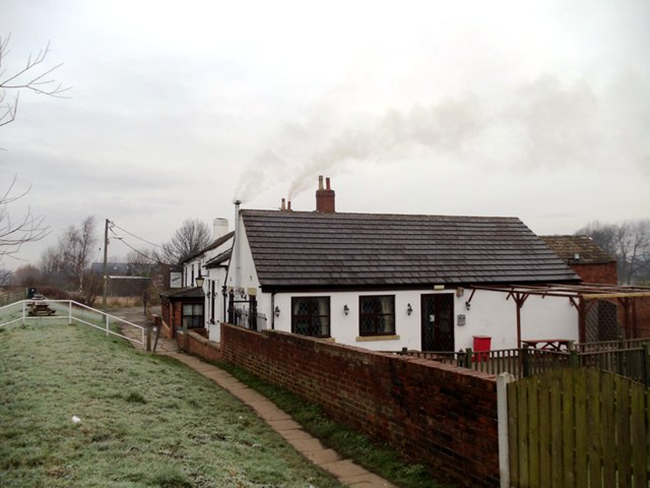
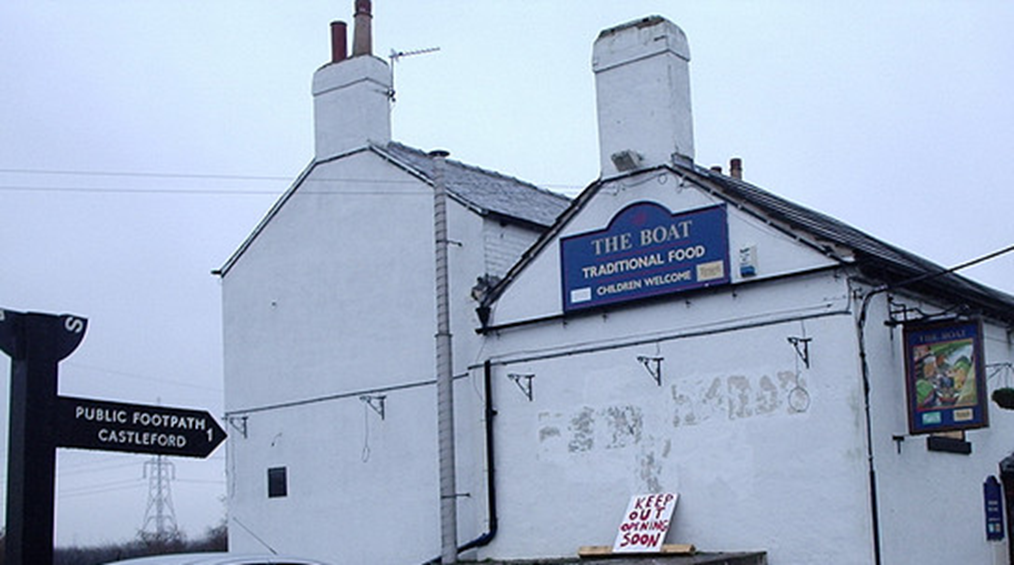
Transportation of goods was carried out by boats or ` BARGES `of various sizes, which were hauled by horse. The horses required a clear, foot-path, in order to pull the barges, and this was known as the ` TOW PATH `. The BOAT INN is situated on the banks of the River Aire at Allerton Bywater and it was at this location that the TOW PATH changed from the Methley side of the river to the Allerton Bywater bank and vice versa. Hence, a means of transportation across the river was required ` THE FERRY BOAT` . The ferry was operated from the local Inn and is often referred to as The Boat House or Ferry Boat Inn on Census records. Over the years, this has been shortened and is now known simply as ` The Boat Inn.`
The Ferry plays a major part of the Boat Inn history as recorded later.
NOTE:- Some of this information may relate to LOCK LANE as this was classed as ALLERTON BYWATER – pubs such as The Griffin – Navigation Inn – Lord Nelson – Junction – are all listed as Allerton Bywater. Some calculated assumptions therefore, have been made as to the premises.
Alehouse Act (1552): The Act introduced licensing controls which established that a person wishing to sell ale or beer required a licence from a Justice of the Peace at the Quarter Sessions or Petty Sessions.
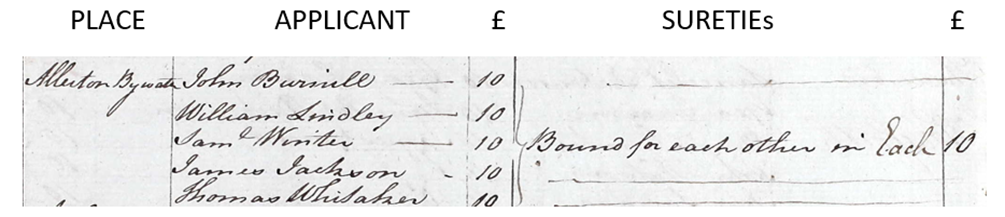
Alehouse recognisances 1753 -1829
Alehouse recognisances were bonds entered into before the licensing justices, they guaranteed the good behaviour of publicans. The sureties were a bond, or promise by one party to assume responsibility for the debt obligation of a borrower. A breach meant loss of both money and licence.
1771 ALLERTON BYWATER
1778 ALLERTON BYWATER
1781 ALLERTON BYWATER
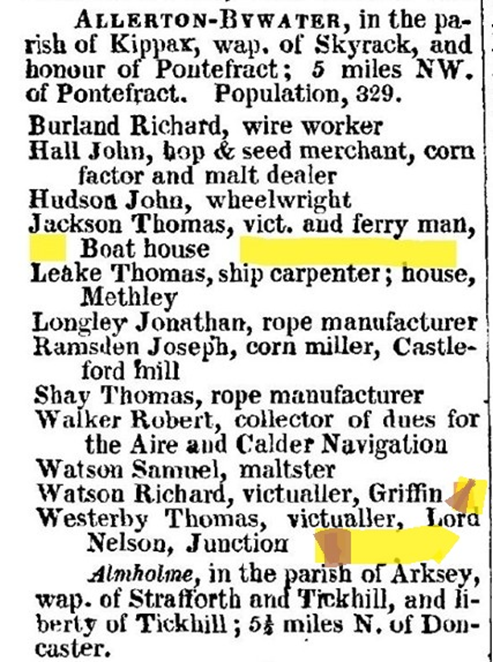
Transcript of the entry of “professions and trades” for ALLERTON BYWATER in Baines’s Directory and Gazetteer Directory of 1822.
Jackson Thomas, vict. and ferry man, Boat house
In May 1669, the royal assent was given to the Aire and Calder Navigation Act, and by 1703 forty miles of additional waterway had been opened up to navigation, allowing keel boats to sail upstream as far as Leeds on the river Aire. This allowed them to also sail downstream with coal into the River Ouse system and out into the Humber. — ALLERTON BYWATER PARISH MAGAZINE
1826 – The Aire and Calder Navigation Company commenced construction of the canal, which would increase water traffic.
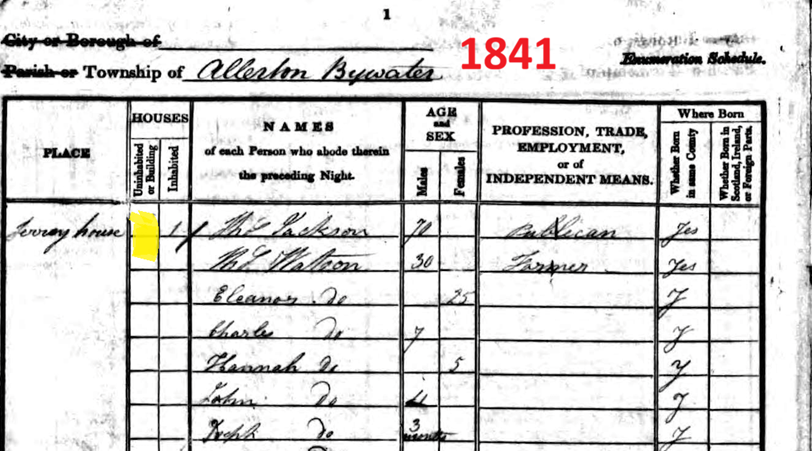
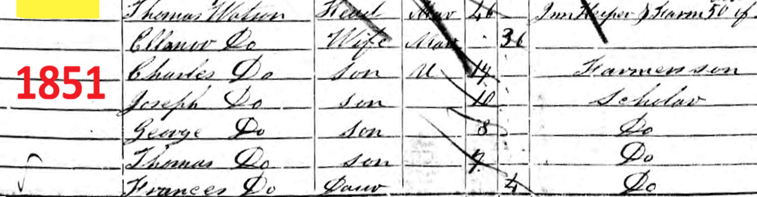
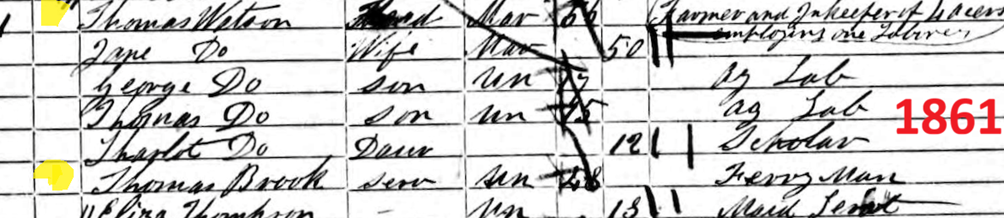
1841 Census shows Thomas Jackson to be a Publican living in the Livery House. This was probably stables to the rear of the Boat Inn. Also living here is Thomas Watson (farmer) and his family. In the 1851 Census he becomes Innkeeper and farmer. Again, this is probably the Boat Inn, as he is shown as publican there in 1871 Census
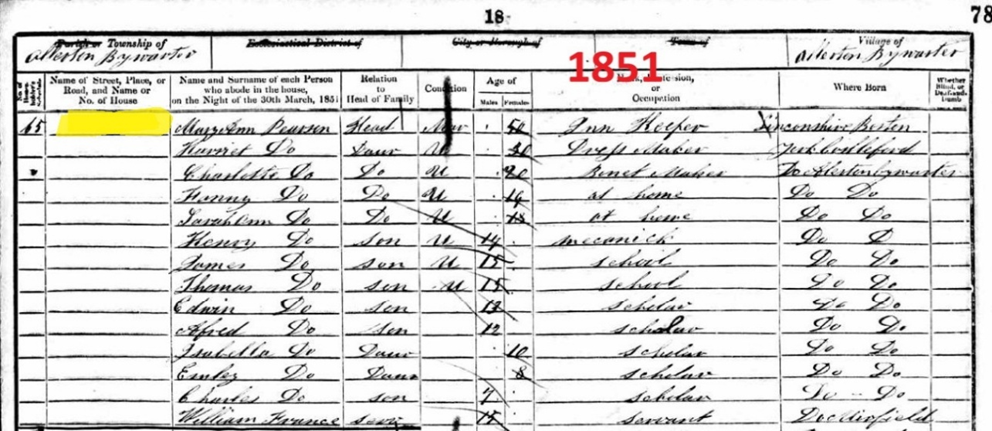
1851 Census for Allerton Bywater shows 2 Innkeepers – Thomas Watson ( Boat Inn ? ) as mentioned in the 1841 Census, but no mention of the premises and Mary Ann Pearson, with her family, again no mention of the premises. ( probability is the Navigation Inn – Lock Lane ? )
1861 Census for Allerton Thomas Watson is a Farmer and Innkeeper Thomas Brook is registered on the Census at the same abode and said to be Ferryman. ( This points to the Boat Inn )
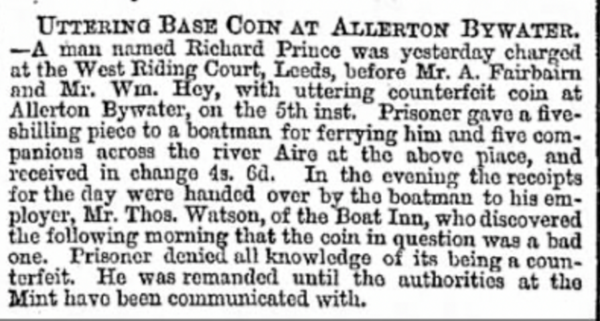
1866 – Fraud on the Ferry: The charge for using the Ferry was 6d per week or 2½ pence in today’s money.
However, this did not deter fraudsters
Allerton Bywater Ferry From the Leeds Mercury Abt. 14th March 1866
UTTERING BASE COIN AT ALLERTON BYWATER. A man named Richard Prince was yesterday charged at the West Riding Court, Leeds, before Mr. A. Fairbairn and Mr. Wm. Hey, with uttering counterfeit coin at Allerton Bywater, on the 5th inst. The prisoner gave a five- shilling piece to a boatman for ferrying him and five companions across the river Aire at the above place, and received in change 4s. 6d. In the evening, the receipts for the day were handed over by the boatman to his employer, Mr. Thos. Watson, of the Boat Inn, who discovered the following morning that the coin in question was a bad one. Prisoner denied all knowledge of it being a counterfeit. He was remanded until the authorities at the Mint have been communicated with.
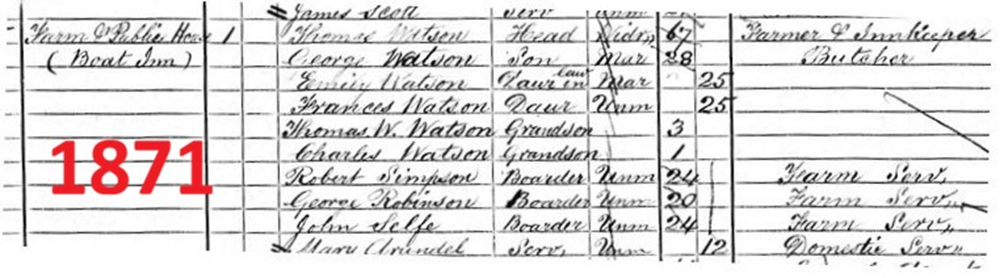
1871 Census for Allerton Bywater shows clearly that Thomas Watson is a farmer and the Innkeeper of the Boat Inn living with him is his son George and family
1881 Census-John H Atkinson and family are now resident in the Boat Inn
1891 Census Thomas L Tilney is a licensed victualler at the Boat Inn. Only he and his wife are registered.
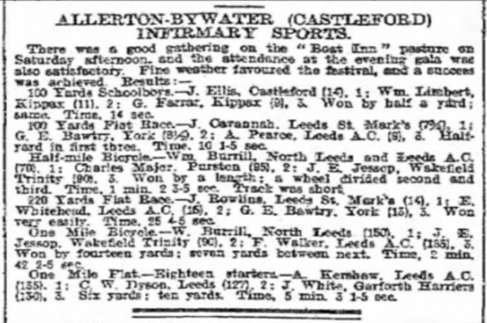
SPORTS DAY REPORT
TRANSCRIPT FOLLOWS THE CLIPPING
Leeds Mercury 18th June 1900 — ALLERTON-BYWATER
(CASTLEFORD) INFIRMARY SPORTS.
There was a good gathering on the ” Boat Inn” pasture on Saturday afternoon, and the attendance at the evening gala was also satisfactory. Fine weather favoured the festival, and a success was achieved. Results:-
100 Yards Schoolboys.-J. Ellis, Castleford (14), 1; Wm. Limbert, Kippax (11). 2: G. Farrar, Kippax (9), 3. Won by half a yard; same. Time, 14 sec.
100 Yards Flat Race.-J. Cavannah. Leeds St. Mark’s (73/4), 1; G. E. Bawtry, York (81/2). 2; A. Pearce, Leeds A.C. (5), 3. Half- yard in first three. Time, 10 1-5 sec.
Half-mile Bicycle.- Wm. Burrill, North Leeds and Leeds A.C. (70), 1: Charles Major. Purston (85), 2: J. E. Jessop, Wakefield Trinity (90), 3. Won by a length; a wheel divided second and third. Time, 1 min. 2 3-5 sec. Track was short.
220 Yards Flat Race.-J. Rowlin, Leeds St. Mark’s (14), 1: E. Whitehead, Leeds A.C. (15), 2; G. E. Bawtry, York (15), 3. Won very easily. Time, 25 4-5 sec.
One Mile Bicycle.-W. Burrill, North Leeds (150), 1; J. E. Jessop, Wakefield Trinity (90), 2; F. Walker, Leeds A.C. (185), 3. Won by fourteen yards; seven yards between next. Time, 2 min. 42 2-5 sec.
One Mile Flat.-Eighteen starters.-A. Kershaw, Leeds A.C. (135), 1; C. W. Dyson, Leeds (127), 2: J. White, Garforth Harriers (130), 3. Six yards: ten yards. Time, 5 min. 3 1-5 sec.
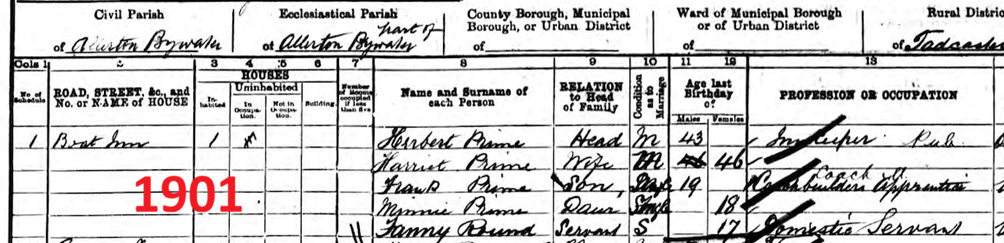
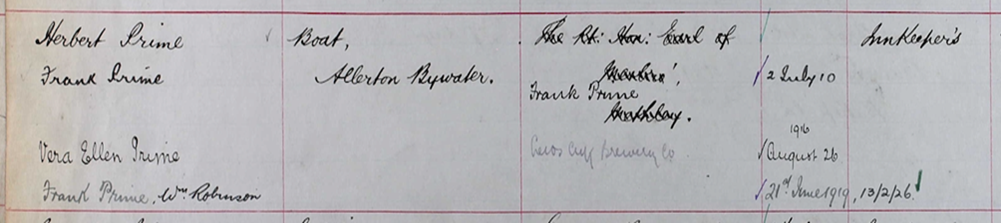
1901 Census – Herbert Prime “Innkeeper” and his family are living at the Boat.
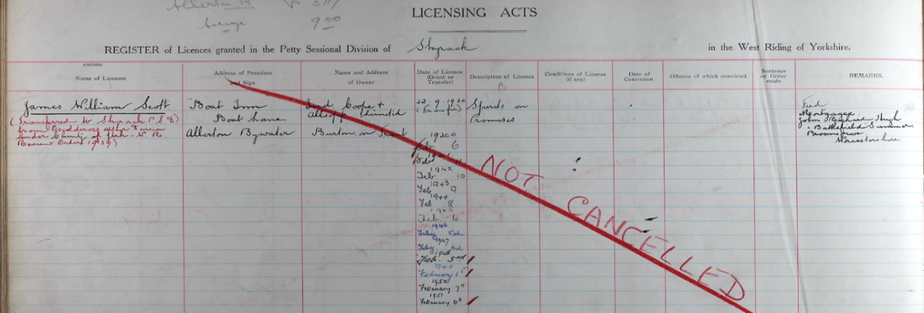
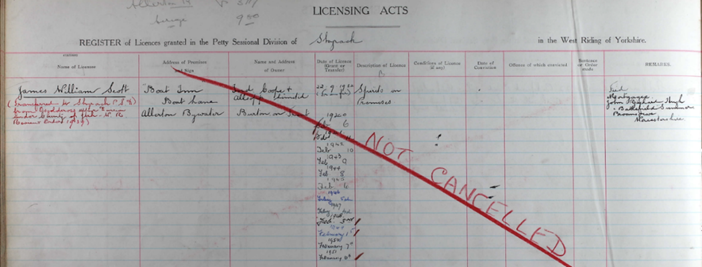
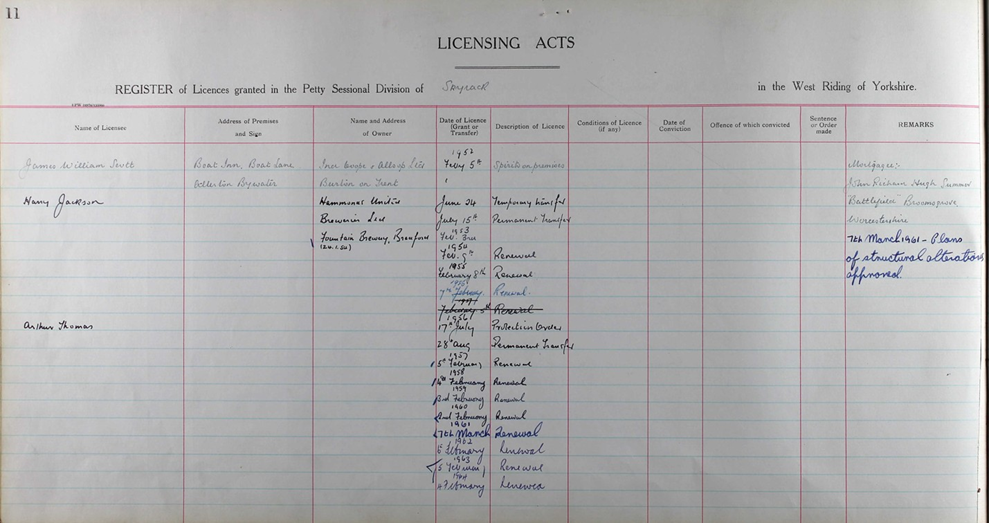
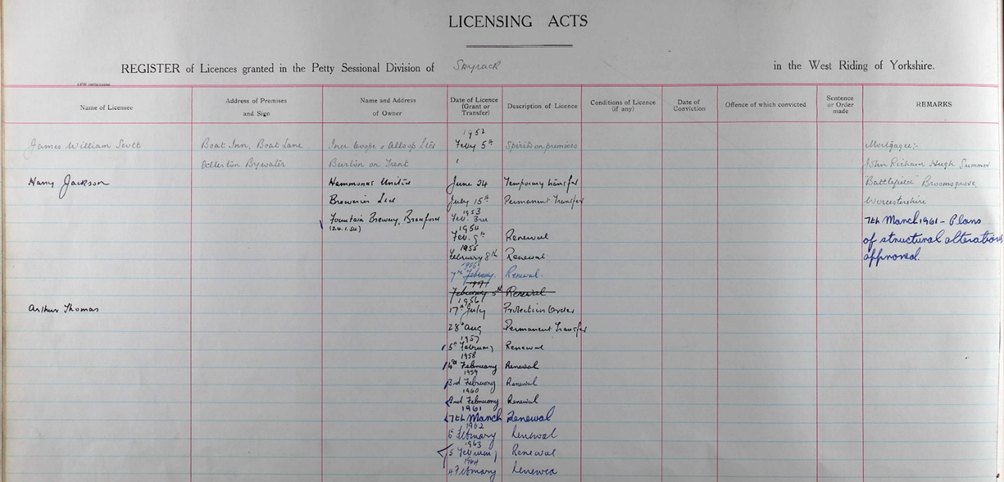
Register of Licenses:
Herbert and Harriet Prime have moved on
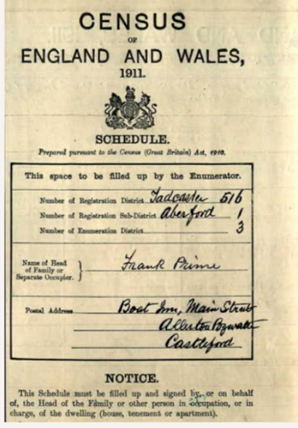
1911 Census shows Herbert Prime’s son Frank Prime has taken over the Licence and is now licensee at the Boat Inn and appears to own the premises.
1916 – 26 August 1916 – Leeds City Brewery Co. have taken the premises. For reasons unknown, both Vera Ellen Prime, Frank’s wife, and Frank are resident here until 1926.
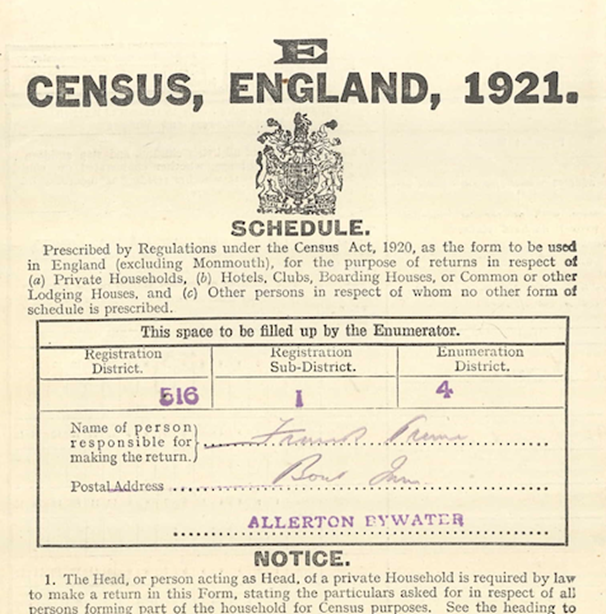
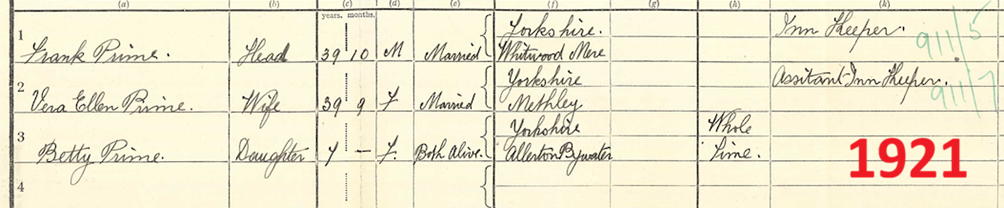
1921 – Census shows Frank Prime is still the Innkeeper, his wife, Vera Ellen Prime who is now assistant Innkeeper.
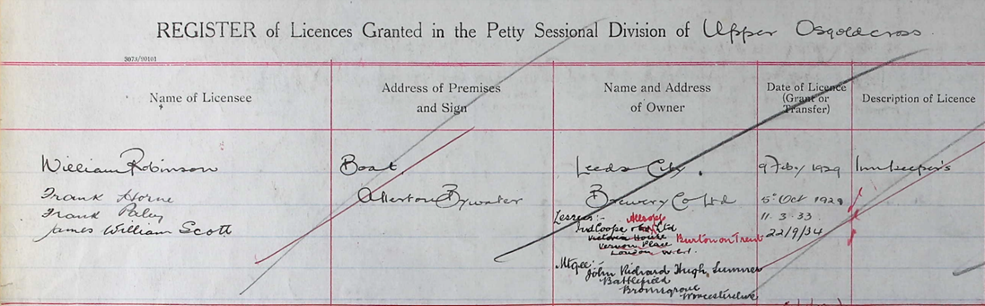
1926 – 13 February 1926 William Robinson is licensee at the Boat Inn, at this time it is owned by Leeds City Brewery Co.
1929 – The license is transferred to Frank Horne on the 5 October 1929.
1933 – Frank Paley takes over the license on the 11 March 1933. Boat is NOW owned by Ind Coope and Allsopp Limited Burton on Trent.
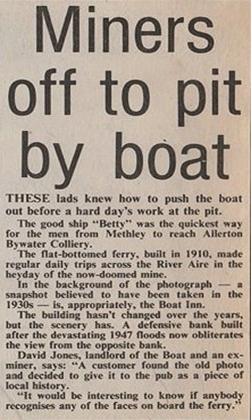
1930s news cutting
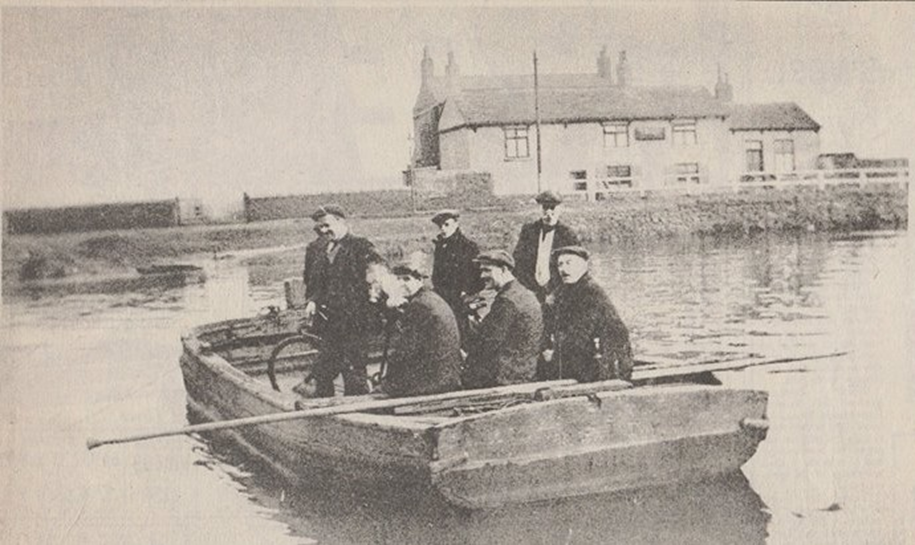
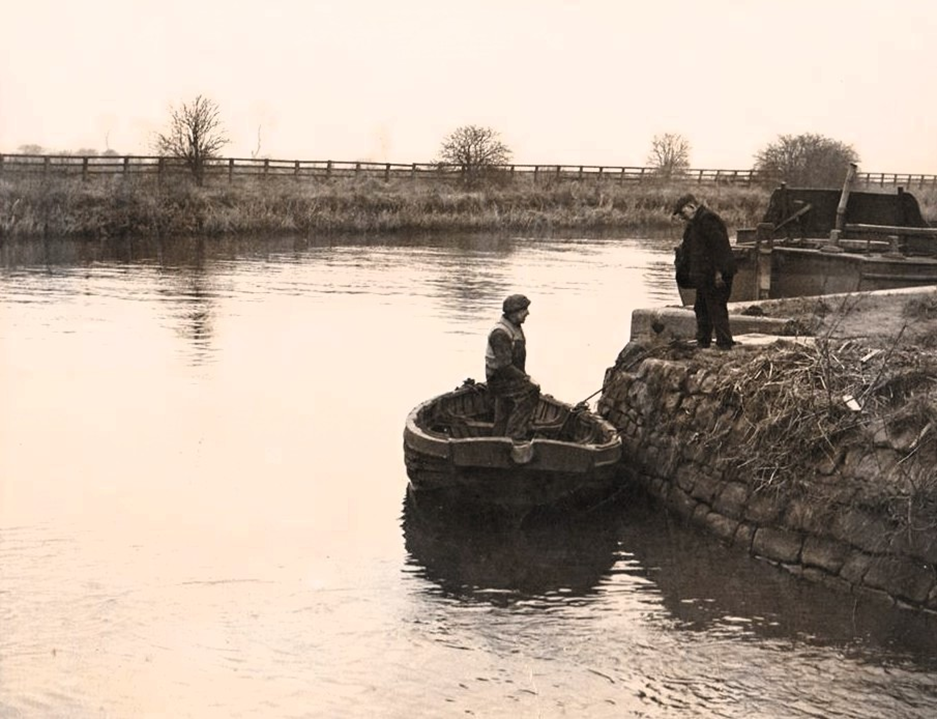
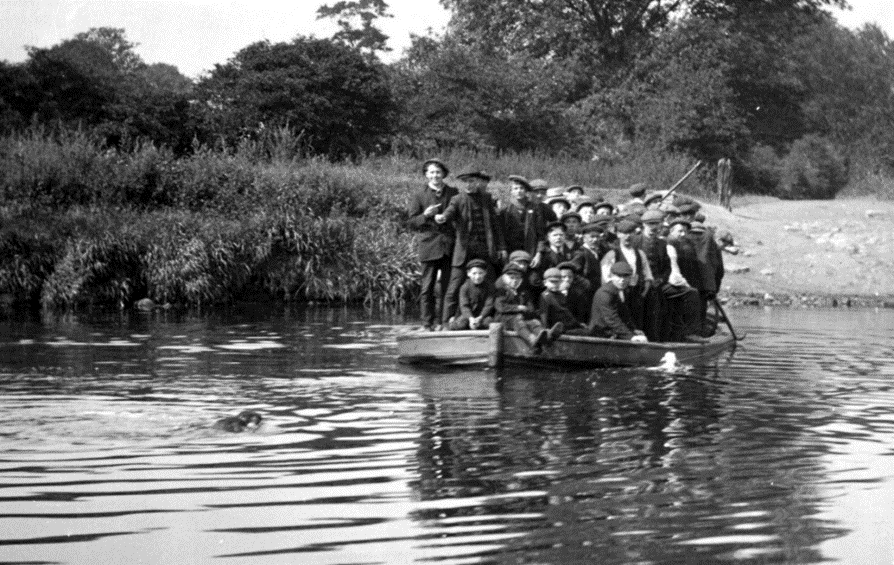
Miners off to pit by boat THESE lads knew how to push the boat out before a hard day’s work at the pit. The good ship “Betty” was the quickest way for the men from Methley to reach Allerton Bywater Colliery. The flat-bottomed ferry, built in 1910, made regular daily trips across the River Aire in the heyday of the now-doomed mine. In the background of the photograph – a snapshot believed to have been taken in the 1930s –
On the Allerton bank the Boat Inn can be clearly seen, and moored at the bank-side, the small passenger boat like the one below.
1934 – 22 September 1934 – James William Scott was granted a License for the Boat Inn and here he remained until 1951
1939 – James William Scott and family resident at the Boat Inn 1939
My Grandad was the ferryman. Wilfred Henry Lawrenson. He used to take me with him in the late 40’s. I was born in 1941.
1939 – England Register
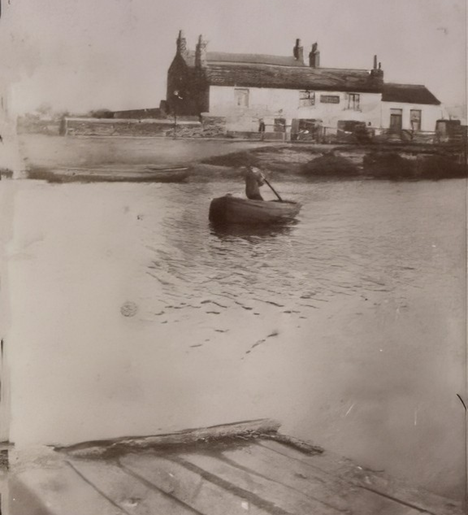
1940 – The photo below taken around 1940, shows one Ferry Boat used for carrying passengers across the river. It is being sculled using one oar by the ferryman; this, for many years was the occupation of Mr. Henry Laurenson. (William Henry Lawrenson ?)
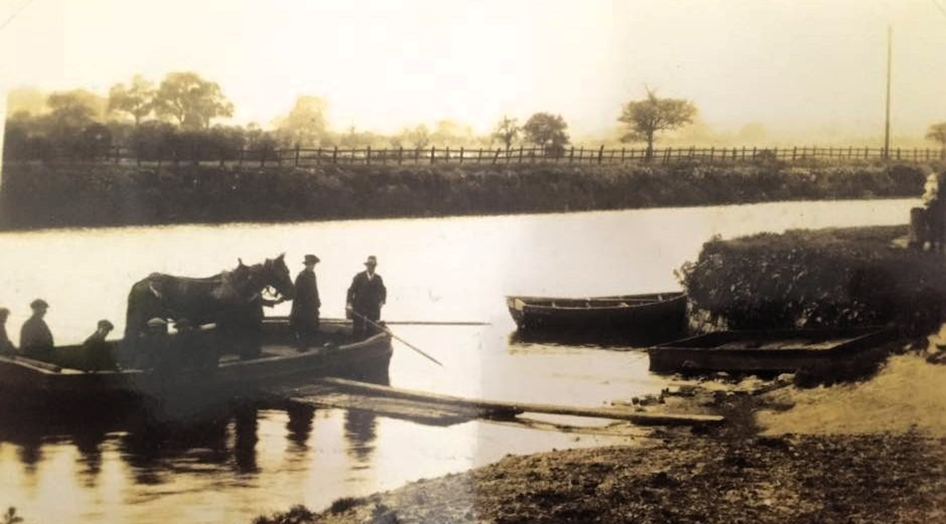
In the foreground is the landing stage at the Methley side of the river. On the opposite side, Allerton Bywater and the Ferry Boat Inn, used and patronised by bargemen. Moored at the Allerton side is a large, flat-bottomed chain-pulled barge, which was used to carry the horses across the river. Stables to the rear of the Boat Inn were used for the Barge horses, whilst the ` Bargees – Watermen – Boatmen` as they were known, would rest on their vessels. A reference in the 1841 Census: Thomas Jackson, known to be a Publican of the Boat Inn, is living at the Livery House; this is possibly stabling for the horses.
For the Methley Miner who worked at Allerton Bywater Colliery the Ferry transport to work was vital, as a round journey through Castleford with limited public transport, would have been time-consuming and costly. Far easier to cycle or walk to work via the Ferry, the charge for using the Ferry was 6d per week or 2½ pence in today’s money.
1951 – James William Scott has been Licensee of the Boat inn from 1934 – 1952
1952 – 24 June 1952 the ownership changes again to Hammonds United Breweries Limited, Fountain Brewery, Bradford.
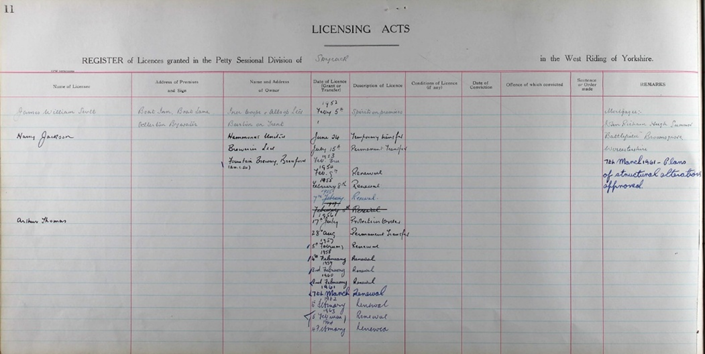
And Harry Jackson takes over as Innkeeper with a permanent transfer of the license on the 15 July 1952.
1953 – As public road transport improved, the ferry became less and less used Hammond’s United Breweries, the owners, considered the Ferry had become unviable and closed the Ferry,
The Methley Miners approached their union
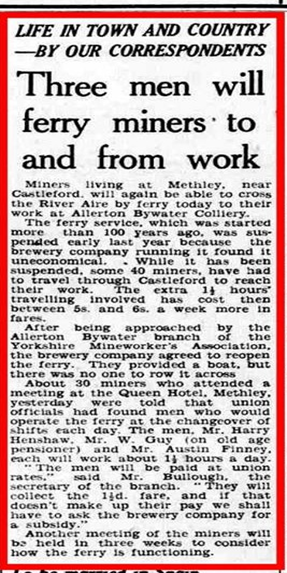
19 October 1953 – Three men will ferry miners to and from work
Miners living at Methley, near Castleford, will again be able to cross the River Aire by ferry today to their work at Allerton Bywater Colliery. The ferry service, which was started more than 100 years ago, was suspended only last year because the brewery company running it found it uneconomical. While it has been suspended, some 40 miners, have had to travel through Castleford to reach their work. The extra 1 hour’s travelling involved has cost them between 8s. and 6s. a week more in fares. After being approached by the Allerton Bywater branch of the Yorkshire Mineworker’s Association, the brewery company agreed to reopen the ferry. They provided a boat, but there is no one to run it. About 30 miners who attended a meeting at the Queen Hotel, Methley, yesterday were told that union officials had found men who would operate the ferry at the changeover of shifts each day. The men, Mr. Harry Henshaw , W. Guy, ( on old age pension ) and Mr. Austin Finney, each will work about 11/2 hours a day. “The men will be paid at union rates,” said Mr. Bullough, the secretary of the branch. They will collect the 11/2 d. fare, and if they dosn’t make up their pay we shall have to ask the brewery company for a subsidy.” Another meeting of the miners will be held in three weeks to consider how the ferry is functioning.
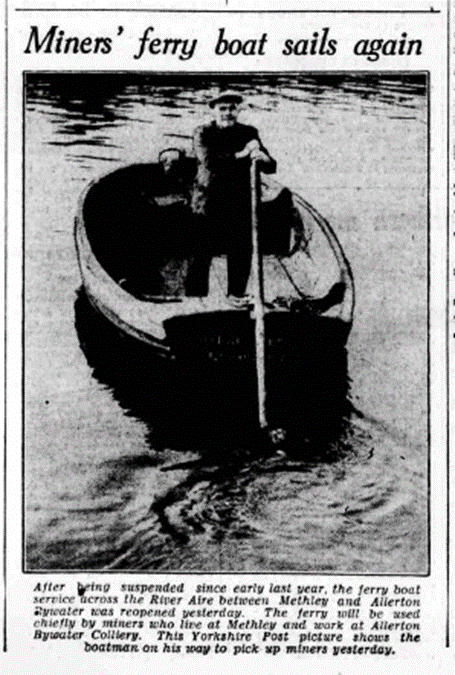
20 October 1953
After being suspended since early last year, the ferry boat service across the River Aire between Methley and Allerton Bywater was reopened yesterday. The ferry will be used chiefly by miners who live at Methley and work at Allerton Bywater Colliery. This Yorkshire Post picture shows the boatman on his way to pick up miners yesterday.
Below gives an idea how popular this crossing was.
1956– 28 August 1956 – Arthur Thomas becomes the Innkeeper of the Boat.
1959 – Finally,Hammond’s United Brewerieswho owned the ferry as well as Boat Inn, gave notice of plans to cease operating the ferry in July 1959.
1960 – Leeds nostalgia: Old ‘steel record’ player found in pub
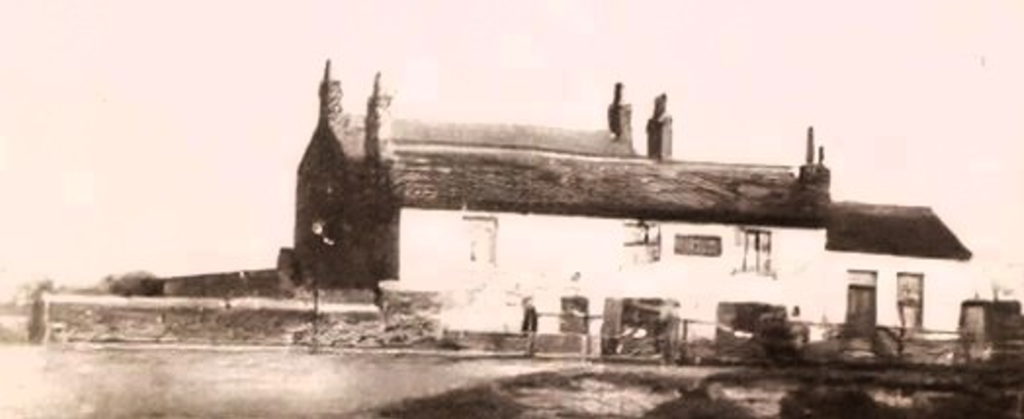
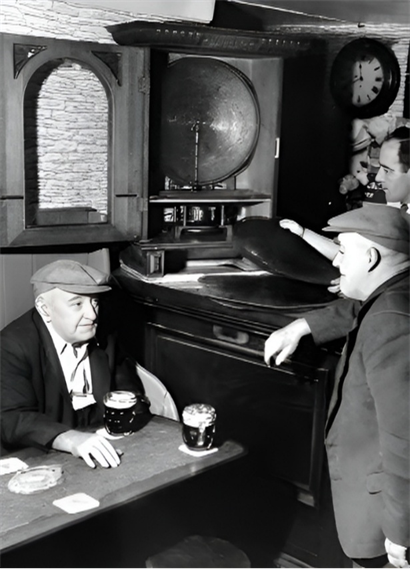
Allerton Bywater. 9 October 1960 – If you go down Allerton Bywater’s Main Street and turn into Boat Street, you’ll come to a dead end by the River Aire – a picturesque backwater where stands the 17-century Boat Inn, one-time calling place for Methley miners taking ferryboat trips to and from Allerton Bywater Colliery. Pop into the bar there and you may find 79-year-old Billy Guy and 80-year-old Walt Hepworth, both ex-miners with over 60 years’ pit service, supping their pints of old and listening to old tunes played from 20in. steel records on a machine built in Saxony about the time they were born. This forerunner of the modern juke box is a Polyphone – a clockwork-powered form of musical box, housed in an ornate, penny-in-the-slot cabinet, which plucks dulcet music from a repertoire of about 20 steel discs. Found by the licensee, 33-year-old Mr. Arthur Thomas, stored away in a spare room when he and his wife Irene, also 33, took over the pub four years ago, the machine has been cleaned and “rejuvenated”
1961 – 7 March 1961 plans for structural alterations were approved.
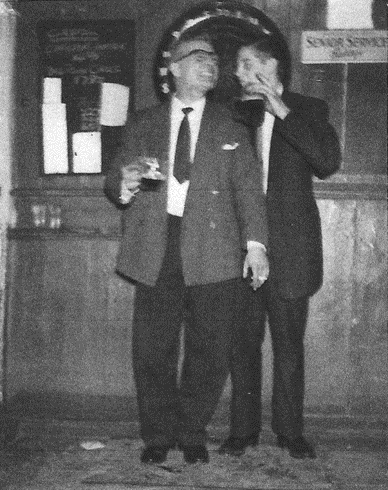
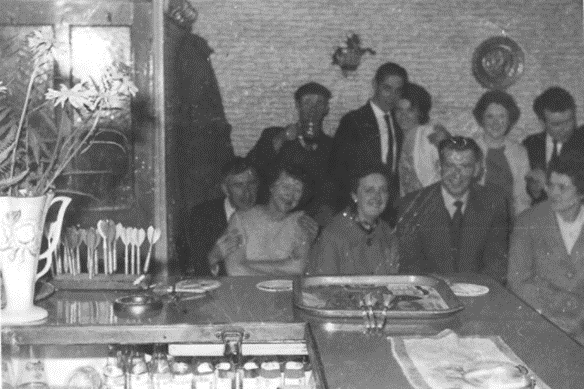
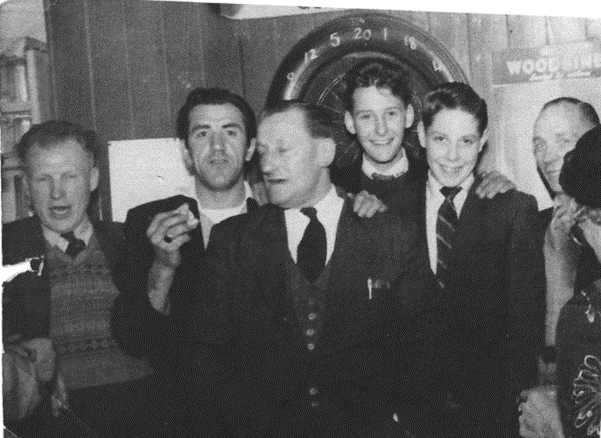
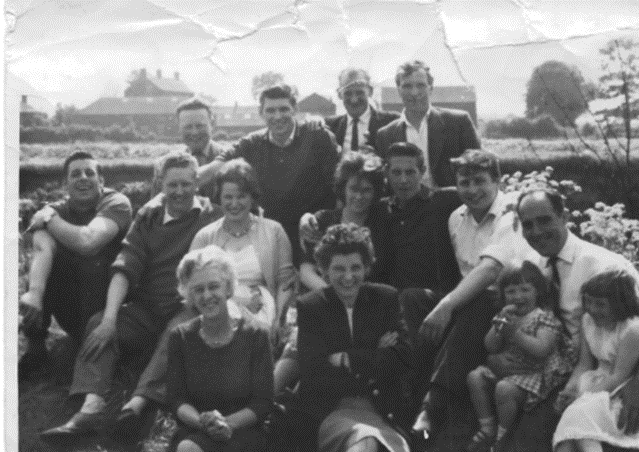
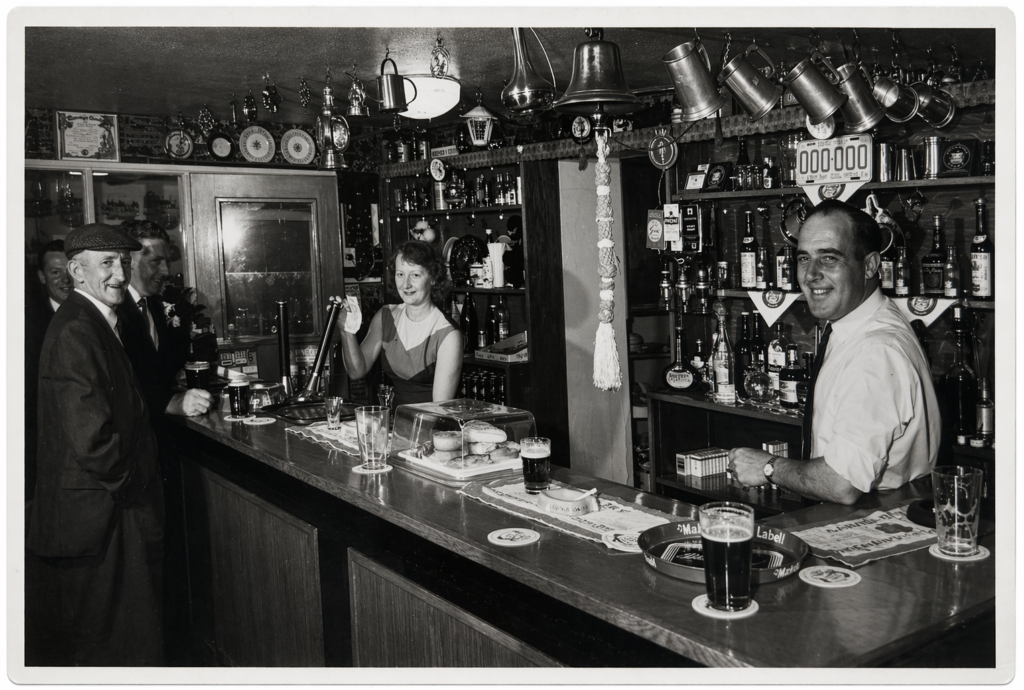
Darts team and regulars at the time — Photo`s supplied by Hazel Milner
1964 – 4 February 1964. Arthur Thomas gets one of the final licences, granted in the Petty Sessional Division of Skyrack.
From this period, information is vague as to who actually owns the premises and who is licensee.
The following may not be totally accurate as it was gathered from local knowledge and recollection
******************************
( please contact if you have any proven information the following web site ) Allerton Bowers History
*******************************
1976 – 1980 Jack and Joan Sutcliffe
Cliff Winstanley – Jack and Joan Sutcliffe in 70s – a guy called Dave and his wife I think she was called Jean not sure of surname might have been Jones. — In the 80s Brian and Ann Lockwood in 90s
1982 – 1991 Dave and Jean? Jones
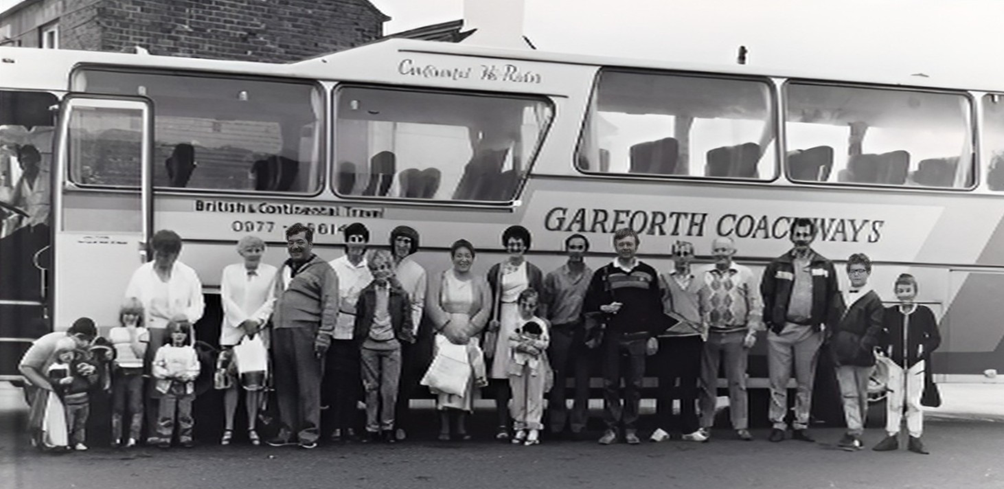
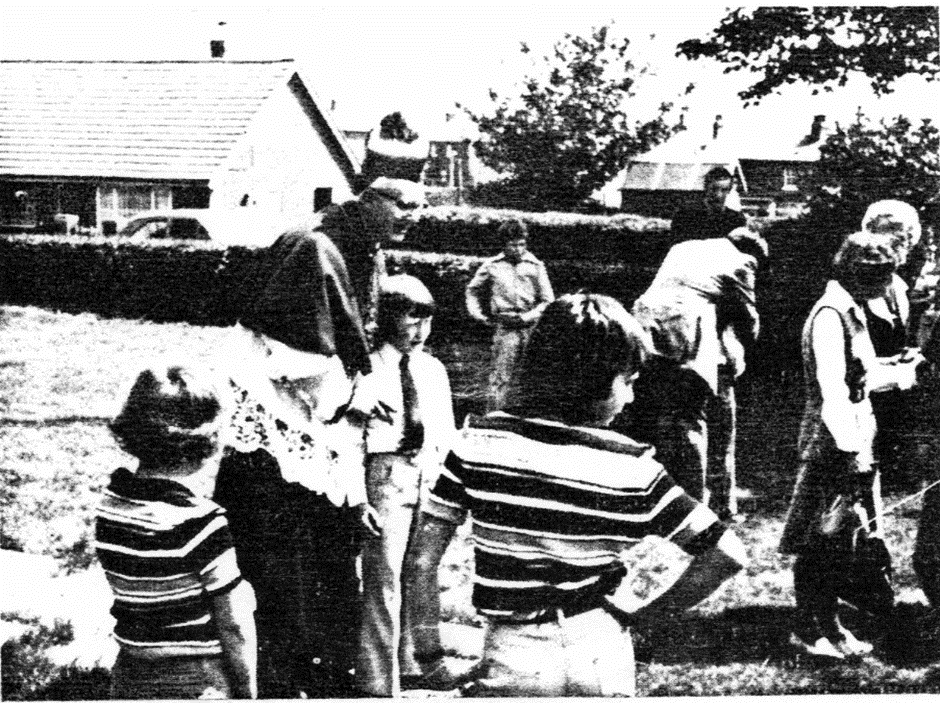
Below Scarborough trip organised by the 100 club – date ??
Children and parents prepare to leave the Boat Inn, Allerton Bywater, for a day trip to Scarborough. The outing was financed by the pub’s “100” club, which was set up four months ago to provide treats for local youngsters. The children were given pop and sweets and shown a film on the journey before enjoying themselves on the beach.
Kathleen Schofield — the Photo of trip outside boat would be early 80s properly 1983, Landlord then was Jean an Dave Jones Marks mam an dad hope that helps
Pub blaze
Pub blaze FIREFIGHTERS were called to a blaze at the last week.
Published: Thursday 04 March 1993
In early March 1993, a major fire severely damaged The Boat Inn Main Street, Allerton Bywater, a historic pub situated alongside the River Aire. The blaze broke out in the early hours of the morning, requiring a significant response from the West Yorkshire Fire and Rescue Service to prevent the building from being completely destroyed.
LIST OF PUBLICANS BETWEEN – DATES UNKNOWN (SUPPLIED BY Glyn Thomas)
Phil and Elaine Trowel // Ray Kelly // Peter Sissons // Kevin Beardmore
1997 –Rugby stars relaunching the Boat RUGBY league icon Brian Lockwood is making himself a legend in his own lunchtime. Brian aims to re-float the fortunes of the famous BoatInn at AllertonBywater .
Published: Thursday 12 June 1997 Newspaper: Pontefract & Castleford Express
1997– Brian Lockwood, takes over the Boat Inn to find he is not the only resident as the next article explains :-
The Ghost at the Boat Inn is always up to mischief
Flying Loafs of bread, Taps tuning on in the middle of the night & even frightening our bank manager.
When we took over the pub in 1997 & we had plans to refurbish the Bars and Restaurant. One of the Ex landlords came in to have a nosey and was talking to Brian about what we were doing, the old landlord asked about where we are moving the bar Brian replied “were going to put it along the back wall in the old tap room”, the Ex landlord said “he’ll drink you dry”, “who” asked Brian, “The Ghost”.
Brian told him he didn’t believe in them, and then the ex-landlord said: “He’ll be coming. He comes through the wall there”. He pointed at a wall at the end of the pub; behind lay the pool room.
Brian thought nothing of it until his son Kieron started knocking through the area of the wall in question to create a new entrance to the old pool room.
Behind the plaster he found an old door. The old wall next to the door had pieces of old hand-painted wallpaper, a type not used for 60 years or more.
We concluded that if there was a ghost, then it was using the old doorway that had been boarded up for years.
Weeks later, our Head Chef, John, overheard Brian talking about the ghost story to a customer.
He then told how he had watched the door of the fridge open and a loaf of bread flew out, hit him on the side of his face & the fridge door closed. He has seen the ghost more recently as he saw someone in the kitchen & thought it was the oil man picking up the waste oil, he said, “It’s in the shed” There was no reply. The mysterious figure started to walk through the dishwasher as if walking up steps and disappeared into the wall.
When we had the pub refurbished, we blocked a doorway leading to the kitchen so we could have a bigger washing up area, and it was behind the new dishwasher.
And in case of unbelievers, put John’s contact with Spirits down to indulgence in spirits of a different kind, our bank manager, no less, had an encounter in the summer of 99 on their staff barbecue. He was at the bar when someone walked behind him. He turned, but there was no one there. He asked Andrea, our Barmaid who had been facing the bank manager, but she had seen no one.
1999 –Lockwood, family run the Boat Inn at Allerton Bywater
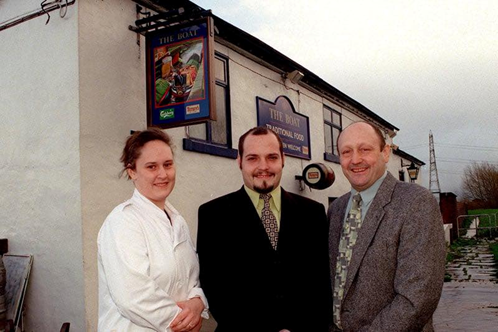
The Boat Inn – Staff at The Boat pictured in December 1999.
From left are chefs Taryn Lockwood and Kieron Lockwood and licensee Brian Lockwood.
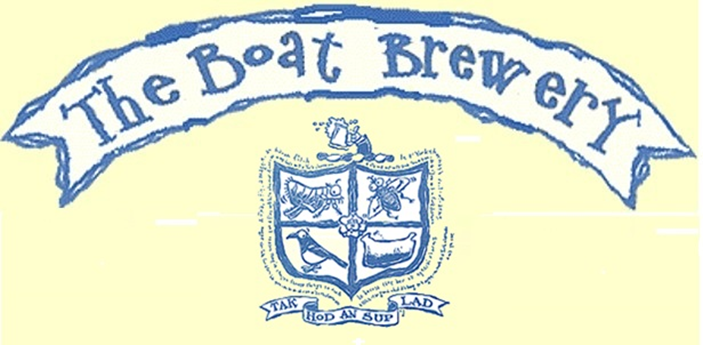
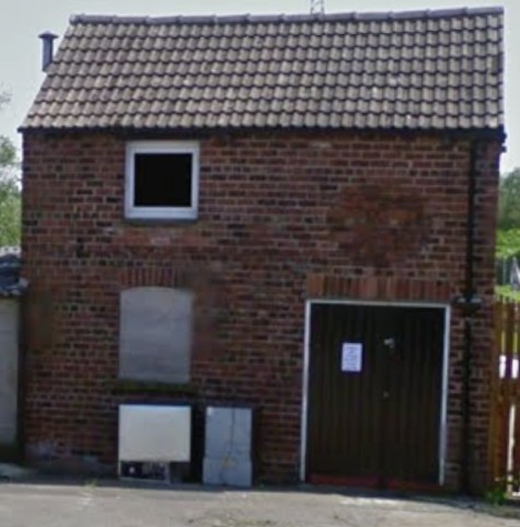
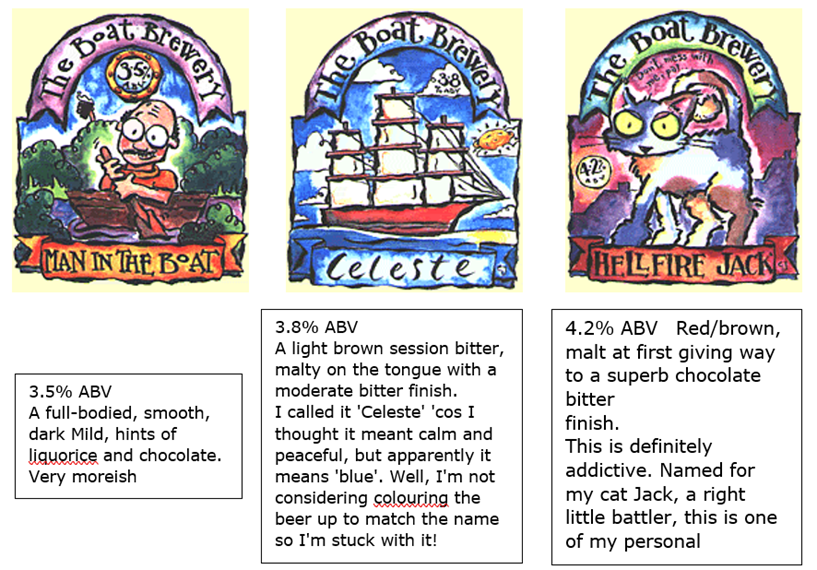
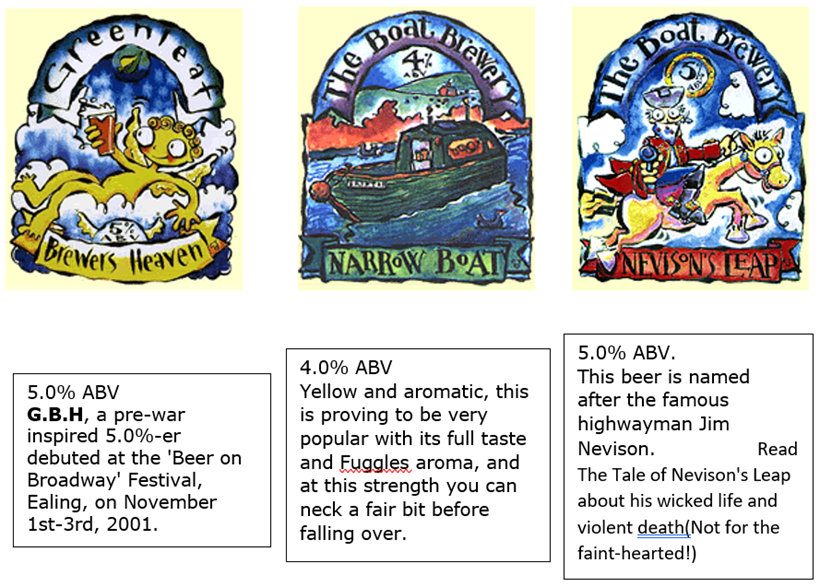
Abt. 2002 – Ron Ridout set up the Boat Brewery, to the rear of the Boat Inn, Main Street, Allerton Bywater
Pint-size brewers squaring up to the big boys the Boat Inn at Allerton Bywater
The licensee was Brian Lockwood at this time.
Published: Saturday 24 June 2000 Newspaper: Yorkshire Evening Post
Ron Ridout — Boat Brewery
Boat Brewery – the origins
The project came about as a result of several circumstances coming together, as though someone was pointing the way.
It went like this: –
Once upon a time in the dark and misty past, well, about ten years ago really, Brian Lockwood (ex-Great Britain rugby league touring captain, six times challenge cup winners medal, best player in the world etc) the current owner of the Boat Inn, had been trying to persuade me to build a brewery to the rear of his then pub (he has had several over the years).
As I reckoned he would probably move from pub to pub, I thought it a bit less than a good idea, until, that is, he arrived at the ‘Boat’, where he actually looked to be putting down permanent roots.
At this point early retirement from my previous employ loomed so with nothing else taking my fancy (and with the promise of various grants from local council sources!) we decided to give the brewery a go.
So refurbishing the stable at the back of the pub and purchasing a full brewing kit from various places the plant was set up, though not without mishap!
Fermenting vessels jumping off the lorry on the way to the brewery didn’t help, nor did my skydiving attempt through the malt trap to the concrete below, plus various other problems.
As I have since realised, these are all just everyday occurrences in the life of a microbrewer.
The first pint (‘Blue Peter’ appropriately enough named) appeared mid-July 1999 and I haven’t had to look too far back since.
Trade at the moment is done entirely over the place, but watch out in future as the brew length extends and I start seeking more customers near and far.
New owners have taken over this pub and they are trying very hard to build up custom. The food is good and reasonably priced. Plenty of beer choices and prices also normal. They had a singer on as entertainment. I think they’re still trying to find their feet as service was a bit slow but then it was full of people on Saturday night
2018 – 2019 Briggs, Jeremy ?? no confirmation
Due to Data protection and other legal restrictions
NO FURTHER INFORMATION or CONFIRMATION is supplied
2020 COVID
February 2026
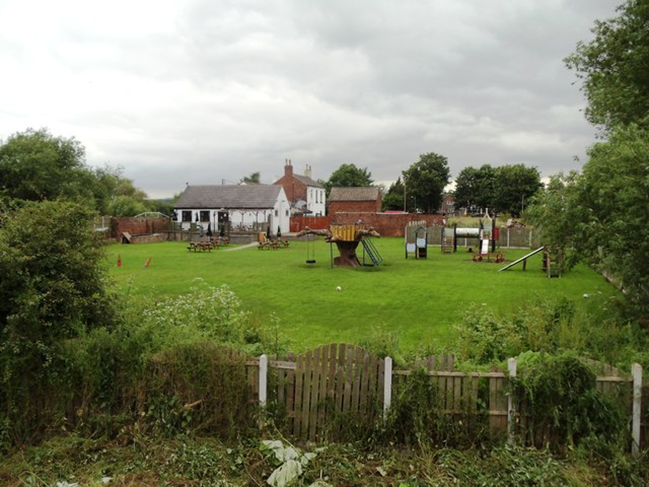
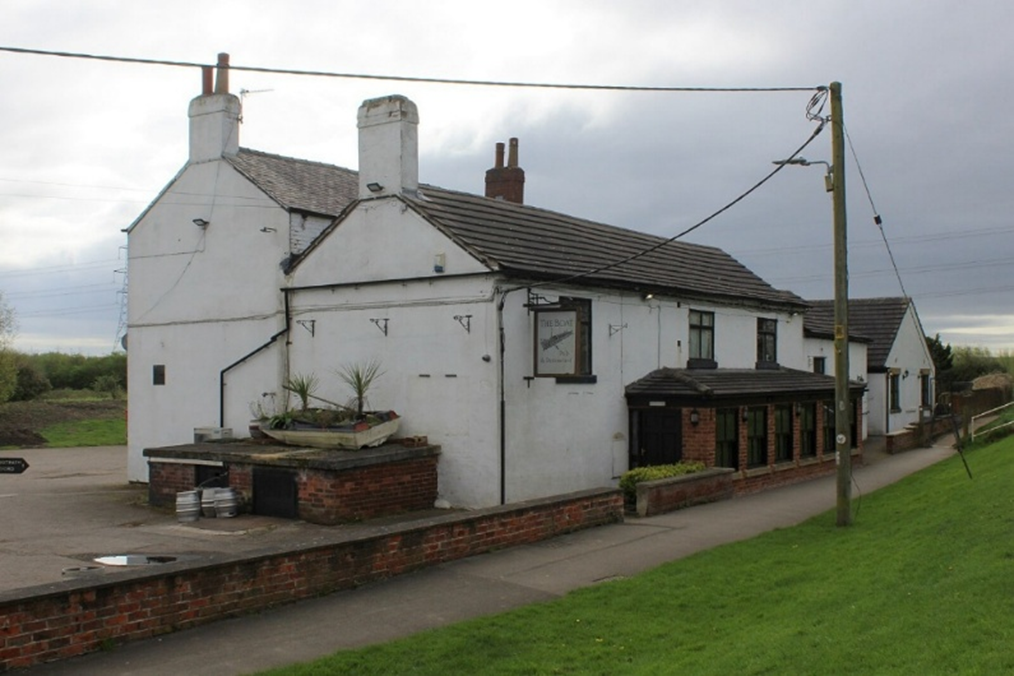
The Boat inn is for lease a two storey rendered brick detached property under a pitched concrete and tile roof. It has a single storey section of similar construction to the side and a brick and concrete tile section to the front. To the rear there is a two storey brick outbuilding with small service yard. To the left is a car park for 25-30 cars and to the right hand side there is a substantial beer garden with play equipment.
Analytical Commentary
The Boat Inn’s management history reflects broader patterns in the English pub trade, including the importance of family succession, the impact of regulatory change, and the challenges of economic and social transformation. The persistence of gaps and uncertainties underscores the need for continued research and the value of local knowledge in reconstructing the past.
Key takeaways include:
Family continuity and community ties were central to the pub’s stability in the 19th and early 20th centuries.
Regulatory and economic pressures led to increased turnover and shorter tenures in the interwar and postwar years.
The rise of brewery ownership and managed houses in the late 20th century altered the traditional model of pub management.
Recent decades have seen renewed challenges and opportunities, with the Boat Inn adapting to changing consumer preferences, the microbrewery movement, and the disruptions of the COVID-19 pandemic.
The future of the Boat Inn depends on its ability to balance tradition and innovation, serving both the local community and a broader clientele drawn by its riverside location and historical character.
Final Reflections
The Boat Inn, Allerton Bywater, stands as more than just a building or a business; it is a living repository of local history, social change, and community identity. The individuals who have managed or run the pub over the past years have left their mark not only on the premises but on the fabric of village life. As the pub enters a new chapter in 2026, its story continues, shaped by the past, responsive to the present, and open to the possibilities of the future.
Note: This report is an open documentary based on the most current and comprehensive sources available as of March 2026. Further research, particularly in local archives and through community engagement, may yield additional information and insights.
Readers and researchers are encouraged to contribute `proven` new findings to the ongoing documentation of the Boat Inn’s history.
******************************
( please contact if you have any proven information the following web site ) Allerton Bowers History
A Chronological History of Licensees and Management
Allerton Bowers History – Rediscovering our past for future generations
The English public house in Allerton Bywater
it`s people and it`s enduring social and economic role.
Introduction
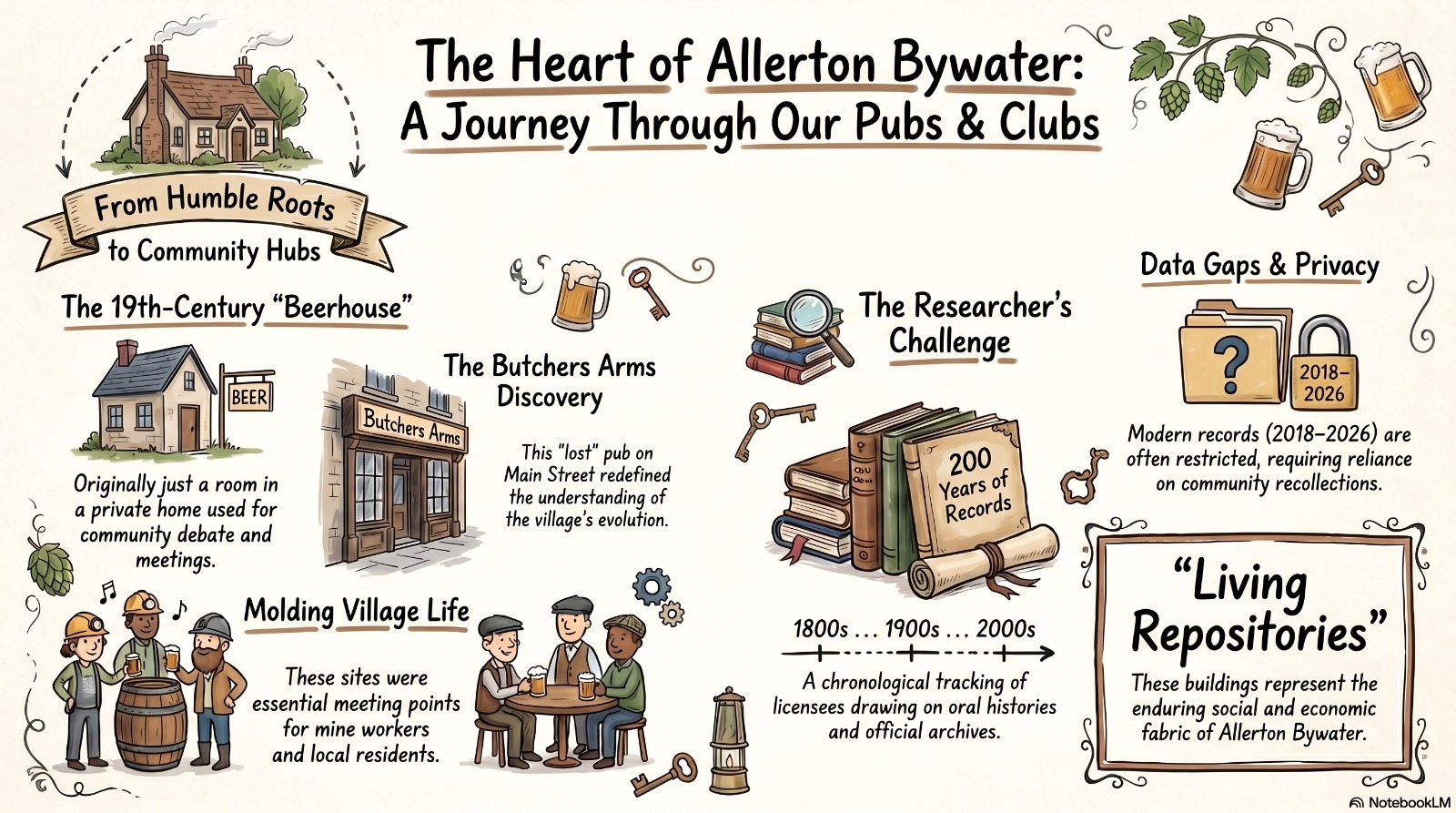
These Pubs and Clubs have served as hubs of the community and witnessed the changing fortunes of the village and its people. The articles present a comprehensive, chronological account of the individuals who have managed or run these premises over nearly two centuries, drawing on a wide array of sources and oral histories. This analysis attempts to lists the known licensees but also provides historical context, highlights notable events and examines gaps and uncertainties in the historical records and offers it`s readers the opportunity to participate by adding their own supported knowledge via the WEBSITE.
Limitations and Gaps
Despite the breadth of sources, several challenges persist:
Incomplete or missing records
Ambiguity in census and directory entries
Potential for short term or interim management
Privacy restrictions
Recent Years ( 2018 – 2026 ): Privacy restrictions limit the publication of certain information
Online reviews and community recollections provide some information but lack official confirmation.
THE CURIOUS JOURNEY BEGAN WITH THE DISCOVERY OF THE BUTCHERS ARMS LOCATED ON MAIN STREET
This project began looking at “ LOST “ PUBS AND CLUBS OF ALLERTON BYWATER
However, during research, the discovery of the so-called “ BEERHOUSEs “ , several of which were scattered around the village, in particular the Butchers Arms on Main Street, Allerton Bywater, changed its perspective. These beerhouses, “ a room in someone’s home “, were meeting points where issues of the day were discussed and debated by the locals and mine workers. They defined the history of the village, how it evolved and how it was moulded around them. It is important, therefore, to look at how they all integrated and grew within the village history, as it was from these roots that the establishments of the various PUBS and CLUBS known today emerged.
Reflections
The Pubs and Clubs of Allerton Bywater stand as more than just buildings or businesses; they are living repositories of local history, social change and community identity. The individuals who have managed or run these premises over the past years have left their mark , not only on the premises but on the fabric of village life. As these Pubs and Clubs enter a new chapter in 2026, their story continues – shaped by the past, responsive to the present and open to the events of the future.
PLEASE ENJOY THE PROJECT ARTICLES
THIS IS A PROGRESSIVE SITE – FURTHER ARTICLES WILL BE ADDED AS AND WHEN THEY ARE RESEARCHED OR BECOME AVAILABLE OR FROM YOUR SUPPORTED INPUT.
2026 – Acknowledgements: John & Keith Dickinson, Steve Mirfin, all who have already contributed and all who will contribute in the future.
All the researched data is under continuous review and can be updated or ammended at any time. Everyone in the group is welcome to add to this research.
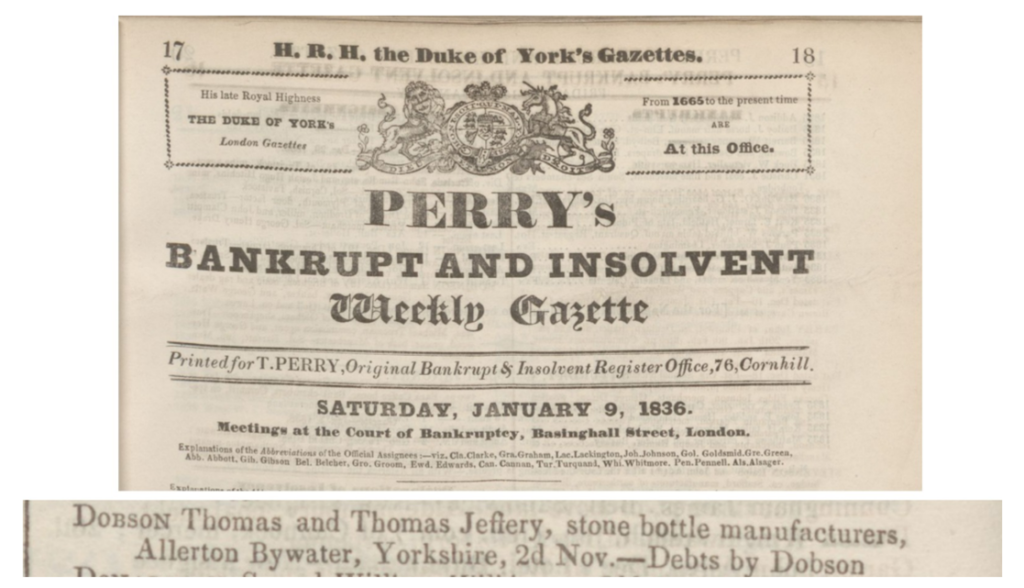
Between Thomas Dobson and Thomas Jeffery, Allerton Bywater, Yorkshire, stone bottle manufacturers.
Dobson Thomas and Thomas Jeffery, stone bottle manufacturers, Allerton Bywater, Yorkshire, 2nd Nov. – Debts by Dobson
Despite the above report, Thomas Dobson looks to carry on the business as “Stone and Blackware Manufacturer” and appears to erect some new buildings.
ISSUES WE ARE UNABLE TO AUTHENTICATE
1838, an Indenture of Enforcement was recorded that involved Thomas Davison Bland and Thomas Dobson, indicating the Bland connection to the Allerton Pottery. This suggests that they played a role in the pottery’s operations or ownership during that time.
NOTE: – An Indenture of Enforcement typically refers to a legal document that outlines the terms and conditions governing the issuance and management of bonds or other financial issues.
2. NOVA SCOTIA – IS MENTIONED IN RELATION TO THE POTTERY
It is said — Clay was removed from the NOVA SCOTIA site to a depth of approx 8 to 10 metres. It was taken by horse and cart to the pottery and the excavation was refilled with debris from the pottery.
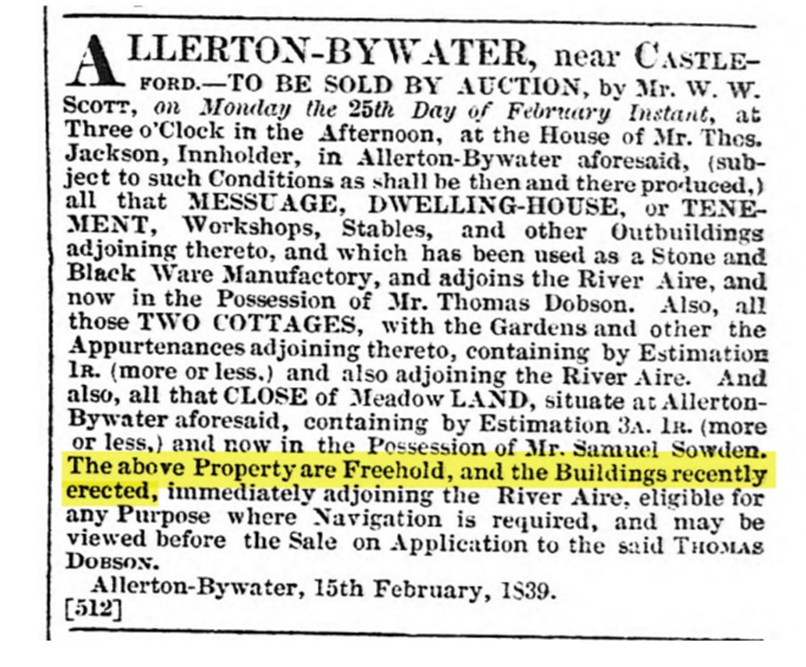
1839 On 15 February 1839 in THE YOKSHIRE GAZETTE, the business is advertised for sale under Thomas Dobson’s name.
IN 1841 CENSUS THOMAS JACKSON IS THE PUBLICAN OF THE FERRY INN (BOAT INN )
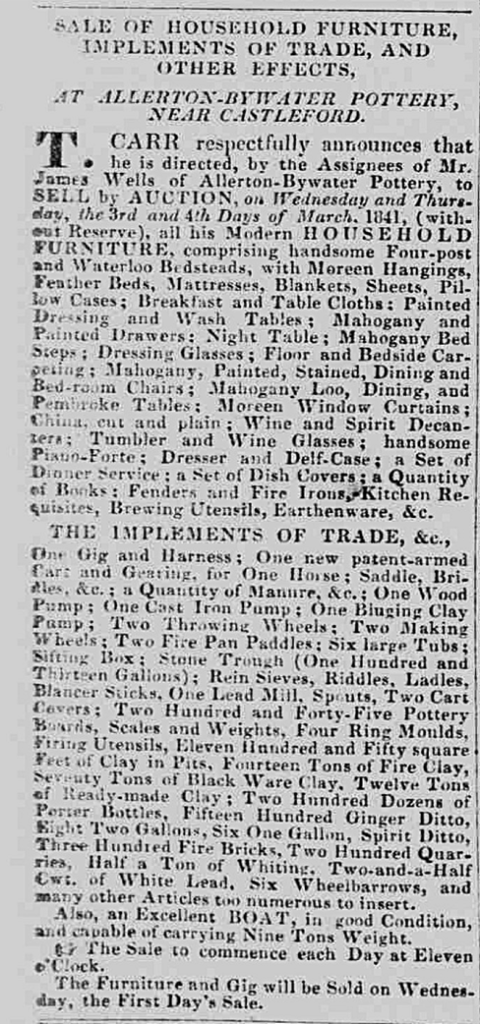
REFERENCE IS MADE TO THE POTTERY IN 1841 SALE
T Carr respectfully announces that he is directed, by the assignees of Mr James Wells of Allerton Bywater Pottery, to sell by auction, on Wednesday and Thursday, the 3rd and 4th of March 1841, (without reserve) all his modern Household furniture and the implements of Trade. –
SALE OF HOUSEHOLD FURNITURE, IMPLEMENTS OF TRADE, AND OTHER EFFECTS,
AT ALLERTON-BYWATER POTTERY, NEAR CASTLEFORD.
T. CARR respectfully announces that he is directed, by the Assignees of Mr. James Wells of Allerton-Bywater Pottery, to sell at AUCTION, on Wednesday and Thursd- ay next, at Eleven o’Clock, (with the usual Reserve,) all hisModern HOUSEHOLD FURNITURE, comprising handsome Four-post and Waterloo Bedsteads, with Moreen Hangings, Feather beds, Mattresses, Blankets, Sheets, Pillow Cases; Breakfast and Table Cloths; Painted Dressing and Wash Tables: Mahogany and Painted Drawers; Night Tables: Mahogany Bedsteps; Dressing glasses Floor and Bedside carpeting; Mahogany Painted Stained, Dining and Bed-room Chairs; Mahogany Loo, Dining, and Pembroke Tables; Moreen Window Curtains; China Cut and Plain; Wine and Spirit Decanters; Tumbler and Wine Glasses; handsome Piano-Forte; Dresser and Delf-Case; A Set of Dinner Service; A set of Dish Covers; A Quantity of Books; Fenders and Fire Irons; Kitchen Requisites, Brewing Utensils, Earthenware, &c. THE IMPLEMENTS OF TRADE, &c. One Gig and Harness; One new patent-armed Car; and Gearings, for One Horse; Saddle, Bridle, &c. A Quantity of Manure, &c.; One Wood Pump; One Cast Iron Pump; One Bluging Clay Pump; Two Throwing Wheels; Two Making Wheels; Two Fire Pan Paddles; Six large Tubs; Sifting Box, Stone Trough; ( One Hundred and Thirteen Gallons) Rein Sieves; Riddles, Ladels, Blancer Sticks, One Lead Mill, Spouts, One Cart Cover; Two Hundred and Forty-Five Pottery Boards, Scale and Weights; Ring Moulds, Firing Utensils; Eleven Hundred and Fifty square feet of Clay in Pits, Fourteen tons of Fire Clay, Seventy Tons of Black Ware Clay, Twelve Tons of Ready made Clay, Two Hundred Dozens of Porter bottles, Fifteen Hundred Ginger Ditto, Eight Two Gallons, Six One Gallon, Spirit Ditto, Three Hundred Fire Bricks, Two Hundred Quarries, Half a Ton of Whiting, Two and Half Cwt. of White Lead, Wh6 Wheelbarrows, and many other Articles too numerous to insert. Also, an Excellent BOAT, in good Condition, and capable of carrying Nine Tons Weight.
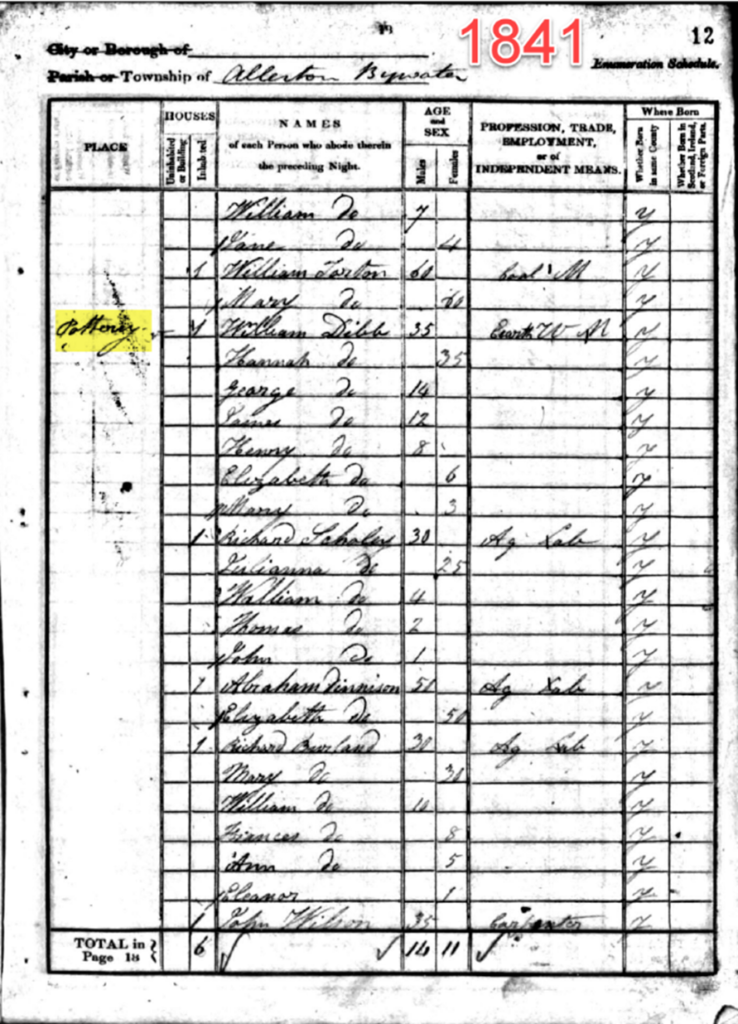
1841 – In the Census taken 6 JUNE 1841
William Dibb appears to have purchased the pottery
It gives his birthplace as Methley and he is described as an Earthenware Manufacturer.
He lives at the Pottery with his wife and 5 children.
William Dibb
35 Years
Hannah Dibb
35 Years
George Dibb
14 Years
James Dibb
12 Years
Henry Dibb
8 Years
Elizabeth Dibb
6 Years
Mary Dibb
3 Years
Earthenwareis one of the most ancient types of pottery produced. It is made from a coarse grain clay and has been used for thousands of years throughout history for a number of different purposes. Over time, earthenware has been made from a type of clay known as red earthenware or, perhaps more familiarly, terracotta.
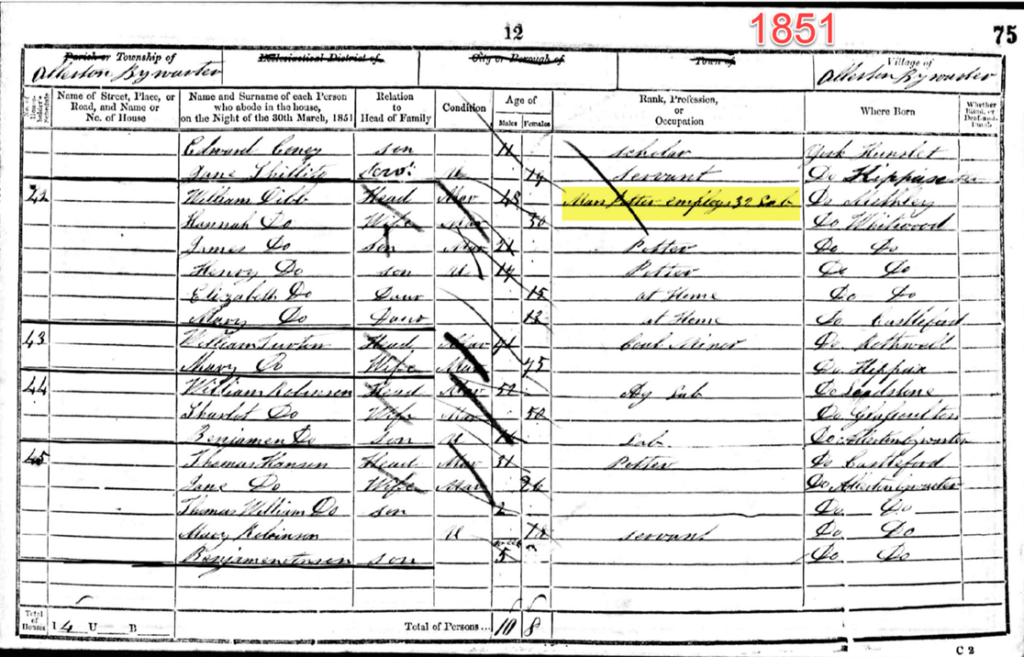
1851 Census.
William Dibb is described as Main Potter employing 32 operatives.
His sons George, James and Henry all work here as Potters
William Dibb
48 Years
Hannah Dibb
50 Years
George Dibb
24 Years (not at home, married and living in Allerton Bywater)
James Dibb
21 Years
Henry Dibb
17 Years
Elizabeth Dibb
16 Years
Mary Dibb
13 Years
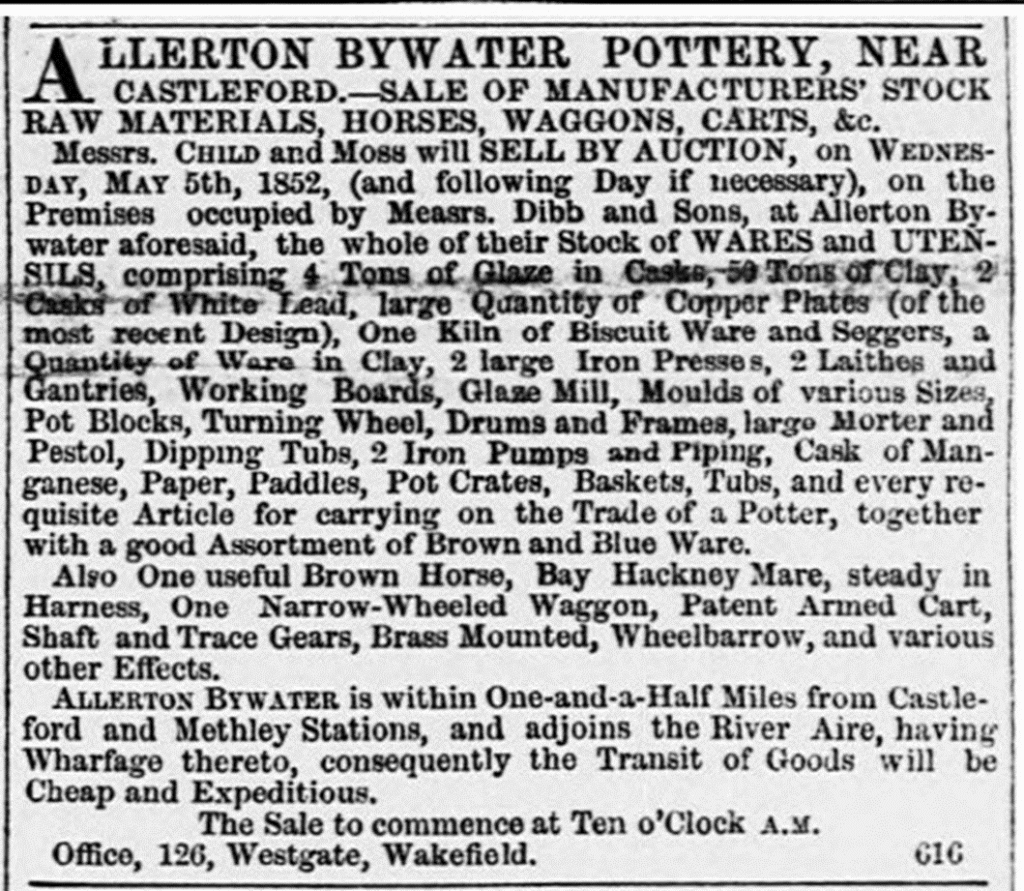
1852 – 1 May 1852 A Sale of manufacturers’ stock, etc., for Mr Dibb and sons.
1861 Census.
William Dibb has moved to Knaresborough and is described as an Earthenware Dealer.
It seems his sons have also moved on and left the pottery.
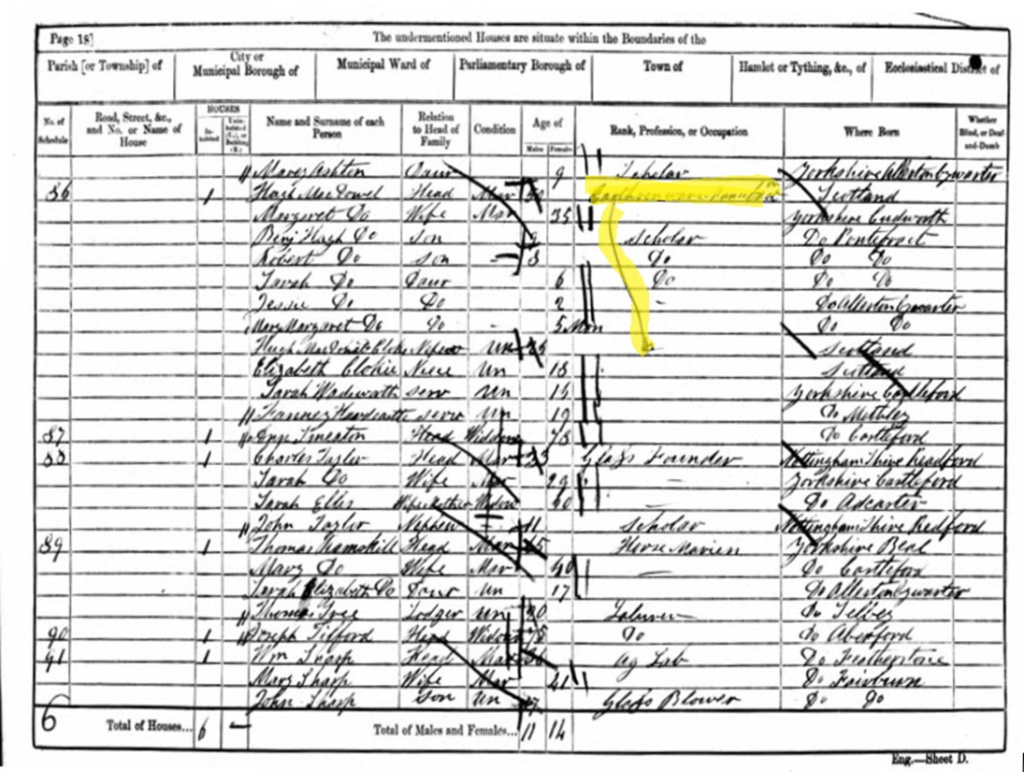
HUGH MacDOWELL appears in Allerton Bywater on the 1861 Census with his wife Margaret, 5 children, a nephew, a niece and 2 servants. He is described as a Earthenware Manufacturer, He originates from Scotland, but has interests in several local potteries between 1856 and 1862 including Allerton Bywater Pottery, Eagle Pottery, and Castleford Mere Pottery under the name of Hugh McDowell & Co
* also living with him are Nephew Hugh Macdowel and Niece Elizabeth who both have the surname “ Clokie “ another name synonymous with the local “ Castleford and Albion potteries “.
Allerton Bywater 1861 Census – Hugh MacDOWELL
Hugh Macdowell
50
Head
Margaret Macdowell
35
Wife
Benj. Hugh Macdowell
9
Son
Robert Macdowell
8
Son
Sarah Macdowell
6
Daughter
Jessie Macdowell
2
Daughter
Mary Margaret Macdowell
5/12
Daughter
Hugh Macdowell Clokie
25
Nephew
Elizabeth Clokie
18
Niece
Sarah Wadsworth
16
Servant
Fanney Hardeartte
19
Servant
For further Reference:-The above 1861 Census appears to indicate that both Hugh Macdowell and Hugh Macdowell Clokie, are both linked as Earthenware manufacturers and are possibly in business together.
Historical Note:-
Heather Lawrencein Yorkshire Pots and Potteries described Hugh MacDowellas ‘something of a tycoon in the pottery trade’. This appears to be an exaggeration, although being involved with a number of potteries in the Castleford area.
He was a tea merchant from nearby Pontefract, but originated from Scotland.
Known for it`s “White Ware ” the Eagle Pottery was the only pottery that MacDowell actually controlled. It had been constructed in 1853 and he purchased it in 1856 after the owners became bankrupt.
He continued here until his death in 1868, firstly as Hugh MacDowell & Co and then as John Roberts & Co.
The partnership with Roberts being dissolved in 1868, shortly before McDowell’s death.
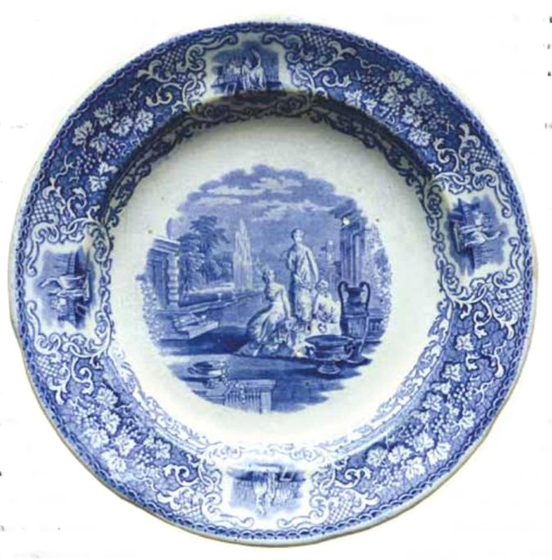
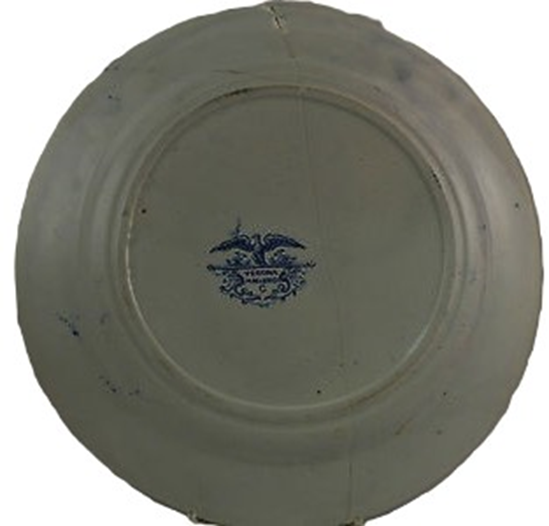
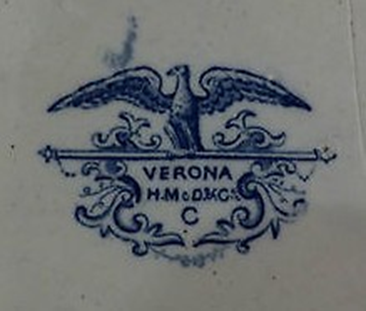
VERONA PATTERN PLATE Attributed to Hugh MacDowell
1861 – Hugh MacDowell died on the 15th of November 1868
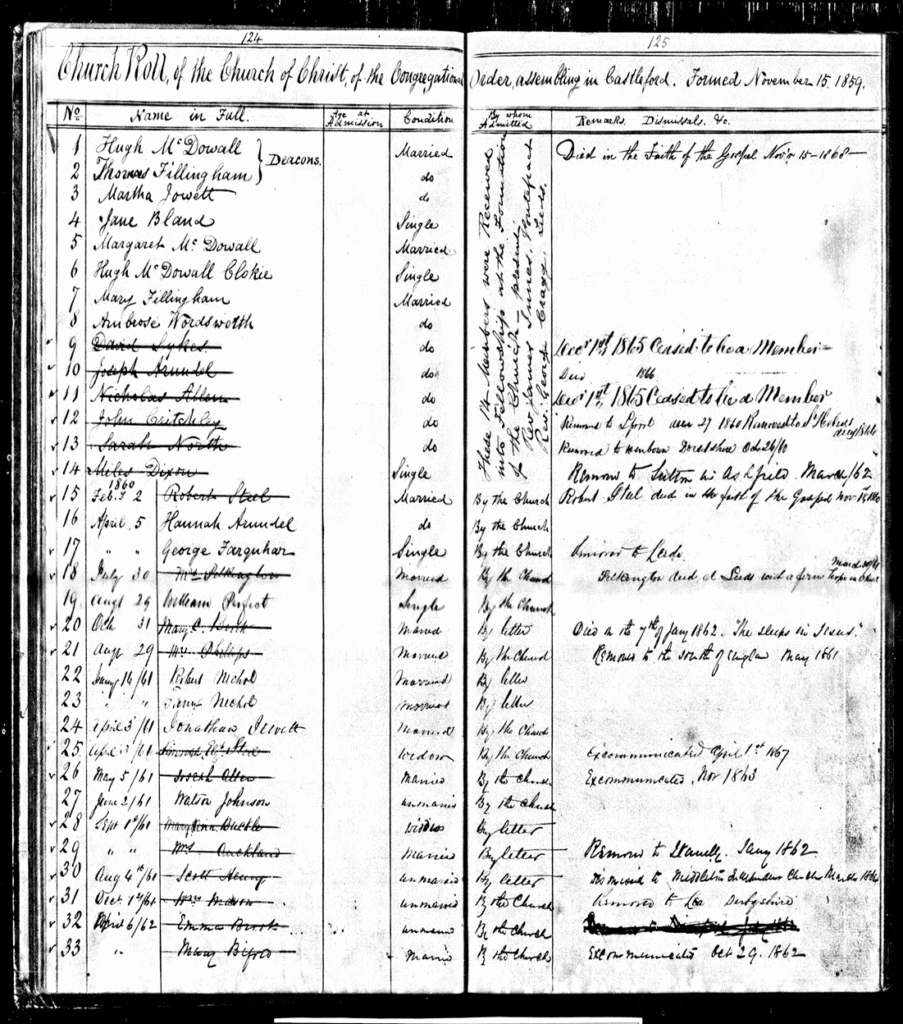
From the document below Hugh MacDowell is listed as a Deacon of The Church of Christ of the Congregation Order and died in the faith of the Gospel –
15th of November 1868
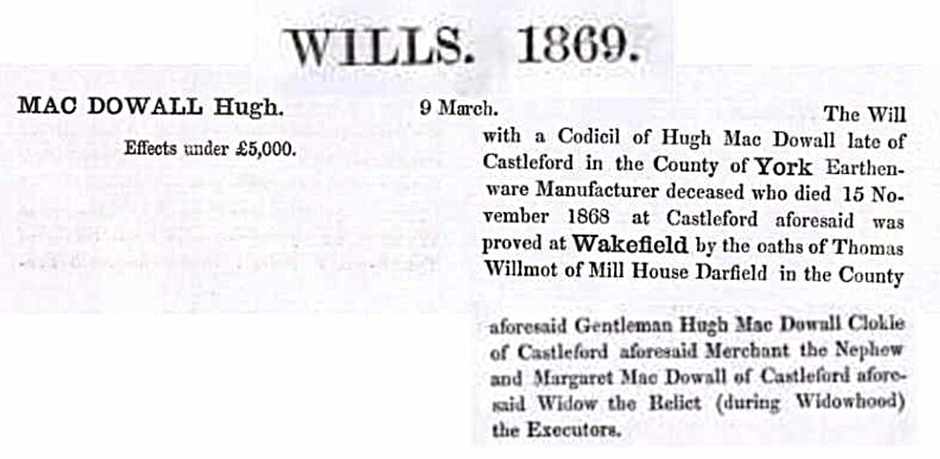
Hugh MacDowell Will 9th March 1869
The Estate of Hugh Macdowell is left to his widowed wife Margaret and Hugh Macdowel Clokie his nephew.
As previously Referenced:-The 1861 Census appears to indicate that both Hugh Macdowell and Hugh Macdowell Clokie, his nephew, are both Earthenware manafacturers and it would seem possible they are both managing their businesses together as this WILL in 1868 appears to confirm.
Pottery workers from Allerton Bywater in the 1861 Census.
All these appear to be potters in Allerton Bywater at this time; however, they may not all have worked at the Allerton Bywater pottery.
Hugh MacDowell
George Dibb
John Ellis
Joseph Dibb
William Robinson
Harriet Dibb
John Robinson
Kate Dibb
Thomas Allerton
George Ashton
Mathew Bullough
William Ashton
Joe Bullough
Samuel Henry Skelton
George Norton
Henry Skelton
Mary Ann Norton
David Skelton
Ellen Norton
1871 Census.
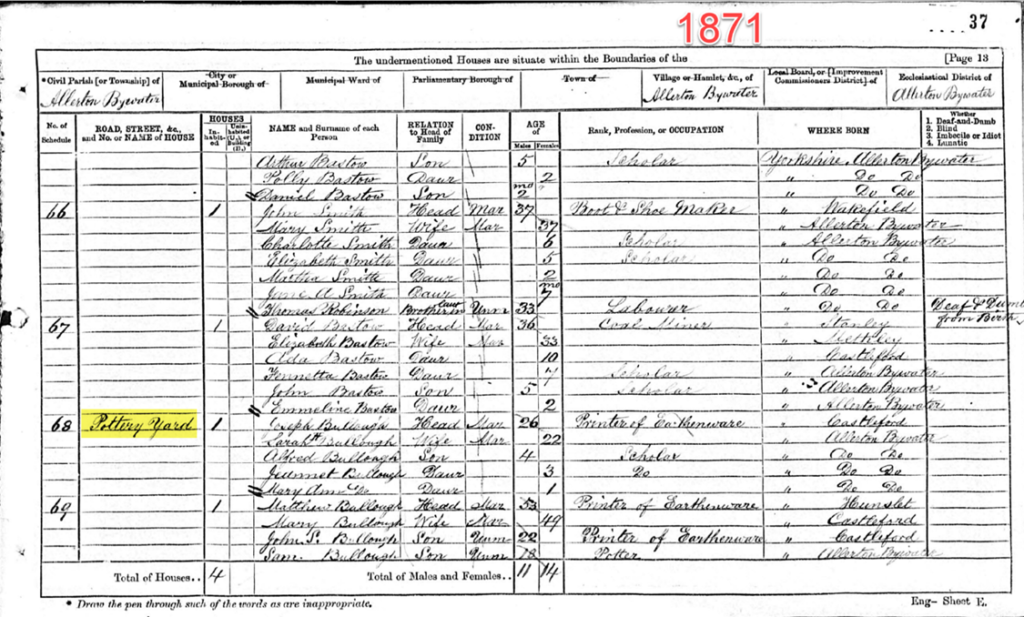
The pottery appears to be still in production in this 1871 Census
Some names are still prominent:-
William Robinson who is described as Handler in Pottery
Joseph, Mathew and John Bullough are described as Printers of earthenware
John Robinson.
Sam Bullough.
Anne Ellis is described as a transferor of pottery.
However this is not a complete list and it is unclear who the actual owner is.
It has to be assumed it is still under the ownership of the beneficiaries of
Hugh MacDowell`s will. “ Hugh Macdowell Clokie “
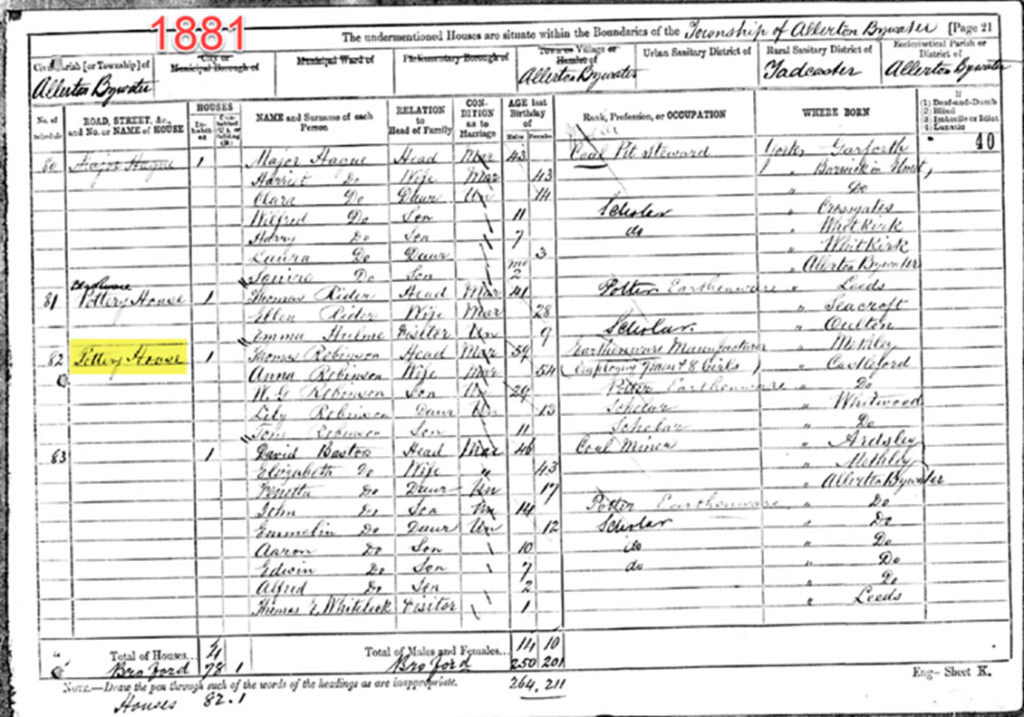
Thomas Robinson appears to be the next owner of Allerton Bywater Pottery; strangely, his prior occupation between 1868 and 1876 was that of a TAILOR.
1871 Census shows he originates from Methley, he is resident in Methley Road, Whitwood Mere, and electoral registers indicate he has a Home, Shop and Premises there.
1871
From the electoral registers of 1876, he appears as resident in Allerton Bywater, but still has a Home, Shop and Premises in Whitwood Mere
1876
1877 he has a pottery business and is resident in Allerton Bywater
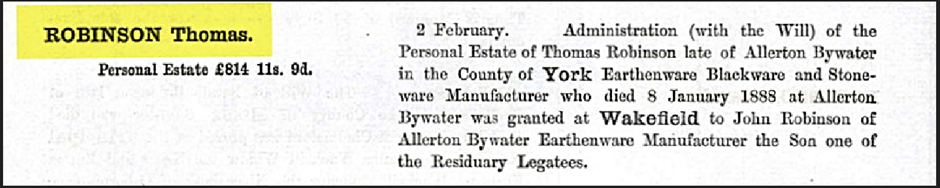
His will – 2 February 1888 values his estate at £814 11s 9d. and passes to his son John Robinson of Allerton Bywater
1888 – Friday 4th of May 1888
Friday 4th of May 1888 a fire broke out at the Pottery
Fires in Leeds.
At about half-past one o’clock, Superintendent Baker received a telegram from Mr. Thomas Robinson, of the Allerton Pottery, near Castleford, to the effect, “Send fire engine at once; fire raging.” The new tender was at once despatched, with two horses attached, and was followed a few minutes later by the steamer, drawn by four horses. In the short space of fifty minutes the scene of the fire was readied, but it was then found that the fire had been extinguished with the exception that the ends of several of the beams were burning. Those the fire brigade soon put out. The building which had been attacked was 20 yards long by eight yards broad, and the upper room in which was stored two tons of straw, this and the roof were destroyed. The damage, which is estimated at £700, is covered by insurance in the Liverpool and London and Globe office. The fire was caused by a pan of wax boiling over.
On the way to Allerton, while turning out of Great Wilson-street into Hunslet Lane, one of the leading horses of the steamer fell, and Police-constable Moore, who was riding it, received such an injury to his knee that he had to turn back. The animal was not injured.
Source – The Leeds Mercury – Friday, May 4, 1888; Issue 15624
A question has to be raised around the sender of the Telegram `Thomas Robinson`, presumably it is the brother and partner of John.
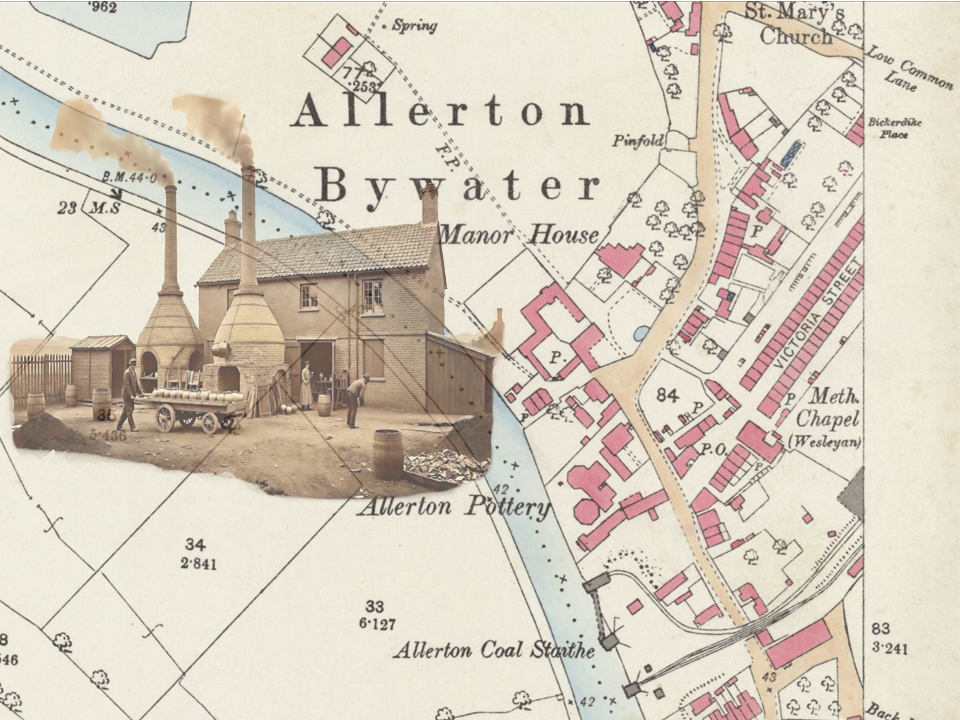
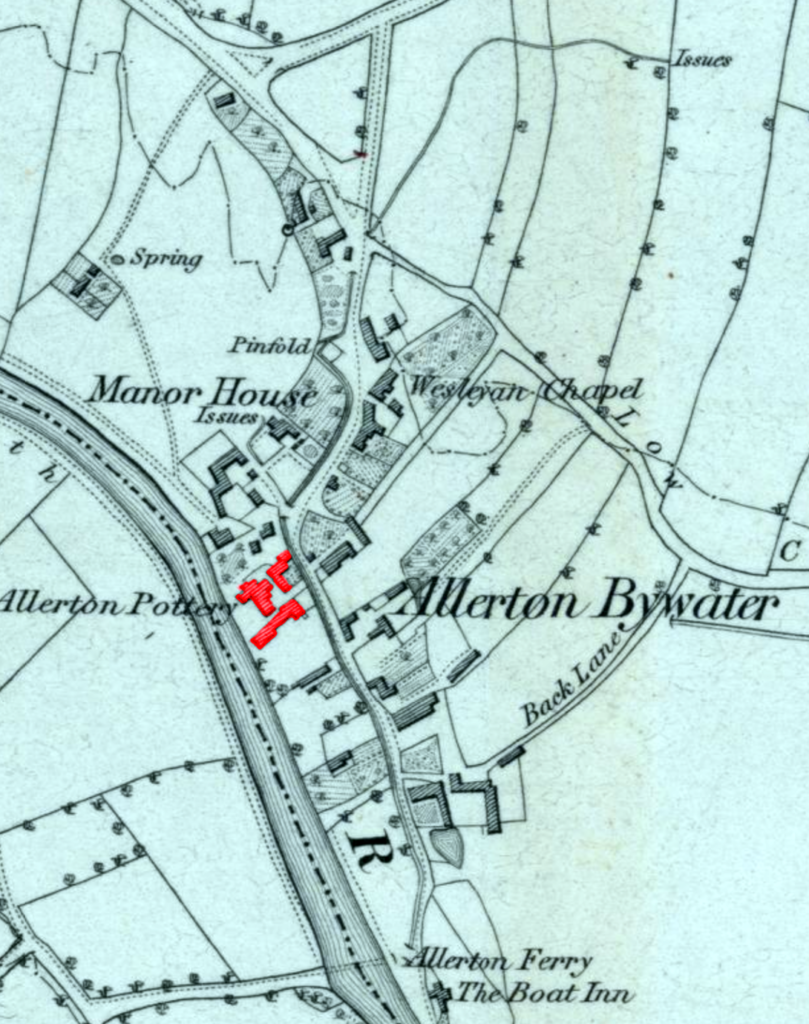
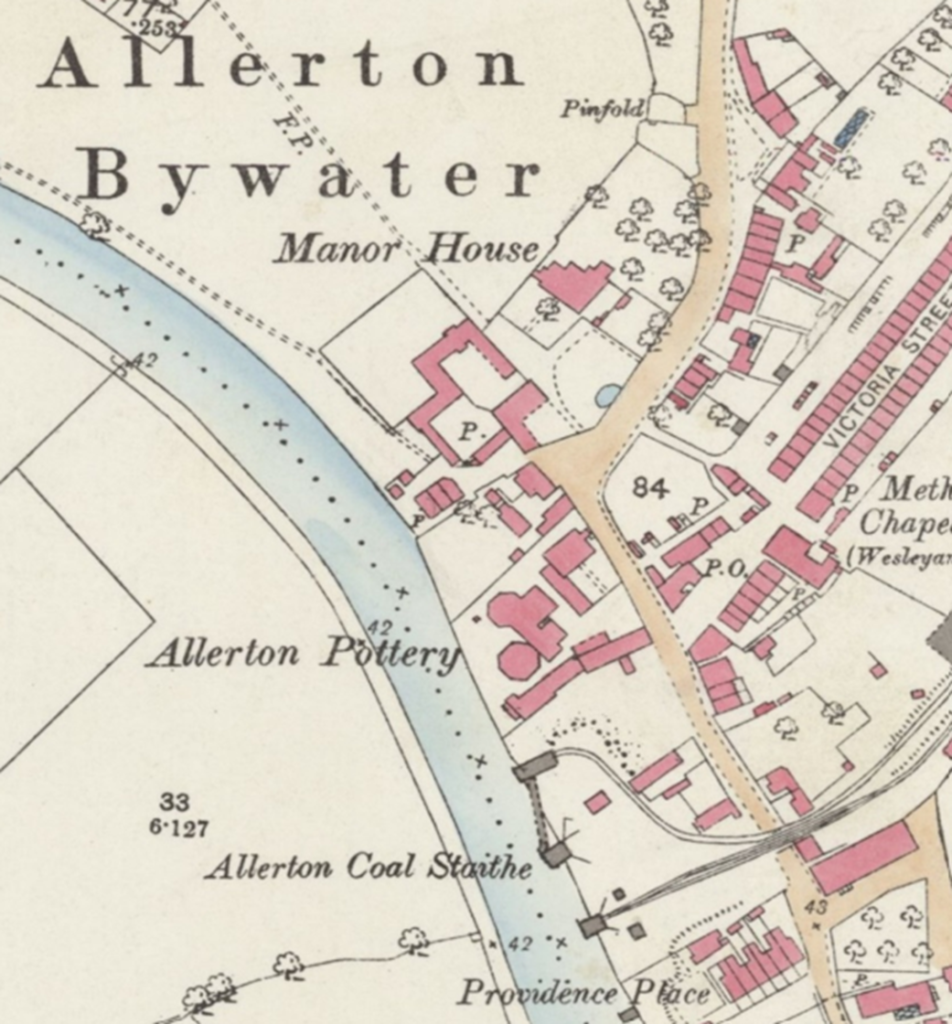
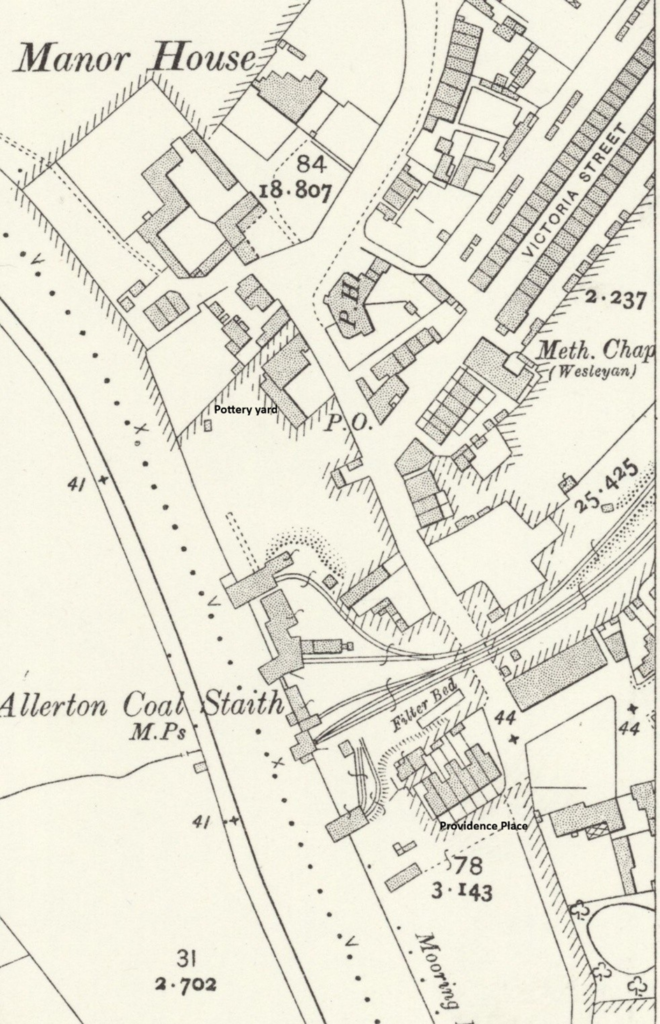
Map showing Pottery around 1890
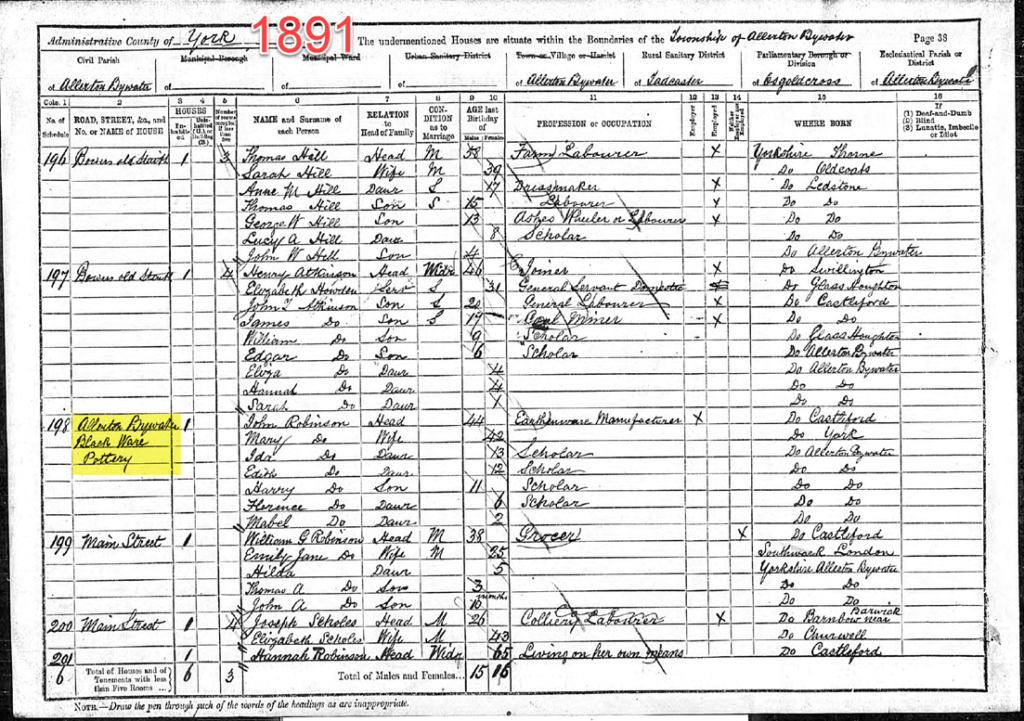
1891 Census
John Robinson is listed as ` Earthenware Manufacturer ` living in Allerton Bywater at the Blackware Pottery, situated on Main Street, with his wife and five children.
Census A
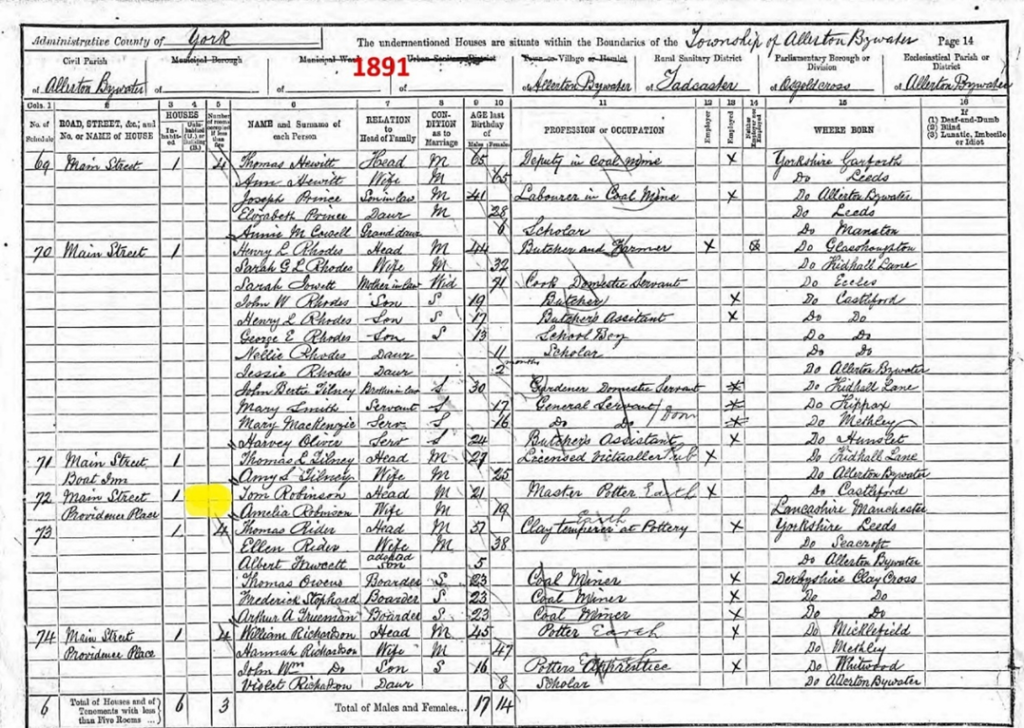
Thomas Robinson is listed as ` Master Potter – Earthenware ` and is living nearby on Main Street Allerton Bywater, at Providence Place.
Census B
Census A
Census B
John Robinson
44
Tom Robinson
21
Mary Robinson
42
Amelia Robinson
19
Ida Robinson
13
Edith Robinson
12
Harry Robinson
11
Florence Robinson
6
Mabel Robinson
2
1891 Robinson Bros. Partnership – John Robinson / Tom Robinson
The historic Allerton Bywater Pottery was operated by the Robinson Brothers (John and Thomas) in the late 19th and early 20th centuries.
1893 The Robinson Brothers owned Eleven Acres Pottery on Nicholson Street, Half Acres. .
POTTERY MARK FOR ROBINSON BROTHERS
They appear to be producing “Blackware and Common Earthenware Pottery”
Information Note:- What is Blackware Pottery ?
How is Blackware pottery made?
It is created through a process that involves combining various natural materials. Firstly, raw materials such as clay, earthen minerals, and water are assembled together. These ingredients are then carefully moulded into desired shapes using techniques like hand-building or wheel-throwing. After shaping, the clay body undergoes a crucial step called firing, where it is placed inside a kiln and exposed to high temperatures. This firing process not only hardens the pottery but also enhances its heat resistance, transforming it into the beautiful and durable ceramic objects we admire.
Creating Blackware pottery employs a distinct technique known as fire reduction. This involves manipulating the oxygen levels within the kiln, resulting in an oxygen-deprived environment. The fire is then suppressed by covering it with cow or horse dung during the firing process, causing the pottery to undergo carbonisation. This meticulous process imbues the pottery with its characteristic black hue, rendering each piece ‘one of a kind.’
What is the use of black pottery?
Black pottery has a diverse range of uses beyond just cooking and food storage. Its unique properties make it an ideal choice for enhancing the flavours and nutritional values of dishes. Additionally, black pottery is renowned for its ability to convert acidic foods into alkaline, promoting better digestion. Its toxin-free nature ensures a healthier cooking environment, making it an excellent option for any kitchen. Moreover, the sleek black appearance of black pottery adds an elegant touch to any table setting, making it a versatile and aesthetically pleasing option for serving food.
1898 The Allerton Pottery is in the hands of his executors
WEDNESDAY 23 FEBRUARY 1898
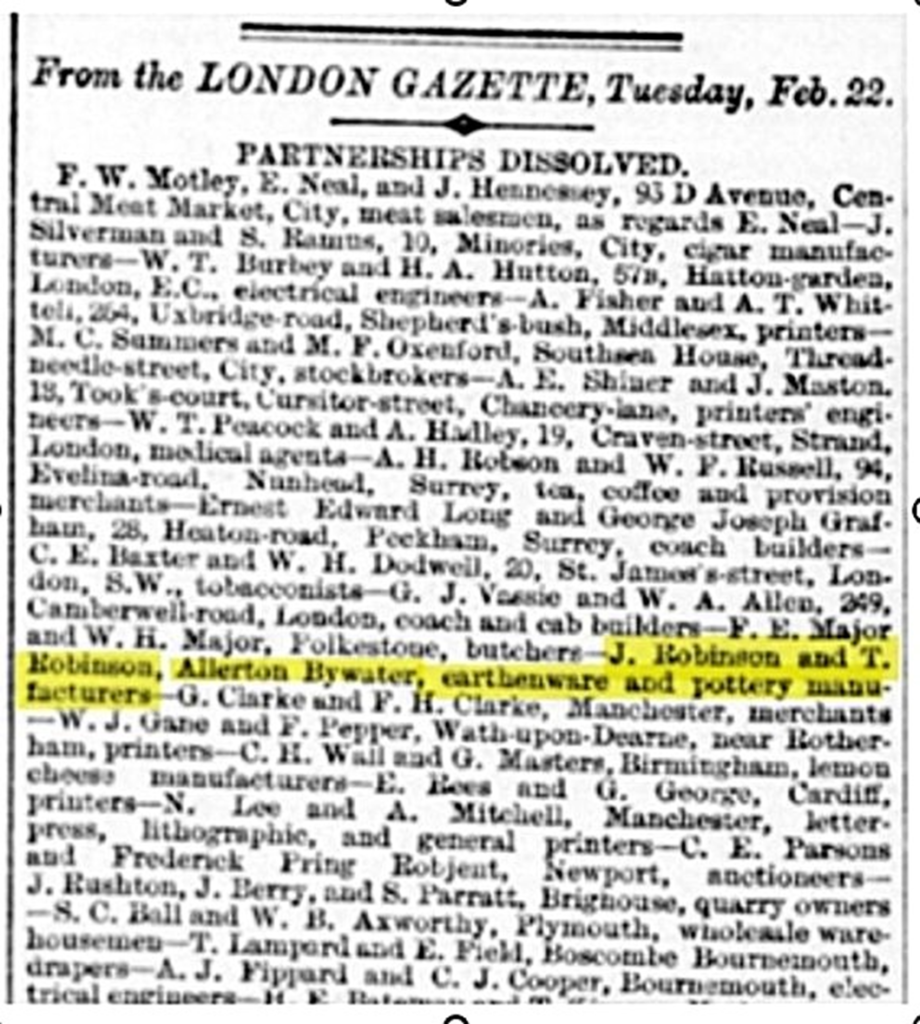
PARTNERSHIPS DISOLVED
J. Robinson and T. Robinson, Allerton Bywater earthenware and pottery manufacturers
JOHN ROBINSON CONTINUES HIS POTTERY CONCERNS IN CASTLEFORD AREA
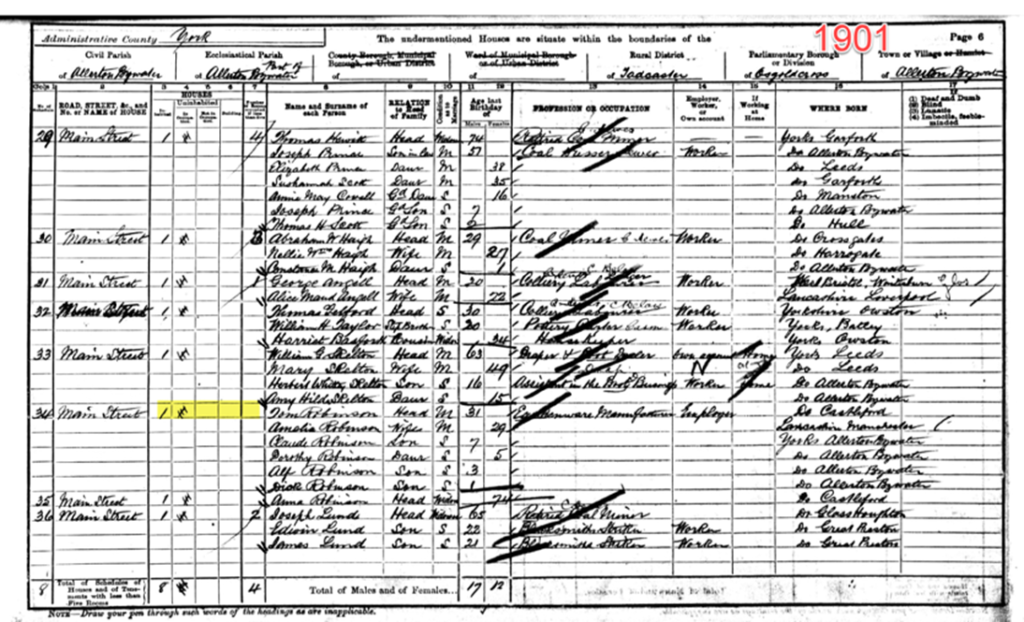
TOM ROBINSON CONTINUED TO RUN THE ALLERTON BYWATER POTTERY AFTER THE PARTNERSHIP WAS DISSOLVED.
1901Census – TOM ROBINSON
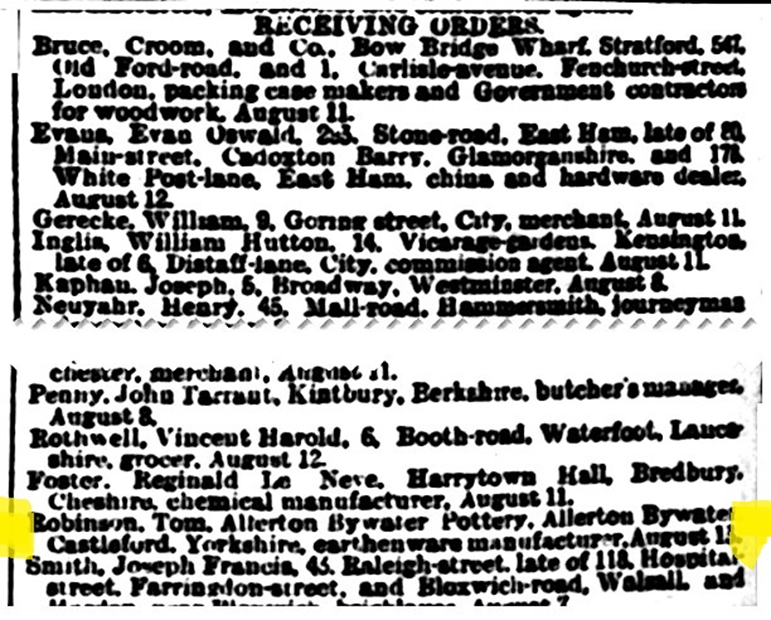
1902 – Tom Robinson faced bankruptcy at the Allerton Pottery
16 August 1902
Receiving orders on Tom Robinson 13 August 1902
THE EDINBURGH GAZETTE, AUGUST 19, 1902.
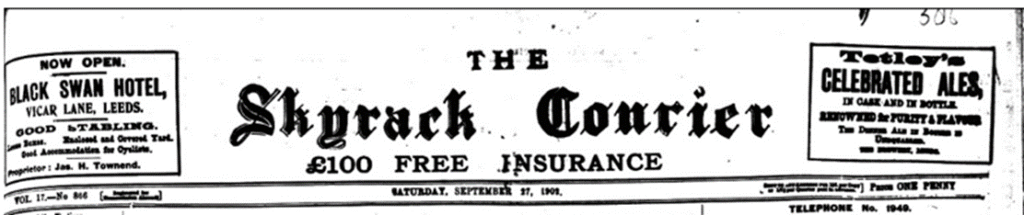
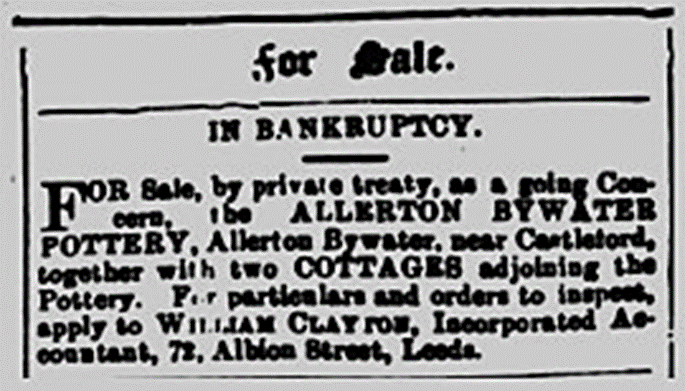
1902 – For sale due to bankruptcy.
SATURDAY27 September 1902
For sale by private treaty, as a going concern, the ALLERTON BYWATER POTTERY, Allerton Bywater near Castleford, together with two COTTAGES adjoining the Pottery. For particulars and orders to inspect, apply to WILLIAM CLAYTON, Incorporated accountants, 72 Albion Street, Leeds.
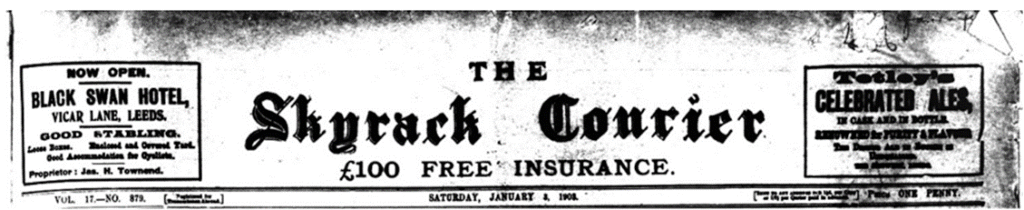
1903 — For sale with covenant
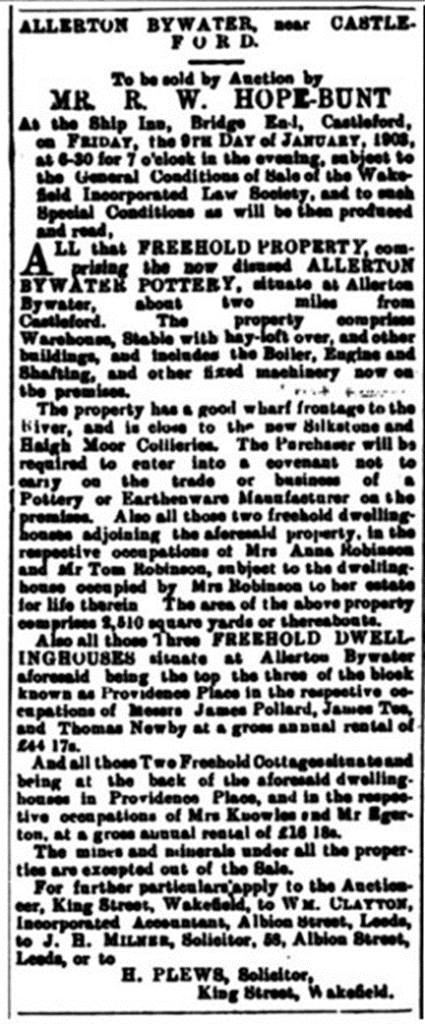
03 SATURDAY January 1903
TRANSCRIPTION
3 JANUARY 1903. – ALLERTON BYWATER, CASTLEFORD.
To be sold by Auction by MR. R. W. HOPE-BUNT
At the Ship Inn, Bridge End, Castleford, on FRIDAY, the 9TH DAY of JANUARY, 1863, at 8-30 or 7 o’clock in the evening, subject to the General Conditions of Sale of the Wakefield Incorporated Law Society, and to such Special Conditions as will then be produced and read.
ALL that FREEHOLD PROPERTY, comprising the NEW disused ALLERTON BYWATER POTTERY, situate at Allerton Bywater, about two miles from Castleford.
The property comprises Warehouse, Stable with hay-loft over, and other buildings, and includes the Boiler, Engine and Shafting, and other fixed machinery now on the premises.
The property has a good wharf frontage to the river, and is close to the new Silkstone and Haigh Moor Collieries.
The purchaser will be required to enter into a covenant not to carry on the trade or business of a Pottery or Earthenware Manufacturer on the premises.
Also all those two freehold dwelling-houses adjoining the aforesaid property, in the respective occupations of Mrs Anna Robinson and Mr Tom Robinson, subject to the dwelling-house occupied by Mrs Robinson to her estate for life therein.
The area of the above property comprises about 2510 acres, square yards or thereabouts.
Also all those Three FREEHOLD DWELLING HOUSES situate at Allerton Bywater aforesaid being the top three of the block known as Providence Place in the respective occupations of Messrs James Pollard, James Tee?, and Thomas Newby at a gross annual rental of £44. 17s.
And all those Two Freehold Cottages situated and being at the back of the aforesaid dwelling-houses in Providence Place, and in the respective occupations of Mrs Knowles and Mr Egerton, at a gross annual rental of £16 18s.
The mines and minerals under all the properties are excempted out of the Sale.
For further particulars apply to the Auctioneer, King Street, Wakefield, or to W.M. CLAYTON, Incorporated Accountants, Albion West, Leeds to J. R. MILNES?, Solicitor, 86, Albion Street, Leeds or to H. PLEWS, Solicitor, King Street, Wakefield.
1903 –The pottery is no longer an active commercial enterprise; the site was located between the River Aire and Main Street and the business closed down.
1908 – Map showing Pottery around 1908
1911
John and Tom Robinson both maintain occupations in the Pottery business
2022
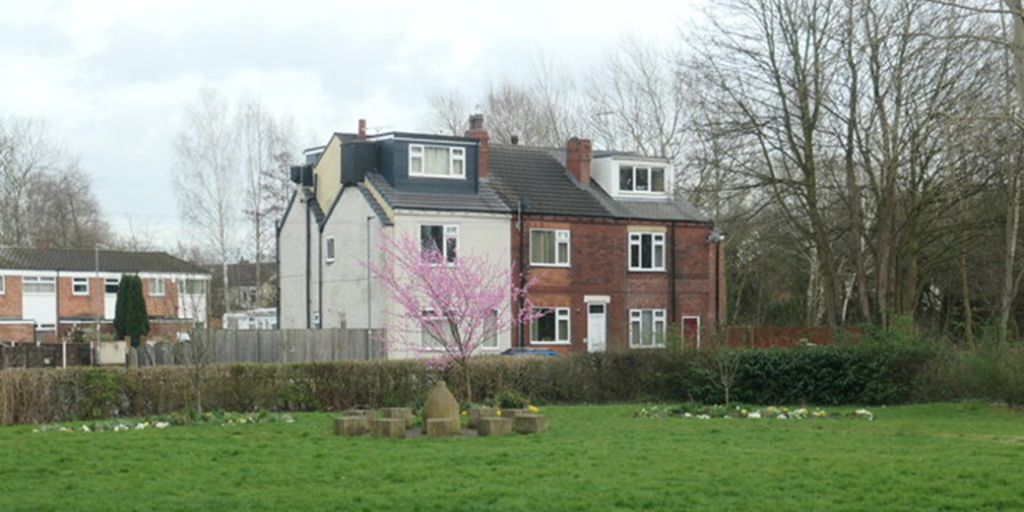
Public Garden, Allerton Bywater
In the middle of the seating area is a model of a bottle oven. This commemorates the Allerton Bywater pottery which was close to this site. The pottery was in business by 1838 but had closed by 1903
BACKGROUND INFORMATION TO ALLERTON BYWATER and LOCAL POTTERIES
And the ROBINSON FAMILY
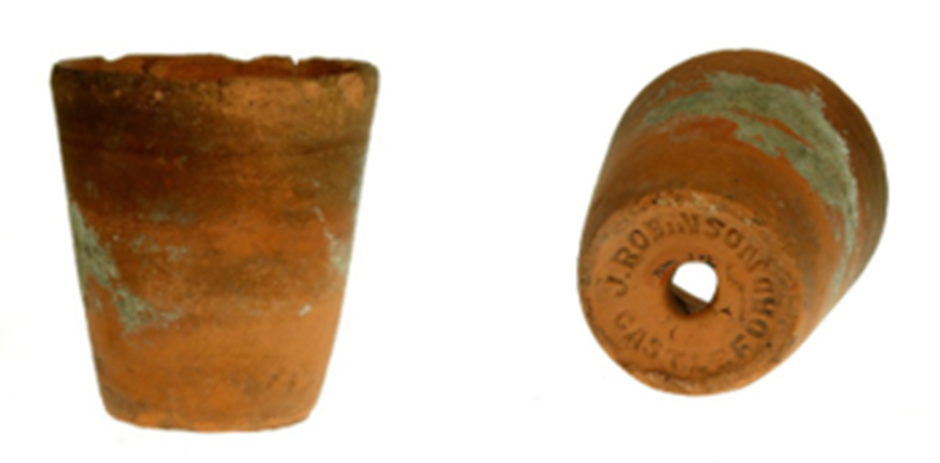
The brothers, John and Tom Robinson, also operated a pottery in Castleford known as Eleven Acres Pottery. Examples of their red earthenware flowerpots are shown below. The Encyclopaedia of British Pottery and Porcelain Marks gives two marks for the Allerton Pottery: R.B. for Robinson Brothers (1897–1904) and J.R & S. for John Robinson & Son (1905–1933).
Red Earthenware Flower Pots
Smaller Castleford potteries produced inexpensive white earthenware. A few continued to use the coarser local red clay. Products included pancheons, ovenware, and stoneware bottles.
Clokie and Masterman established its pottery on the site of the Dunderdale pottery in 1825. The pottery changed names frequently, Castleford Pottery, Albion Pottery, and the Britannia Flint Mills. Clokie and Masterman specialized in plain white and blue band wares. The company also produced institutional China. Pieces from the 1920s and 1930s featured Art Deco designs.
Clokie & Co., Ltd., closed in 1961.
ARTICLE – Researched and Produced by :-
John and Keith Dickinson – Mick Taylor
Thanks to all who have previously researched the subject, some of which has been used to enhance the article
Herbert Smith, a towering figure in British trade unionism, rose from abject poverty in the Yorkshire coalfields to lead the miners through some of the most tumultuous labour struggles of the early 20th century. Born into hardship, he became a symbol of working-class resilience, advocating fiercely for miners’ rights while navigating complex industrial and political landscapes. His life embodied the grit of the mining communities he represented, marked by personal triumphs, union leadership, and unyielding opposition to exploitation.
Early Life and Entry into Mining (1862–1880s)
Herbert Smith was born on July 17, 1862, in the poor house (Gilbert Union workhouse) at Great Preston, near Kippax. His father, a miner, had been killed in a mining accident days earlier, and his mother died shortly after, leaving him orphaned. He spent his early years in the workhouse until adopted by Samuel Smith, a miner, and his wife Charlotte. (We can’t be certain that Smith was his birth name with him being adopted).
Smith received no formal schooling initially but later studied informally in Glasshoughton and Pontefract. Reared by his foster parents, he experienced the harsh realities of poverty firsthand, including time in a workhouse, which later fuelled his commitment to social welfare.
At age nine, in 1871, Smith began working in the fields. By age ten, in 1872, he descended into the pits at Glass Houghton Colliery, enduring the gruelling conditions typical of child labour in Victorian mining. Despite his youth, he quickly became active in union affairs. At seventeen, around 1879, he was elected to his union’s branch committee, marking the start of his lifelong involvement in trade unionism. He also developed a reputation as a talented boxer, holding titles as a prize fighter in the Yorkshire coalfields, which honed his fighting spirit.
Before turning twenty-one, likely in the early 1880s, Smith was elected to a local school board, serving as its chairman for twelve years. He also became a Guardian of the Poor, drawing on his own workhouse experiences to advocate for the vulnerable, much like fellow unionist Will Crooks.
Rising Through Union Ranks (1889–1905)
In 1889, Smith participated in the conference that formed the Miners’ Federation of Great Britain (MFGB), a pivotal step in unifying miners’ unions nationally. Officers included Ben Pickard as president, and the federation started with 36,000 members.
By 1894, his peers elected him as checkweighman at Altofts Colliery, a role ensuring fair weighing of coal and protecting miners’ earnings. In 1896, he became Chairman of the Castleford Trades Council, expanding his influence in local labour circles. In 1897, Smith joined the Independent Labour Party (ILP), aligning with socialist ideals that would shape his career.
In 1902, he was appointed to the joint board of the South and West Yorkshire Coal owners and Workmen, facilitating negotiations between labour and management. The following year, in 1903, he was elected to the West Riding County Council, demonstrating his growing political stature. In 1904, he advanced to Vice-President of the Yorkshire Miners’ Association (YMA).
Leadership in Yorkshire and National Emergence (1906–1913)
In 1906, Smith was elected President of the YMA, a position he held until his death in 1938. Under his leadership, he emphasized practical knowledge of mining, spending about three days a fortnight underground to stay connected with workers’ realities. This hands-on approach earned him respect and an unrivalled expertise in mining operations.
Smith stood unsuccessfully as a Labour Party candidate in the Morley constituency during the December 1910 general election, highlighting his ambition to influence policy through Parliament. That same year, he led rescue efforts at the Wellington Pit Disaster in Whitehaven, showcasing his bravery and commitment to miners’ safety—a pattern that would recur.
In 1912, during the Cadeby Main Colliery disaster, which claimed 136 lives, Smith performed exhaustive rescue work. King George V and Queen Mary visited the site, where the Queen was overcome by the tragedy. Eight years later, in 1920, upon being presented to the Queen, she recalled him as “the big man in a little brown jersey who went down the Cadeby mine,” underscoring his memorable presence.
World War I and Post-War Roles (1914–1921)
In 1914, Smith played a key role in forming the Triple Industrial Alliance with the National Union of Railwaymen and the National Transport Workers’ Federation, aiming for coordinated industrial action to challenge state power. However, the outbreak of World War I halted potential strikes, leading to an “Industrial Truce” where unions agreed to avoid disruptions in exchange for profit limitations on war-related industries.
During the war, miners’ output was critical, but enlistment depleted the workforce by 17.1%. Smith navigated wage disputes, including a 1915 South Wales strike where miners secured an 18.5% increase after government intervention. In 1916, amid coal shortages, the government assumed control of the industry, appointing Alfred Milner as Coal Controller. Smith was appointed to the Coal Controller’s Advisory Board in 1917.
That year, he also became Vice-President of the MFGB, serving until 1922. In 1921, he was elected President of the Miners’ International Federation, holding the role until 1929.
Presidency of the MFGB and Major Disputes (1922–1926)
In 1922, Smith was elected President of the MFGB, succeeding Robert Smillie. He also served as a Trades Union Congress (TUC) representative to the American Federation of Labour that year, alongside Edward L. Poulton. Elected to Barnsley Town Council in November 1923, he served for eleven years.
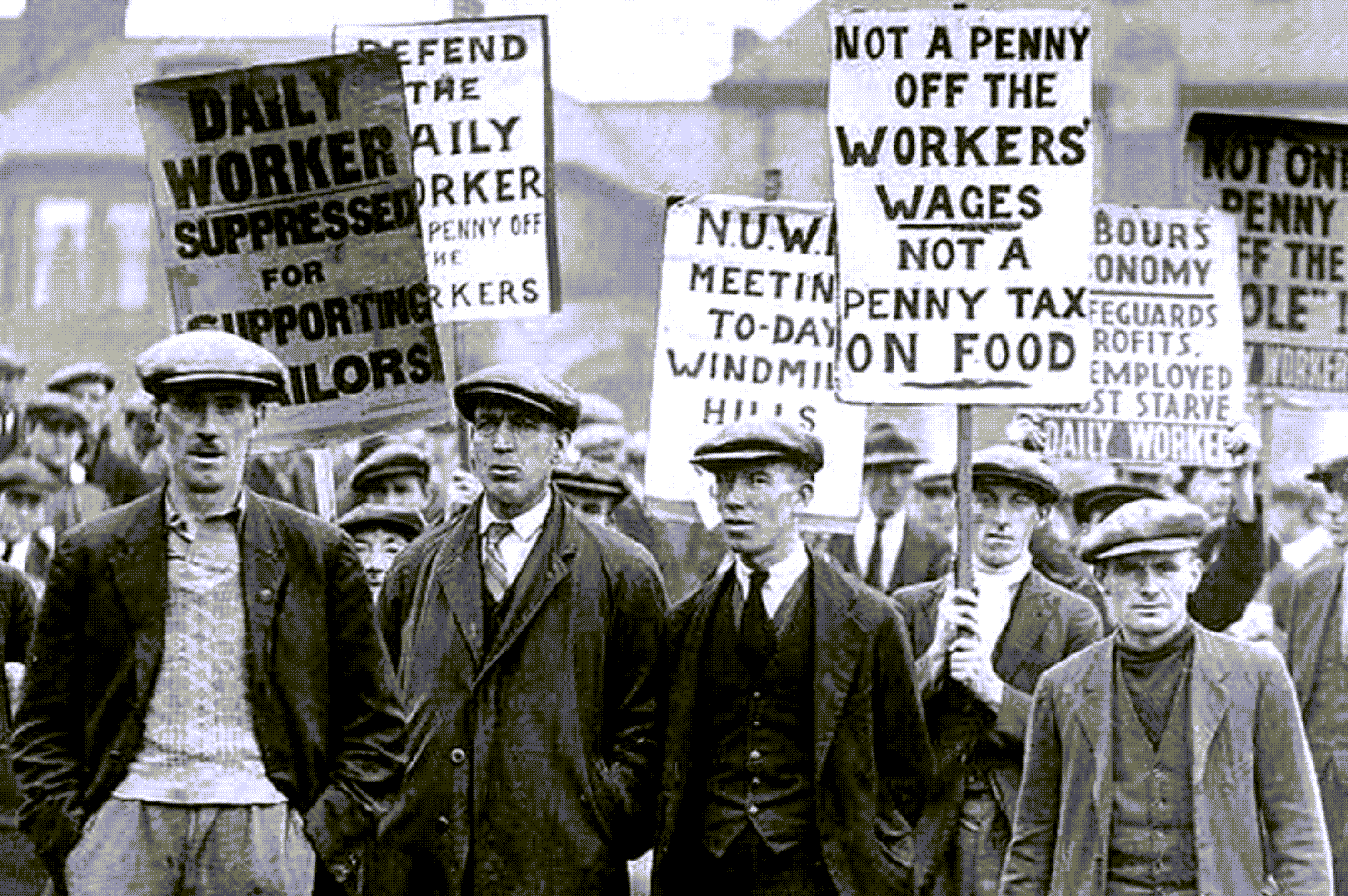
In 1924, Smith led the MFGB in a successful wage dispute, securing increases for miners. The following year, on June 30, 1925, mine owners announced wage cuts, prompting threats of a general strike. Backed by transport and railway unions, the miners held firm with the slogan “Not a penny off the pay, not a minute on the day.” On July 31, the government capitulated, providing a subsidy until May 1, 1926 – an event dubbed “Red Friday” as a victory for labour solidarity.
The Samuel Royal Commission, established to investigate the industry, reported in March 1926, criticizing owners but recommending subsidy withdrawal and wage reductions while rejecting nationalization. Smith rejected the report outright, reaffirming the miners’ stance.
The General Strike and Lockout (1926)
In May 1926, failed negotiations led to the General Strike, called by the TUC in support of the miners. Over 1.7 million workers struck, paralyzing industries. Smith, alongside MFGB Secretary A. J. Cook, led the miners, but tensions arose with TUC leaders like Jimmy Thomas. The strike ended on May 12 after nine days, with the TUC accepting Samuel’s terms, leaving miners locked out.
The seven-month lockout followed, with the government suspending the Seven Hours Act, allowing an eight-hour day. Hardship mounted, and by November, most miners returned to work under worse terms, facing victimization and blacklisting. Smith blamed the defeat on disunity but praised the miners’ motives.
Later Career and Resignation (1927–1934)
Post-strike, the 1927 Trade Disputes Act curtailed union powers, leading to MFGB membership declines. In 1929, Smith resigned as MFGB President in protest against an agreement to lengthen mining hours, which Yorkshire miners opposed. He unsuccessfully sought re-election in 1930 and 1931.
At the 1930 Miners’ Federation Conference in Weston-Super-Mare, Smith defended Yorkshire against accusations of desertion during the 1926 disputes, amid stormy debates over the “butty” system and national agreements.
Smith continued rescue work, including the Bentley Pit Disaster in 1931 and the Wharncliffe Woodmoor Colliery Disaster in 1936. In 1932, he served as Mayor of Barnsley. A 1931 nationwide collection among miners funded a bust of him at Barnsley’s Miners’ Hall and homes for aged miners named in his honour.
In November 1934, at age seventy-two, Smith retired from Barnsley Town Council after eleven years of service.
Final Years and Legacy (1935–1938)
Smith remained YMA President until his death. Known for his massive build, strong jaw, and tenacity, he was a formidable negotiator with a suspicious nature toward capitalism, yet sensitive to hardship and infused with Yorkshire humour. He distrusted figures like Lord Northcliffe and fought communism within unions.
On June 16, 1938, Smith died at age seventy-five in his Miners’ Association office at 2 Huddersfield Road, Barnsley. His legacy endures as a “gallant old fighter” devoted to miners, embodying the struggle for fair wages and conditions. Obituaries highlighted his rise from workhouse orphan to union leader, and his gruff, broad Yorkshire demeanour.
Smith’s career exemplified the transition from local activism to national leadership, influencing labour history through his role in the General Strike and advocacy for miners’ welfare. Though criticized for doggedness and limited vision, his lifelong dedication inspired generations.
Citations and Credits
Primary details drawn from provided documents: (Spartacus Educational biography by John Simkin, updated January 2020);
This page is a placeholder for information, about the village, found during our research. It will be updated, ammended or corrected whenever new information is discovered.
Roman Period:
A Roman transport route from Castleford to York bypassed the area.
The River Aire likely used by Romans to supply forts, including Castleford.
Possible presence of Roman watchtowers along the River Aire.
Medieval Period:
1410: Records indicate tithes of coal were being paid to the Vicar of Kippax, suggesting early coal mining activity in the parish, which included Allerton Bywater.
17th Century:
Demand from West Riding towns for better transport to Hull and the high seas drives the development of the Aire & Calder Navigation.
1656: Sir John Lowther of Roundhay purchases the hamlets of Great Preston and Astley, recognizing the value of their “rich coal mines and lime quarries.”
18th Century:
1699: An Act of Parliament is passed to make the River Aire navigable from Leeds, requiring the construction of locks.
Early 18th Century: Small boats begin to reach Leeds Bridge from Knottingley (by November 1700).
The Aire & Calder Navigation becomes a major waterway, facilitating coal transport and import of raw materials.
1750s: Increasing traffic on the Aire & Calder Navigation leads to complaints of delays and the poor state of the river.
1775: William Jessop appointed as Consultant Engineer for the Aire & Calder Navigation; his improvements allow for larger, 60-ton boats.
19th Century:
Early 19th Century: The area around Allerton Bywater is predominantly agricultural, with limited impact from early collieries like Fenton and Carter.
1816: Completion of the Leeds and Liverpool Canal further increases traffic on the Aire & Calder Navigation, necessitating more improvements.
Early 19th Century: Humber Keels and sloops are used for trade on the Aire & Calder, with masts and sails lowered at Goole and horses used for towing inland.
1822: Passenger services established on the Aire & Calder Navigation between Selby and Hull.
1825: A new canal from Knottingley to Goole opens.
1826: The Port of Goole opens, boosting trade on the Aire & Calder.
c. 1830: Passenger numbers on the Aire & Calder peak at around 20,000 per year.
1835: Steam packet services between Leeds and Goole cease due to the owner’s death.
1838: An Indenture of Enforcement mentions Thomas Davison Bland and Thomas Dobson in relation to the Allerton Potteries.
1841: Census shows the majority of males in Allerton Bywater were farmers or farm labourers, with mining a minority.
1843: Description of the “take” of the newly sunk Allerton Bywater Colliery (likely the Haigh Moor Seam).
1853: W H Bartholomew appointed Chief Engineer of the Aire & Calder Navigation; he develops the “Tom Puddings” compartment boats, significantly increasing carrying capacity.
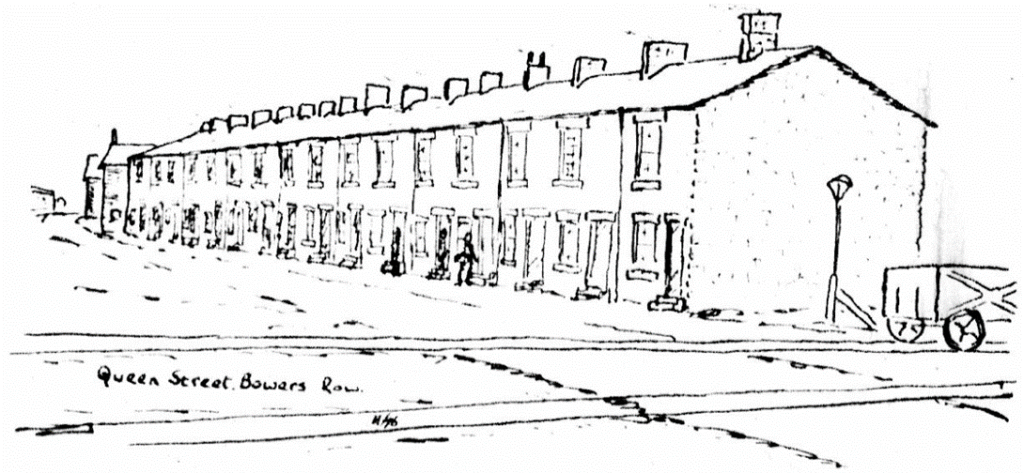
Late 1860s: Victoria Street, a double row of 58 terraced houses, is built to accommodate the influx of coal mining families.
1863: Foundation stone of St Mary the Less Church laid by Mrs Davison Bland.
1865: St Mary the Less Church consecrated.
1867: January 1st. Parish of Allerton Bywater formed from Kippax.
Mid-1870s: Thomas Carter decides to sink new shafts to exploit lower seams (Silkstone and Beeston) as his existing Haigh Moor colliery nears the end of its working life. This marks the establishment of the “present” Allerton Bywater Colliery.
1875: The New Silkstone and Haigh Moor Colliery (the “present” colliery) begins operation. The Kippax Colliery at Owl Wood also opens around this time.
Late 1870s/Early 1880s: Significant increase in the population of Allerton Bywater due to the new collieries.
1881: Thomas Robinson in occupation of Allerton Bywater Pottery.
1883: Thomas Robinson leases the Allerton Potteries for ten years.
December 1888: Sale of the Allerton Bywater Colliery completed, with John Edey becoming the owner.
1897: Henry C. Embleton expresses concerns about the sale price of the colliery to John Edey.
November 1897: Litigation by the Silkstone & Haigh Moor Coal Company against John Edey commences.
1898: Silkstone and Haigh Moor Coal Company sues John Edey for misconduct in the colliery sale.
February 1899: Mr. Justice Stirling delivers judgement, ruling that the sale of the colliery to John Edey should not stand, and appoints Receivers and Managers.
Late 1890s: Allerton Bywater Colliery secures leases for coal under land owned by John Bland and Charles Lowther.
December 1899: Dispute between the Colliery Co. and Estate Owners regarding unauthorised working of the Firthfield Seam.
20th Century:
Early 20th Century: The Co-operative Society establishes a presence in Allerton Bywater.
May 1900: Allerton Bywater Colliery sets a new weekly output record of 9,140 tons.
June 1900: The Colliery is connected to the town’s water supply but faces restrictions, leading to the sinking of its own wells.
1902: The New Silkstone & Haigh Moor Collieries Limited is incorporated and purchases Allerton Bywater Colliery.
1904-1905: Driving of a drift to reach the Flockton Thin Coal at the Allerton Bywater Colliery.
1905: Compressed air coal cutting machines introduced at Allerton Bywater Colliery.
May 1905: Contract drawn up for sinking a staple pit at the colliery.
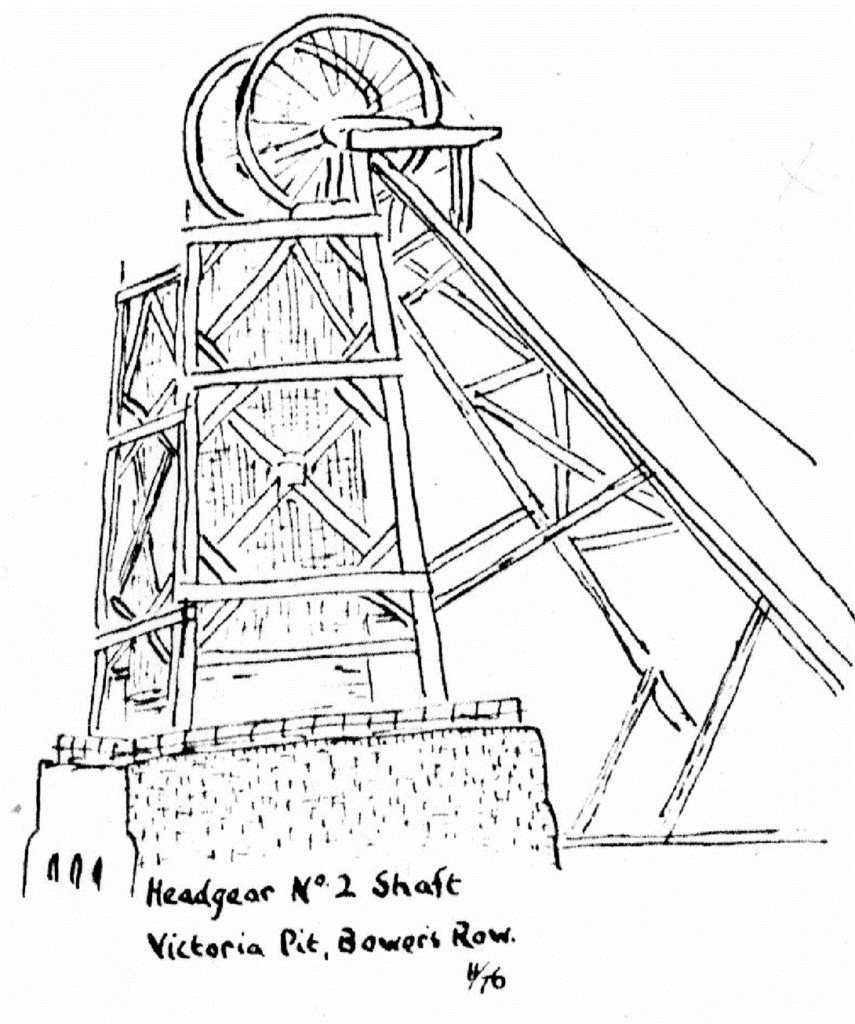
1906: A Bradley & Craven steam winding engine installed at No. 2 Shaft of the colliery.
March 1906: The Haigh Moor Seam is opened out at the colliery through drifts driven across the Methley Junction Fault.
1907: Major G.H. Peake buys a majority stake in The New Silkstone & Haigh Moor Collieries Limited.
1908: The Colliery Company re-registered as The New Silkstone & Haigh Moor Coal Company Limited 1908.
January 1910: The Co-operative Number 2 branch relocates to Station Road.
c. 1912: The Staple Shaft at the colliery is deepened to the Beeston Seam.
1915-1916: Correspondence regarding the working of a coal pillar under property at Nova Scotia and agreements on reduced rental due to potential subsidence.
1919: The New Silkstone and Haigh Moor, Wheldale, and Fryston Collieries unite to form Airedale Collieries, with Major Peake as Chairman.
November 1920: Fred Linley (14 years old) and Frank Gilbert (77 years old) sign on to work at the pit, highlighting the range of ages in the workforce.
1921: Winnie Cockerham’s father moves to Yorkshire to work in the mines.
1925: Alf Holmes’ first full week’s pay at Victoria Pit, Bowers Row, was seven shillings and sixpence.
1927: Advertisements in Parish Magazines provide a snapshot of local businesses operating at the time.
March 10, 1930: Explosion in the Old East District of the Silkstone Seam at Allerton Bywater Colliery.
1930s: The “butty” system of mining at Allerton Bywater is superseded by the longwall system.
January 1939: Negotiations between L.F. Estates and Airedale Collieries result in a reduction of the minimum rent for certain coal seams.
World War II (1939-1945): Allerton Bywater Home Guard formed as the 13th Company of the West Riding Regiment, participating in drills and exercises.
1945: Airedale Collieries Ltd acquires T. & R.W. Bowers Allerton Main Collieries.
December 1945 & 1946: Airedale Collieries leases additional Flockton and Haigh Moor reserves.
1947: Nationalisation of coal mines in Britain, including Allerton Bywater Colliery.
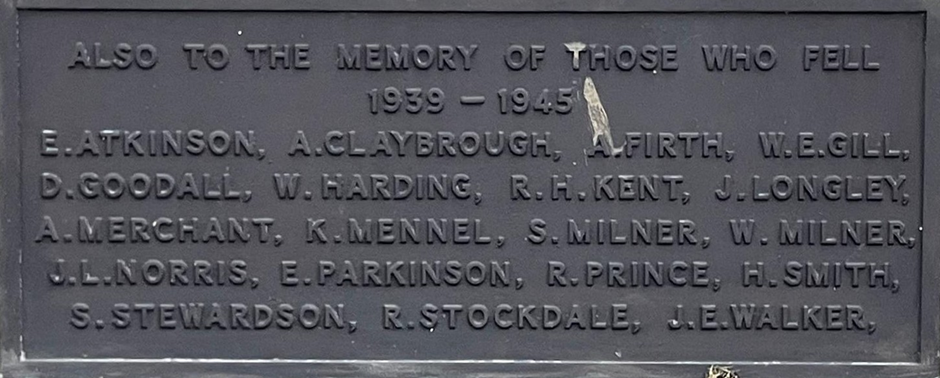
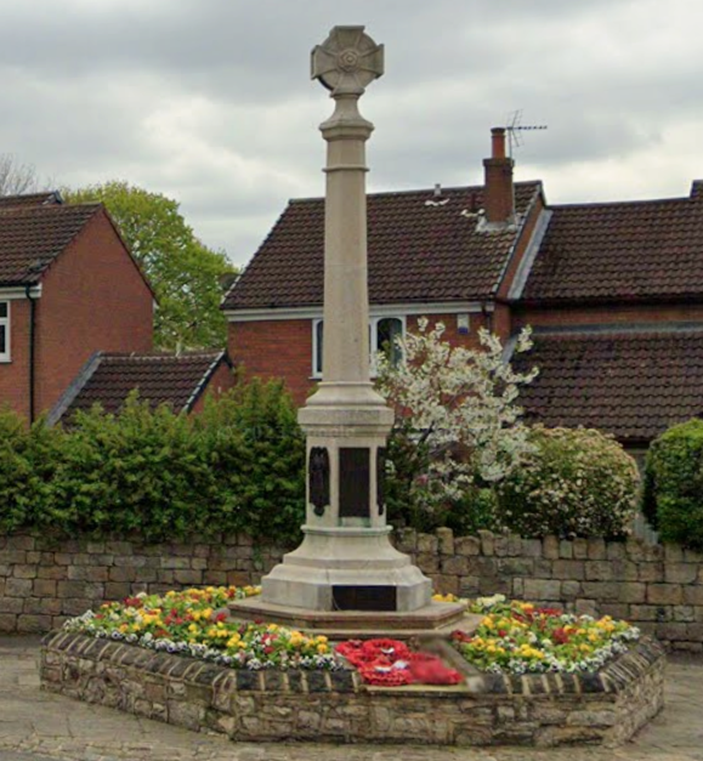
Palm Sunday, 1947: War memorial window dedicated at St Mary the Less Church in memory of 19 parishioners who died in WWII.
December 31, 1951: Reginald W Veitch resigns as Head Master of Bowers Row School after 23.5 years.
June 16, 1950: Bowers Row School trip to London with 118 children.
c. 1958: The old Flockton Pit Bottom at Allerton Bywater Colliery is abandoned.
September 1997: Two windows from the former St Aidan’s Church at Great Preston installed at St Mary the Less Church.
21st Century:
October 2005: Publication of “On the street where you live” by the Allerton Bywater Community Resource Group.
Cast of Characters
William Jessop: (Late 18th Century) Consultant Engineer appointed to improve the Aire & Calder Navigation. His work enabled larger boats to use the waterway.
W H Bartholomew: (Mid-19th Century) Chief Engineer for the Aire & Calder Navigation who developed the innovative “Tom Puddings” compartment boats in 1853, significantly increasing carrying capacity.
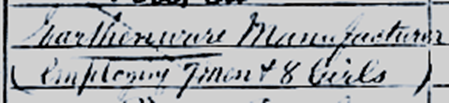
Thomas Robinson: (Late 19th Century) Operated the Allerton Bywater Pottery from 1881. He leased and later purchased the pottery, employing several men and girls.
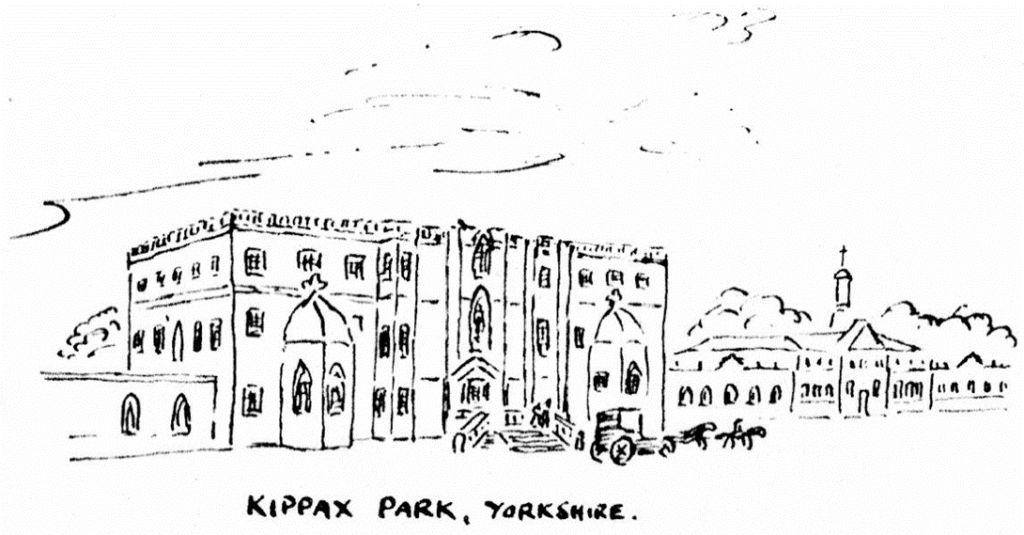
Sir John Bland of Kippax Park: (Late 17th/Early 18th Century) Local landowner who invested in the development of the Aire & Calder Navigation. The Bland family also owned land under which coal was later mined.
Christopher Lowther of Great Preston: (Late 17th/Early 18th Century) Another local landowner who invested in the Aire & Calder Navigation. The Lowther family also established Bowers Row School.
Thomas Davison Bland: (Early-Mid 19th Century) Possibly a descendant of Sir John Bland, mentioned in connection with an Indenture of Enforcement related to Allerton Potteries in 1838 and whose wife laid the foundation stone of St Mary the Less Church.
Thomas Dobson: (Early-Mid 19th Century) A previous occupant of the Allerton Potteries, mentioned in the 1838 Indenture and later in the sale documents to Thomas Robinson.
Thomas Jeffries and Samuel Sowden: (Mid-19th Century) Previous occupants of the Allerton Pottery before Thomas Dobson.
James Wells: (Mid-19th Century) Another previous occupant of the Allerton Pottery before Thomas Robinson.
John Edey: (Late 19th Century) Became the owner of Allerton Bywater Colliery in December 1888. His acquisition was controversial, leading to a lawsuit for grave misconduct.
Edwin Edey: (Late 19th Century) John Edey’s brother, who played a role in the controversial purchase of the colliery.
Mr. Justice Stirling: (Late 19th Century) The judge who presided over the case brought against John Edey and ruled that the sale of the colliery should not stand.
Mr. Wing: (Late 19th Century) Appointed as a Receiver and Manager of the Allerton Bywater Colliery by the court following the judgement against John Edey.
Mr. Child: (Late 19th Century) Appointed as a Receiver and Manager of the Allerton Bywater Colliery, nominated by the Wakefield and Barnsley Bank (a mortgagee of the colliery).
Percy Greaves: (Early 20th Century) Chairman of Fryston and Wheldale Collieries. He declined a joint venture with Major Peake but agreed to an amalgamation, leading to the formation of Airedale Collieries.
Major G.H. Peake: (Early 20th Century) Chairman and Managing Director of Strafford Main Collieries Limited. He bought a majority stake in Allerton Bywater Colliery in 1907 and later played a key role in the formation of Airedale Collieries, becoming its Chairman.
George Deakin: (Late 19th/Early 20th Century) Colliery Manager at Allerton Bywater Colliery, signing documents on behalf of the owners.
Henry C. Embleton: (Late 19th/Early 20th Century) Mining Engineer and surveyor for the Lane-Fox Estate, involved in matters of leases, royalties, and disputes with the Colliery Company.
Mr. Lane-Fox: (Late 19th/Early 20th Century) Owner of land under which coal was mined; Embleton acted as his agent in mining-related matters.
George Paley: (Early 20th Century) Day shift deputy at Allerton Bywater Colliery in 1930, involved in the events leading up to the explosion.
Reginald W Veitch MBE. B.Sc (VS) LCP,MRST.FRHS: (Mid-20th Century) Long-serving Head Master of Bowers Row School, resigning in 1951 after 23.5 years.
Captain Percy Wilson, Captain George Marsh, Captain Norman Dixon, Lieutenant Thomas Gladman, Sergeant Frobisher, Sergeant John Harrison, Sergeant Frank Hutchinson, Sergeant Samuel Ashton, Corporal Bernard Jones, Corporal William Lawrence, Corporal Percy Emery, Lance Corporal Jack Crossland, Lance Corporal S Epworth, Lance Corporal A Smith, Lance Corporal T Pratt, Lance Corporal J Taylor, Lance Corporal S Jones, Private Jack Moulding, Private William Keith, Private Jack Adams, Private Richard Jones, Private Richard Cheesebrough, Private Clifford Crossland, Private Arthur Barraclough, Private Roy Cockerham, Private Ronald Hewitt, Private Fred Taylor, Private Louise Dutton, Private Clarence Jones, Private Jack Taylor, Private Clifford Jones, Private Ernest Robinson, Private Harry Robinson, Private Fred Owen, Private Henry Smith, Private Eddie Clayton, Private Albert Clark, Private John Pratt, Private William Hunt, Private Reginald Wilde, Private Bert Hepworth, Lance Corporal Sydney Hepworth, Lance Corporal Albert Smith, Lance Corporal Tommy Pratt, Private Arthur Flatters, Private Ernest Holgate, Private Joseph Green, Private Maurice Fletcher, Private James Cockrem, Private Frank Denton, Private Alfred Jaques, Captain William Beecham, Private Tom Gales, Private Walter Cockerham, Private Hainsworth, Private George Barrett, Private Percy Scargill, Private Tom Payne, Private Edward Bastow, Private Fred Millar, Private Frank Colley, Private Frank Dobson, Private Albert Byram, Private Samuel Lloyd: (Mid-20th Century) Members of the Allerton Bywater Home Guard during World War II.
Bert Hepworth and Ronnie Hewitt: (Mid-20th Century) Drivers for the Allerton Bywater Home Guard.
Bill Hunt: (Mid-20th Century) Dispatch rider for the Allerton Bywater Home Guard, using a combination motorcycle and sidecar.
Alf Holmes: (20th Century) A miner who started working at Victoria Pit, Bowers Row in 1925 and vividly described the harsh working conditions.
Reg Manley: (20th Century) Winnie Cockerham’s father, who worked at Allerton Bywater pit for around forty years, dedicated to First Aid and Rescue Brigade.
Millicent Manley (née Milner): (20th Century) Winnie Cockerham’s mother, whose father and brother were involved in the Allerton cricket team.
Albert Milner: (20th Century) Millicent Manley’s brother, a talented cricketer who could have potentially played for Yorkshire and was also assistant groundsman at the Allerton cricket field.
Fred Prince: (20th Century) Winnie Cockerham’s uncle, who started a newsagent business in his front room before moving to Victoria Street and later Church Corner.
Aunt Eva: (20th Century) Fred Prince’s wife, known for baking rabbit and apple pies.
Tubby Whitely: (20th Century) Owned a sweet shop in Allerton Bywater, known for allowing children to exchange peelings for sweets and for Mrs. Whiteley’s unique paper cones.
Numerous other individuals are mentioned in connection with local businesses and the community, providing a glimpse into the social fabric of Allerton Bywater over time.
This timeline and cast of characters represent the key events and individuals highlighted in the provided sources, offering a comprehensive overview of Allerton Bywater’s history and its people.
Briefing Document: Allerton Bywater – History and Industry
This briefing document synthesises information from three sources: “On the street where you live,” “The last colliery in Leeds,” and “Yorkshire Collieries – Allerton Bywater Colliery – Eddie Downes.txt” to provide an overview of the history, key themes, and important facts related to the village of Allerton Bywater, with a particular focus on its coal mining and community development.
Main Themes:
The Dominance of Coal Mining: Coal mining emerges as the central pillar of Allerton Bywater’s existence for a significant period, profoundly shaping its population growth, infrastructure, social structure, and the daily lives of its inhabitants.
Evolution of Transport: The development of transport infrastructure, from Roman roads and river navigation (River Aire and Aire & Calder Navigation) to railways, played a crucial role in the area’s economy, particularly for the transportation of coal.
Community and Social Life: Despite the harsh realities of industrial work, a strong sense of community developed in Allerton Bywater, evident in local businesses, social institutions like churches and schools, and shared experiences.
Changes and Transformations: The village underwent significant transformations over time, from a predominantly agricultural area to a thriving mining community and, eventually, facing the decline and closure of its major industry.
Individual Experiences and Perspectives: The narratives and recollections of residents offer valuable insights into the lived experiences of different eras, highlighting both the hardships and the community spirit.
Most Important Ideas and Facts:
Early History and Roman Influence:
The Romans utilized the area for transport, with a route from Castleford to York bypassing what would become Allerton Bywater. They relied on horses and carts, and the River Aire was likely used to supply forts like the one at Castleford.
Traces of Roman watchtowers have been found along the riverbanks.
Development of the Aire & Calder Navigation:
The Aire & Calder Navigation’s development in the 17th century was driven by the West Riding towns’ need for better transport to Hull.
An Act of Parliament in 1699 aimed to make the River Aire navigable from Leeds, involving the construction of locks.
The navigation facilitated the transport of coal from Yorkshire coalfields and the import of raw materials, becoming a major waterway by the late 18th/early 19th century.
Improvements by William Jessop in 1775 allowed for larger boats.
The opening of a new canal from Knottingley to Goole in 1825 and the Port of Goole in 1826 further boosted trade.
Passenger services operated on the navigation but declined with the advent of railways.
The “Tom Puddings,” unique compartment boats developed by W H Bartholomew in 1853, significantly increased the carrying capacity on the navigation.
Coal Mining in Allerton Bywater:
Early Mentions: Records indicate coal mining in the area as early as 1410, with “Tithes of Coal” being paid. By 1656, the “rich coal mines” were a recognized asset.
Early Collieries: The first Allerton Bywater Colliery’s exact working details are unclear, but the Warren House Seam was an early workable seam at a shallow depth.
The New Silkstone & Haigh Moor Colliery: Sunk in 1875, this colliery, along with the slightly earlier Kippax Colliery, led to a dramatic increase in the village’s population.
Growth of the Village: The 19th and early 20th centuries saw significant population growth, with the 1881 census showing 1,528 residents and a rise to 3,516 by 1901. This growth was directly linked to the influx of miners.
Working Conditions: Alf Holmes’s account from 1925 vividly describes the harsh and unsanitary working conditions in the mines: “Your hands, face and body were covered in coal dust. It swirled all about and everything was three and four inches thick with it. We breathed it in and ate it with our bread. You just had to, there was no escape from the eternal dust.” He also details the appalling lack of proper toilet facilities.
“Motty” System: Up until the early 1940s, a “Motty” system (identity card) was used to track the coal filled by each face worker, with penalties for excessive muck.
The “Butty” System: This system operated for many years, with “butties” acting as middlemen between the mine owners and the miners, and each stall having an identification number for calculating production value.
The 1930 Explosion: A tragic methane explosion on 10th March 1930 in the Silkstone Seam resulted in fatalities, highlighting the inherent dangers of coal mining. The official report details the events: “a flash ‘like lightning,’ and flame was seen in 101’s gate and flame or the reflection of it in 1S’s right bank.”
Leases and Royalties: The colliery operated on leases from various landowners, including the Earl of Mexborough, Lane-Fox, the Wheelers, the Davison-Blands, and the Medhursts. Royalty payments were based on seam thickness and area. Negotiations regarding rents and working conditions were sometimes contentious.
Amalgamation and Nationalisation: In 1919, the New Silkstone and Haigh Moor, Wheldale, and Fryston Collieries merged to form Airedale Collieries. Allerton Main Colliery was later acquired. The company was nationalised in 1947.
Closure: Allerton Bywater Colliery was the last deep mine in the Leeds area, closing in 1992, marking the end of a significant era.
Output and Statistics: In May 1900, a weekly output record of 9,140 tons was set. Over 216 years of coal production, approximately 60 million tonnes of coal and 22 million tonnes of dirt were mined. The colliery used increasing amounts of electricity over time. Over 65 men lost their lives in accidents at the colliery.
Allerton Bywater Pottery:
Thomas Robinson operated the pottery from 1881, employing several men and girls.
Records detail the lease and subsequent purchase of the pottery, including kilns, workshops, and land.
Local Businesses and Community:
The “On the street where you live” source provides a detailed snapshot of various local businesses operating in Allerton Bywater over the years, including grocers, butchers, newsagents, bakers, drapers, cobblers, and public houses.
The presence of numerous inns and taverns (“Boat Inn,” “Angel Inn,” etc.) indicates the social aspect of the community.
Personal recollections offer insights into the services provided by these shops and the characters who ran them. For example, Tubby Whitely’s sweet shop where children could exchange peelings for sweets, and Mrs. Whiteley’s unique paper cones for sweets.
The Co-operative Society established a presence in the village in the early 20th century.
St Mary the Less Church:
The foundation stone was laid in 1863, and the church was consecrated in 1865.
It features stained glass windows, including a war memorial window dedicated in 1947.
Education:
Bowers Row School was established by the Lowthers of Swillington. Records mention school trips and long-serving headmasters.
Home Guard during World War II:
The Allerton Bywater Home Guard became the 13th Company of the West Riding Regiment.
Local men participated in drills and were eventually fully equipped with military uniforms and weapons.
They conducted exercises, including the use of live grenades and the Northover Projector.
Scouting:
A Scout troop was active in Allerton Bywater as early as 1909.
Meeting places varied over time, including the Old Church Hall and the Victoria Hotel.
Personal Accounts:
Winnie Cockerham shares memories of her father, a miner from Somerset who dedicated his life to First Aid and Rescue at the pit, and her mother’s family with connections to the local cricket club.
The anecdote about her father being told “We don’t give houses to foreigners” despite being from Somerset highlights potential local perceptions.
Memories of local shops and their proprietors offer a personal glimpse into the village’s past.
Knur and Spell:
The document briefly describes this traditional game involving a “knur” (wooden ball) and a spring-loaded trap.
Background to the Parish of St. John the Evangelist, Allerton Bywater
Foreword to:-
A GARDEN BY CHANCE
I was delighted to read Father Hargreaves’ history of the Parish of St. John the Evangelist at Allerton Bywater. He has clearly gone to great trouble to do so, and if other parish priests follow his example, there would be a most interesting documentation for future generations.
It is always helpful to know the historical background of the places in which we live and I feel sure that the people of St. John’s will derive a greater understanding of the developments of their area from this admirable little production.
Father Hargreaves’ aim in writing it was to try and make the older inhabitants accept the new-comers and to make the new-comers willing to be accepted and to enter into the community. This little book indeed should help to develop a sense of community responsibility and a deep affection for the traditions of the area, and it is my prayer and good wish that this would happen.
I hope that all new-comers to the area will be able to read this history and I hope that in future it will be shown by the Parish priest of Allerton Bywater to the Bishop and all his successors when they come on Visitation so that they may know how things have developed in the wonderful providence of God.
Wm. Gordon Wheeler, M.A., Bishop of Leeds.
A GARDEN BY CHANCE
Background to the Parish of St. John the Evangelist, Allerton Bywater.
The Johnny Pit winding gear was quiet, for a change.
Down at the foot of the hill the pumps of Middle Pit were working to keep all the shafts and levels free from flooding. but the barnyard noises from down the street could easily make you forget where you were.
This was how it had sounded in the old days, when all around here was woodland and farms, when the larks and the woodpigeons could make themselves heard on weekdays, before the Lowthers opened the mine down the hill, before Joshua Bower and Company opened their Victoria Pit and their Albert Pit (but we had our own names for them), and before Bowers built these rows of red brick miners’ houses, one shop, no pub.
The folk were walking up the hill in their Sunday-best, this 29th day of August, 1915.
Most of the people were making for the chapel on the road which ran by the woods, but a few excused themselves and turned right towards Woodend. Old Mr Sennett was feeling able for the walk this morning and came stumping up from the Cotts; the Connells and the Conellys were walking up Hill Street, the longest row of them all, 37 houses of neat ride, with sandstoned steps and sills to relieve the monotonous brick, up past the one general-store-Post-Office at the top, chatting to the Hessions from 3 Albert Street, joining all the Greaneys who lived in Number One School Street, walking past the school whose bell-cote proclaimed that it had been “erected by Charles Hugh Lowther, Baronet, Lord of the Manor, in the year of Our Lord 1870”. But we weren’t so much interested in the Lord of the Manor – more in seeing of the Riley children were ready to come from Hollinhurst, or in looking out for Dominic Lavin in his gig, trotting down to Castleford.
Down Whitehouse Hill we walked (only you would call it Leeds Road), past the Angel, down Main Street at Allerton Bywater. We picked up Miss Cross, the schoolteacher from Otley, and that young lad from Rhodes Farm whose name we could never remember. On past the Vic, then past the Boat Inn, and along the towpath beside the river, to Lock Lane, over the Bridge into Castleford in time for the 11 o’clock at St. Joseph’s.
We prayed for the safety of our men at the Western Front, we prayed for the glory of God and the souls of the men killed in Flanders; the Canon announced the notice about the laying of the foundation stone of St. John’s tomorrow, and the men who had been on nightshift from Bower’s were able to go to Communion without any fuss, even though it was the late Mass.
Back we came, the way we’d gone, with the McCoans from Kippax for company part of the way; but this time when we got to the Boat Inn, we stopped. The men went in for a drink, the first drink of anything since midnight, and for a chat with Mr Prime. His wife chatted with the women, who brought out a bottle of pop for the children to share. Then back home for Sunday dinner, with all the vegetables out of our own gardens. We’d been used to having a joint of beef every Sunday, too, but just lately the war had been making meat rather scarce. Lucky for us that our Dad kept hens and pigs in his plot between the wagon lines and the houses.
FOUNDATION STONE LAID
“The adherents of the Roman Catholic faith at Bowers Row, Kippax, Allerton Bywater and Methley all of which are included in the Castleford Catholic Parish, have hitherto had no nearer place of worship which they could attend than St. Joseph’s, Castleford, and the desirability of making provision for them nearer their own homes has been felt for some time. With this object, Canon Hewison, of Castleford, recently purchased a site at Hollinhurst, at a cost of £442, and on Monday afternoon the interesting ceremony of the stone laying of a new church therein was witnessed. The building to be erected will be a substantial brick structure, Gothic in style, and will be to the plans of Ald. A. Hartley, J.P., architect. Accommodation will be provided for 130 worshippers. The nave will be 39ft. long by 21ft. wide., and the chancel 9ft. by 11ft. wide, while the sacristy attached will be 13ft. square. and a small entrance porch is also to be provided.
There will be three windows of leaded lights on either side, and the roof will be supported by open wood- work. The building is expected to cost about £500. The site contains about 900 square yards, and will leave room for any extension which may be necessary in future years.”
“There was a large assembly to witness the stone laying ceremony. The clergy robed in a tent on the field at the rear of the Angel Inn, and a procession was formed to the site which adjoins the main road some two or three hundred yards away. The clergy present were Dr. Cowgill (Bishop of Leeds), Canon Hewison (Castleford), Rev J. Donkers (Castleford), Rev. H Fove (Pontefract), Rev. W. Fitzgibbon (Pontefract). Rev. A. Dekkers (Goole), Rev F. Mitchell Dewsbury), Rev. J. Inkamp (Normanton), Rev. W. Donkers (Mortomley), and Rev. W. Hawkswell (the Bishop’s Secretary). They were preceded in the procession by the crossbearer and acolytes, schoolchildren from Castleford and the district, and members of the church”.
“The foundation stone was solemnly blessed and laid by the Bishop, and bears an inscription in Latin, of which the following is a transcription: To the greater glory of God and honour of St. John, Apostle and Evangelist, Joseph Robert, the Bishop of Leeds, blessed and laid this stone on the 30th day of August 1915”
“An address was afterwards given by the Rev. Fred Mitchell, basing his remarks on the text: Behold I am with you always, even to the end of the world”.
Under the heading “The Great War”, the report was of a Picardy ridge. held against heavy German attacks, the claim of a French advance at Verdun, and a statement about Allied progress on the Somme, mentioning Poziere, High Wood, and Thiepval. There were photographs of the faces. of nine men from the area, one of whom had been recently wounded, the other eight killed. Underneath these photographs, on the front page this time, was the caption “St. John’s Catholic Church, Allerton Bywater”, “The Opening Service”. Then followed a report, part of which repeated word for word the description of the church given at the stonelaying ceremony a year previous, but which added “but now (the Roman Catholics of the area) have a Chapel of Ease in their midst. . . . The church was used for public worship for the first time on Sunday morning (6th August 1916), there being a very large congregation. The building was first blessed by the Bishop of Leeds, Dr. Cowgill, who was assisted by Canon Hewison of Castleford. High Mass was then celebrated by Canon Hewison, the music being rendered by St. Joseph’s Choir.”
“A Sermon was preached by Dr. Cowgill, who said it was a joy to a Bishop to be with his people when a new church was being opened, and it must be a joy to the people to take part in such a ceremony. It was a joy to him to see a home built for God in the midst of His children, when those children had been without a church and the children would have joy because they had built that home. They had done something for God and something for themselves as well. They had given a dwelling place, and He wanted that dwellingplace because it was His delight to be with the children of men. It was for their sake that He delighted to be with them. They had given Him a tabernacle, but He wanted it only as a meeting place between Him and their souls”.
The reporter, possibly a junior one who had still to learn the difference between a transcription and a translation, then went on to give a summary of the sermon, which if the summary is a faithful rendering, would get full marks for triumphalism and none at all for Christian unity. I find it interesting to note his remark that “in the last 30 years in the Diocese of Leeds the number of churches and priests had nearly doubled, and their schools, in spite of opposition and difficulties, were increasing”; (I find it puzzling, though, to read his statement “not one school had been closed or delivered up to the enemy”, unless it refers to the schools belonging to other denominations which were handed over to the state about 1912-?)
The newspaper report ends by saying that Fr. Mitchell “eulogised the courage of their pastor, Canon Hewison, in undertaking that responsibility and said that not many men of his years would have started building churches. It was their duty to show him loyalty, sympathy, and help. Gifts were afterwards placed on the stone and amounted to £30”.
So it sounds as if Fr. Mitchell was a personal friend of the Canon, imported from Dewsbury to preach the sermon. (Both had 20 more years to live). Fr. John Theodore Donkers was the assistant priest at Castleford, the Canon’s first of many curates, and he took a special interest in Bower’s Row. Fr. Willibrord Donkers was his brother, working at High Green near Sheffield. These two men were Dutch, as were Fr. Dekkers and Fr. Inkamp. Fr. Fové came from the French-Belgian border. The Bishop, his secretary, Canon Hewison and Fr. Fitzgibbon managed to be Englishmen.
The newspaper report was confined to the inside pages, since the front page was devoted to dealing with Great War if space had allowed, it could have mentioned the festivities that went on in the White House field, that Monday, August 30th, 1915, behind the Angel Inn the presence of Kippax Brass Band, Mr Gallagher the builder, and the councillors, finishing in the evening with a gala. All the children of the parish were present. One little girl, whose family were, and still are, members of Bowers Allerton Mission, was lost with envy and admiration at the sight of young Rosie Lavin from Great Preston stepping out of her Daddy’s pony-trap in a gorgeous green dress. But the newspaper didn’t mention that it had more sombre things to deal with. In the next twelve months the church would be built at Woodend, throughout the country voluntary enlistment would be replaced by compulsory military training, first of all for single men, then for all men, single or married; mothers and wives would receive the dreaded telegrams, and on one single day. 20,000 British lives would be thrown away in Northern France.
Leeds is the principal seat of the woollen manufacturers of England, and the most populous town in Yorkshire. It stands in the midst of one of the richest mineral districts of the West Riding, containing no less than 102 collieries. These collieries, with the four in the Normanton district produced 2,505,000 tons of coal in the year 1868, which is rather more than the fourth part of the whole quantity of coal produced in the county of York . . . . This immense supply of fuel, besides answering all domestic purposes, and illuminating the town and neighbourhood with gas (in which, within our recollection, darkness was made visible by glimmering oil lamps), also supplies the means of working every variety of machinery, and of carrying on the varied textile manufactures for which Leeds has been celebrated for so many years”.
So wrote the editor of the “Leeds Mercury”, Thomas Baines, 1. in 1870, including in his list of Yorkshire coal mines and coal owners the following from our own immediate vicinity: Allerton Main (Joshua Bower), Allerton Haigh Moor (Locke & Co.), Astley (Joshua Bower), Allerton Bywater (Thomas Carter & Co.), Garforth (Gascoigne & Co.), Foxholes, Methley (William Wood), and Owlet Hall (Mason & Co.) 2.
It is the mines owned by Joshua Bower that concern us most at the moment in the 1860s (I think), that company sank its shafts. The family, firm of Bower had started as a glass-making concern earlier in the century, then expanded nationwide into roadmaking, then into coalmining. Like the other coalowners, they also farmed the land under which their coal lay, to avoid being accused of damaging other people’s property by the consequent subsidence. Again like the other coalowners, they advertised far and wide for workers to come and live in the houses which they were building beside the new mines. This was part of a pattern in the Leeds area the population had more than trebled in the first half of the 19th century, and that rapid increase was still continuing. 3. But Bowers Row was not an expansion of an already existing village it was simply created out of farmland and scrub. Before the Rows were built, there had been a few cottages scattered among the fields that used to lie between Astley Lane and the River Aire, but in those days the population consisted mostly of rabbits, foxes, and skylarks. People were an innovation, and just about every human being was very much a newcomer.
Other places often did at least have some roots and some town tradition behind them Leeds had had its charter since long before Dick’s Days (Dick Oastler had only just been buried at Kirkstall); even if we narrow the outlook to that of the Roman Catholics, Castleford had had a tiny, shortlived Catholic school in 1590, the Aberford area had a Benedictine priest serving it at least from 1725 and ever since, and the Hammerton family of Monkroyd had been able to establish the Jesuit priests in nearby Pontefract in the reign of James II. One of the results of industrial expansion in the North of England between 1800 and 1850 was to bring large numbers of people to live and work in towns, people who previously had worked and lived in the country. 4. Quite a number of these were English Catholics, whose religion had been to a large extent sheltered by the Catholic land owning gentry, and who therefore had been country folk. Now, in the towns, their priests could more easily develop them into thriving congregations, especially where immigration from Ireland helped to swell their numbers or established new communities. But to the village of Bowers Row, everyone was an immigrant, whether from Barnsley or Ballyhaunis – there were no tradition, except that which you brought in your heart. The mines were sunk, people came to work, and the firm built the rows of houses where they could live.
The census returns of 1871 are the first to show people living at Bowers Row. It includes a small number of people who were born in Ireland and who were at least likely to have been baptised as Catholics – James and Ann Duffin were both born in Ireland but had recently come from Nottingham where all their four little girls had been born; Martin and Ann Doyle were both from Ireland but their young son John had been born locally. James Healy had been born in Meath, his wife Catherine of Longford, but their four-year-old Margaret had been born in Sheffield. A few more Irish-born people lived in Great Preston Edward and Mary Kelly, both from Leitrim, William and Mary Wood, and Henry Findlern and Thomas Day, both lodgers. In Kippax the police constable was an Irishman of 24 called John Croskery, whose wife Annie was a Selby girl they had a five month old daughter, Elizabeth. All the above men, except the policeman, were either “coal miners” or “coal labourers”. Further research would be needed to ascertain how many of the other inhabitants were christened R.C.s.
In the baptism registers of St. Joseph’s, Castleford, which begin in 1881, there start to appear the surnames of people who definitely have descendants still living in the parish these were a nucleus of about half-a-dozen families who originated around Dunmore in County Galway the Greaneys, the Hessions, the Connells, the Connellys, and the Rileys — these folk already knew each other back in Ireland, and started to come over before 1880. The boys would make their first boat trip about the age of 16, unable to afford trousers and dressed in a home-made kilt. In later life they would recall how they came over in petticoats”. At first they worked on the farmland belonging to the mine, quickly earning enough for a pair of pants, and they might or they might not return to Ireland after the harvest. Gradually some of them settled, in penny numbers, and managed to get jobs at the pit and a place to live among the Rows.
John Riley came from Dunmore, lodging first of all at Farren’s Yard near the Ha’penny Bridge over the River Aire on the path to Methley. He eventually got a job as an engine driver at Bowers, and married Mary Madden from Shannon Street, Leeds (just behind the Woodpecker Inn on York Road). The wedding took place at St. Patrick’s Leeds, and the couple set up home at 2 Wood Street, later moving to Hollinhurst when these were built about 1900.
Dominic Lavin, who lived at Great Preston, was born at Ballymote in County Sligo about 1849. He came to England as a teenager about 1864, and after a short circus career (he wrestled bears !), he got a job sinking Bowers mines, eventually marrying at Batley a Scots-Irish girl from Batley named Ann Gordon. They settled first at Side Row, Great Preston, then, again about 1900, they moved to the newly-built Helena Street in Kippax.
The young John Greaney had an aunt and uncle who had lived at Owlet Hall, Kippax, before moving to Great Preston (and later to Barnsley). He lodged with them, courted Mary Ann Conroy from Horsforth, and married her at St. Wilfrid’s, Aberford, the church built towards the end of the Penal Days and served by the Ampleforth Benedictines.
There was no Mass-centre in Castleford until 1877, so the Catholics of our area went to Mass and had their children baptised at either Aberford, or Hunslet, or Wakefield (some of them were working on farms near Wakefield), rather than at Pontefract where the priests looked after Castleford; to me all this suggests that there were ties with Leeds, either of kin or of communication, even though when St. Joseph’s, Castleford, was begun in 1877, for the first three years or so it was served by priests from Pontefract, who by now were secular clergy instead of the Jesuit Fathers.
By 1881, the people of Bowers Row were losing sight of a memory the memory, if it had ever been told them, of a Catholic chapel which, twenty, or so years previously, and probably before most of them had come into the district, had existed quite close by, at Kippax Park, of all places, the home of the Bland family. The copies of the “Laity’s Directory”, which eventually becomes the “Catholic Directory”, from 1824 to 1849 record the existence of a Catholic chapel, open to the public although not licensed for weddings, at “Kippax Park, near Pontefract”. The priest named in the Directory as serving there for the first five years was a Rev. M. Reculet. I hazard a guess that this is the Louis-Felix Recuillez who was one of the French priests who fled the French Revolution, took an oath of allegiance to the English Vicars-Apostolic, and settled permanently as “missioners” in England. 5. By 1829 he had been replaced by Fr. John Bell, who is listed in every year up to 1843. After a short gap, he in turn was replaced by Fr. Thomas Middlehurst, who had previously been at “West Witton, near Bedale”. Fr. Middlehurst is listed until 1848 inclusive; the entry for 1849 simply states the existence of the Mass-centre, and after that there is no further mention of Kippax Park as a chapel. It may or may not be significant that the owner, Thomas Davison Bland, died in November 1848, and was succeeded by his eldest son with the same name. Or possibly the chaplains were elderly men and the needs of the town congregations prevented their being replaced when they died.
What sort of congregation could the Kippax Park chapel have? It would probably be fairly small, consisting of the R.C. members of the family, their guests, those of the servants who were Catholics (like the Boston family at Kippax Lodge), as well as any Catholics living in the vicinity and there were some – 6. William and Mary Beevors of Allerton Bywater, Charles and Mary Hewitt, the Heys, the Austins and the Lockes, all of Kippax. (The Lockes were coal-owners of Kippax, connected with. Gill & Warrington of Normanton.)
But the Blands were staunch supporters of the Church of England, so how could it come about that the Bland family home should house an R.C. chapel ? Our diocesan archivist explained to me that this, the first Mass centre since the Catholic Relief Act of 1778 to start within what is now our parish, was the result of the marriage between Thomas Davison Bland, of Kippax Park and the patron of the Kippax Parish Church, and a lady named Apollonia Mary Stourton, daughter of Lord Stourton of Allerton Mauleverer, near Knaresborough whose family were Catholics of long standing. They married in 1812, and when they set up house at Kippax Park, Mrs Bland established a Catholic chapel there and maintained a resident priest for over 20 years. Their sons followed their father’s religious tradition, and the daughters followed the mother a practice which the priests would tolerate only because there was little else they could do. Edward, one of the younger sons, in fact became Vicar of St. Mary’s, 7. while the eldest daughter, called Apollonia after her mother finished up building a Catholic church. She never married, and she went to live with a younger sister, who had married a Mr Charles Weld, himself connected with the Arundel-Howard-Norfolk family. The Welds lived at Chideock Manor in Dorset, and it was from there that Miss Bland wrote to Bishop Cornthwaite in February 1871, explaining that she wished to give £1000 to build and equip a Catholic church at Castleford, for the benefit of the Roman Catholics there — obviously by now the pattern of increasing and incoming population was being repeated in Castleford. Bishop Cornthwaite was in charge of Roman Catholic affairs for the whole of Yorkshire, and his title was “Bishop of Beverley”, although he lived first at York and then in Leeds. On receiving Miss Bland’s letter, he replied from Leeds, thanking her for her very generous offer, but saying that funds were already available for a church at Castleford. Apollonia then remembered an advertisement appeal made by the priest at Stokesley, near Knaresborough. Bishop Cornthwaite accepted her second offer, and used £1000 to build and furnish St. Joseph’s, Stokesley, in 1873. 8.
The church at Castleford was, in fact, built through the good offices of Mr Richard Austin, of Fryston Hall and Carlton Hall, who owned a large amount of land in the area, and who was connected with the Kippax.
In those days there was great opposition to the purchase of land by Roman Catholics for building churches or schools, and a friendly landowner was a great help. Castleford St. Joseph’s began in 1877, but its baptismal rs start at 1881, possibly because the priest at first lived at St. Joseph’s, Pontefract and may have kept the records in Pontefract while commuting to Castleford for services. The first priest to serve the new ford “mission” was Fr. Gustavus, J. Thonon, 9. but he, within a few years, became assistant priest at St. Patrick’s, Bradford, and Fr. John on came from St. Marie’s in Sheffield to start his 56 years in Castleford. (It is possible that a little time was needed for things to settle following, in 1878, the division of the Beverley diocese into the diocese of Leeds and of Middlesborough). In these days, the title “parish was not in use Fr. Hewison signs his baptismal records with me and the title, abbreviated, “Miss.Apost.”, with the old-fashioned “S” the title can be translated as “the priest appointed to this n”, and illustrates the sense that the Catholics were still feeling their place again in this country.
Just about this time, Joshua Bower went bankrupt. The pit was closed between 1878 to 1880. This bankruptcy perhaps explains why there are no reliable records of Bowers accounts, which makes it so difficult to put a date to the building of the pit houses. Those must have been two very hard years for the Bowers people, and it does occur to me to wonder if the lack of work drove away some of the earlier inhabitants, who seem to have little or no trace behind them. That, to me, is simply another example way in which finding the answer to one historical question seems lead to yet another question.
Tough years or not, there was too much demand for coal for it to be left in the ground – in 1880, the mine opened again, this time as JW Bowers
“A perfect English gentlemen from York” is the description given to
Canon Hewison by one who grew up knowing him. I get the impression of a man with an air of aloof authority who might, these days, be called “paternalistic”. Whether that is a true impression or not, this convert from York certainly worked hard to build up his parish and care for his people, singlehanded from 1880 until 1910; in that year the Rev. Johann Theodore Donkers became his “missionary co-adjutor” (“curate” for short). Father Donkers was a young Dutchman, born in Uden in the Brabant area of South Holland, who trained at Ushaw College, Durham, and was ordained a priest in July 1910. He already had an uncle in the diocese, Fr. Theodore Van Zon, and a brother, Fr. Willibrord Donkers. Castleford was his first appointment and he worked there for seven years, followed by ten years as curate at St. Joseph’s, Bradford, then parish priest first at Woodlands, near Doncaster, then at Bradford St. Peter’s, where he celebrated his Golden Jubilee in 1960 and died in 1965, still in harness at 80 years old.
Fr. Donkers took up his post and soon began to take a special interest in the Bowers Row area, doing a paper round every week to make sure that each family had a copy of the “Universe”; and using Number One, School Street as a base for an every-Friday-Sunday-School. (This continued the habit of Canon Hewison, who in the preceding years would take a weekly horse taxicab to Bowers School, take a class there, call on the R.C.S. then walk home. The Canon took catechism in No. 1 School St. or in any RC house where they would let him. If the women were all cooking or washing, or the men bathing after work, he would take RE classes in the open air).
Fr. Donkers gave every encouragement that he could to the plans that the Bowers Row people had for building themselves a church and these plans were put into action with vigour. There were dances and socials at Bowers School and anywhere else that could be found, collections made from door to door which nobody refused, whatever their denomination, sales of scent cards at a penny each, and any other fund raising scheme that could be dreamed up, including the sale of ham sandwiches, with home-kept and home-killed ham, boiled in a setpot!
The money was handed to Canon Hewison for safe keeping. The Canon used it very well, to help finance his new Catholic school in Castleford ! But the Bowers Row people, though rather dismayed, were not deterred. They made use of the new Catholic school, and carried on collecting for their own new church, helped by the chapel people with whist-drives and collections, to such an extent that it was said by the Catholics that “it was those who were not Catholics who built the church they never refused a thing”. This time, in 1914, the Canon bought the site, along Preston Lane on the edge of Brigshaw Wood. The site was levelled by men of the district, plans drawn up by Mr Arthur Hartley, and the work put in hand by Mr Gus Gallagher, who remembers the “whacking good tea” at the stone laying ceremony. The buttresses were splayed to distribute the weight of the small but “substantial brick structure”, and the whole building was in accordance with building regulations laid down for this area at that time. A concrete raft foundation was not, in those days, considered necessary, and the church rested on three rows of bricks laid directly on to the clay bed. The church was pleasantly simple, possibly reflecting the simple taste of the people who had it built, and certainly reflecting the absence of surplus money.
The phrase “Gothic in style” in the newspaper reports seems to me to be a stretch of the imagination St. John’s has a pitched roof, a pointed chancel arch and tympanum light, and the open woodwork supporting the roof has a few pointed joints but I cannot see how these can earn a building the title “Gothic”. Possibly the Canon either spoke to the reporter with a twinkle in his eye, or else was unconsciously expressing a wish to be linked with the medieval-style revival fashionable in his youth. Whatever we say, St. John’s remains small, unpretentious, simple, homely in the good sense, and with a welcoming atmosphere. But not Gothic. The description of the seating accommodation is also highly optimistic – we can seat 105 people in reasonable comfort, not 130. I’ve so far been unable to discover why the church is dedicated to St. John the Evangelist, although I find it a suspicious coincidence that both priests at Castleford were called John.
The windows of painted glass, all of the same style and pattern, puzzle me a little – I am told that the ones over the altar and the entrance were the original windows when the church was opened in 1916. But the references to safe return from the Great War imply that some, at least, of the nave windows could not have been fitted before 1918. The mystery remains, for the time being, but as least we know who the people are who are mentioned in glass – Sharah Shillito was Canon Hewison’s housekeeper, Mary Horan was his maid, Esther Barron came from a Methley family who supported St. John’s, walking each Sunday over the Ha’penny Bridge; the Needhams were Castleford family who supported St. John’s, the Gallaghers were its builders; the Greaneys were pillars of the parish at Bowers Row, and Thomas Wigglesworth helped to build the church before becoming a Catholic he channelled the help that came from the people of Bowers Allerton Mission Chapel, and his daughter, Mrs Bickerdyke, played the organ at St. John’s; the Conelly boys all came back safely from the War, one of them with the Distingushed Conduct Medal; William Needham did not come back from the War, neither did Peter Mills, nor Peter and Patrick Hession, whose brother Tommy remained in the mine and married the sister of Peter Mills.
The Mills had come from Lancashire to live in School Street. Mrs Mills was one of the stalwarts who worked to finance the building of the church nobody refused, even though when she asked for donations towards the original Stations of the Cross, many people thought that they were being asked to support something to do with the local railway.
The Mills were just one of a number of new names that start to appear in the baptism registers after 1905. Of course, many names appear only once or twice, while other names occur regularly throughout the first 25 years of the Castleford records, and beyond. The records show that Catholics lived, as well as in Bowers Row, Hollinhurst, Allerton, Great Preston and Kippax, in cottages at Fleakingley Beck, Newton, Ledston and Ledston Engine. A connection that I find particularly interesting is to see in the Aberford records that William and Mary Beevors of Allerton Bywater were communicants at Aberford in 1866, and, from the Castleford records, that William and Eliza Beevors of Allerton Bywater had their infant daughter Mary Jean baptised at Castleford in 1890.
Swillington does not appear on our scene until 1919 Joan Elizabeth Westmorland of North Lodge is the first baby from Swillington named for certain in Castleford’s records the village had long since forgotten the Dineleys and their efforts to keep alive the traditional faith, as Ledston had forgotten its Withams and its Websters, Shellitoes and Ellises, and Kippax had forgotten its Ledes, its Vavasours, and its Haldenbys.
Father Donkers stayed with the Canon for seven years, the first and the most long-lasting curate that the Canon ever had. Quite a few others did not last any such length of time since the Canon was a man of his day and maintained his position with vigour. In those days it seems that bishops did not define parish boundaries this was done by the parish priests themselves by a system of mutual disagreement. To quote Mrs Mary Jordan (Miss Darwin, whose parents came from Barnsley in 1907): “When we lived at Leventhorpe Lodge in 1914, we were visited by Fr. White from Hunslet, the Oblates from Mount St. Mary’s, Fr. Donkers on his bicycle from Castleford every Friday, and Fr. Baines from Aberford, who all claimed that we were in their parish!” The cycle riding was the explanation that Fr. Donkers had for his missing right ear-lobe; he said that he lost it through frostbite, from cycling round the Bowers Row area in bitter winter weather.
He was appointed to Bradford in 1917. He said himself that Canon Hewison asked him to stay on with him at Castleford, promising to hand the parish over to him when he retired or died Fr. Donkers, perhaps foreseeing that he would have another 19 years to wait, politely declined the offer, leaving the Canon to “go through curates like cigarettes”. He was succeeded, one after the other, by Fathers Valkenburg, Cuniffe, Moynihan, Whitehead, Reynard, Sole, William O’Grady, and Fred Bennett. In 1935 Fr. Reeves was added to the staff, and Canon Hewison died on the first day of January, 1936. Fr. Comerford took over, with Frs. Bennett, Stoker, George Collins, and Matt Farrelly, three priests at a time.
By this time the pattern of population in the area served by St. John’s was clearly emerging the area was developing as coalmines in other parts of the country began to close down – this is the pattern which continued until not long ago. In 1921 a coalminers’ strike sent the small first wave of Durham people to live in Swillington. In 1922 the closure of the mines in Gloucestershire sent the Woolford family to Allerton and the Bowers Mission. The General Strike in 1926 re-enforced the flight from County Durham members of the Healy family came to Swillington from Annfield Plain, following the earthy advice of their Durham pit manager. The Morgans and the Jordans, the Bills, the Finerans and the Johnsons, all fled Durham for the Yorkshire coalfields.
Similar events in the Lancashire pits brought the Smith, Sherington and Meeson families into the area. This larger wave of movement persisted and grew greater by 1929, following the slump in the U.S.A. The coalmines of Maryport and Whitehaven in what is now Cumbria closed down, so the Irvings settled in Swillington. Up till then Swillington had consisted of (apart from the Lowther estates) just the church, the school, the almshouses and a few farms and cottages. Now it began to develop, and quite rapidly. Most of the newcomers to “Little Durham” felt welcomed, since those to whom at first they were strangers in their midst, had at one time themselves been “strangers in the land of Egypt”. 10.
Miss Darwin, who lived at 28 Park Avenue, Swillington, and taught at Preston School, gave religious lessons in her home for the Catholic children of Swillington, in St. John’s for the Woodend children, and during the Scripture period in the porch at Preston School. Swillington people used to come to Sunday Mass at St. John’s by walking over Fleakingley Beck to Great Preston then down to Woodend. Later they had a special bus, driven by Mr Naylor, from Swillington each Sunday, through Astley, picking up along the way.
Meanwhile, Allerton was developing, too. T. & R. W. Bowers sold out to Pease and Partners about 1930. This, too, was a North-East firm, from Darlington, which brought its own officials. The building line beside St. John’s began to fill up the church had neighbours close at hand, at last. Mrs Brooks, just below the church, was in great demand, for First Communion breakfasts, May Procession teas, or weekly hot water for cleaning the church, and later for children’s instructions. The house just above the church, now used as the priest’s house, was built in 1933 for Mrs Dyer, who up till then had kept the grocery-Post Office in Bowers Row. She had an injured arm, and to allow her coal to be delivered direct to her back door, Canon Hewison let her use part of the church land as a driveway; twenty or so years later, this would be the cause of a bitter dispute when the next owner of the house demanded the same as of right; another ten years or so later, the argument was finally settled when the diocese bought the house.
Then, in 1936, Canon Hewison died. He was succeeded by Fr. Comerford, who, after a while, began to have Sunday Mass said at Swillington as well as at St. John’s, the priest travelling from Castleford to each place. For two years Mass was said at the Swillington Hotel, through the kindness of Mr & Mrs Bickerstaff, and then in the Miners’ Welfare, throughout the period of the 39 – 45 War and up to 1954, on a trestle table raised on wooden blocks brought from Primrose Pit. (The assistant priests included Frs. Farrelly, Creed, Belton, Roche and Townend). By this time, apart from all the world-wide movements of population, a smaller one took place, closer to home the Victoria and Albert Pits closed in 1948 and Bowers Row began to be demolished in 1951. Coalmining had been a nationalised industry since 1947. Kippax Park was demolished in 1953, but house- building was re-started in all the villages of the area.
Anyone looking at Bowers Row now will see a clothing factory, a mission hall, and a vehicle depot. The mission hall still does what it was designed to do, although its congregation no longer live on the doorstep; the clothing factory includes all that is left of the school, and the vehicle depot stands on the site of some of the houses only the dropped kerbstones remain to indicate that once there were streets here. Where the Johnny Pit and the Star Pit used to be, is now the immense crater of an open cast site.
The demolition was a gradual process, and people did not move very far. They moved to new houses in Swillington, to a new estate in Great Preston, and to the new N.C.B. estate off Station Road in Kippax. By now Fr. McGee was parish priest at Castleford, with plans for providing more facilities for the Catholics of the area he had the chance of some land, with the option of building a school, off Wakefield Road at Swillington. Against his better judgement, he was persuaded not to buy it persuaded by people who, later, bought it for themselves, much more cheaply, or so I am told. Instead, he bought a piece of land off Astley Lane, and the chapel-of-ease was built there, dedicated to Our Lady, Help of Christians. This was a dual purpose building by Poskitt’s of Airedale, designed to be both a Mass centre on Sundays and a social centre during the week. The year was 1954, and soon after Swillington chapel was opened, Fr. McGee got a letter from Bishop Heenan of Leeds.
It was 1954, and a wind of change was now sweeping across the See. Fr. McGee was informed that part of his parish was being cut off and formed into a new parish, based on St. John’s, Allerton Bywater. The new parish would consist of Allerton Bywater and Airedale, leaving Swillington still as part of Castleford parish! Fr. McGee rapidly got in touch with the Vicar General who managed to persuade the Bishop to study the map. As a result, Airedale stayed with Castleford for the time being, and the now independant daughter parish, St. John’s, was given into the care of Fr. Kieran Kehoe, with responsibility for looking after Allerton, Swillington, Great and Little Preston, Kippax, Ledston Luck, Ledston, and Ledsham (also Fairburn until 1962, when it was found best to hand this over to the new Knottingley parish).
At first Fr. Kehoe had to lodge at the presbytery in Castleford, until the diocese bought a house for him at 56 Preston Lane, nine doors above the church. He threw himself into the task of getting the new parish on its own feet. His previous appointment had been as a curate at St. Patrick’s, Huddersfield, where he knew a joiner called Charlie McNulty. Mr McNulty came over and fitted the sacristy with oak dressers and cupboards, while pine benches were bought to replace the old kitchen chairs in St. John’s. Fr. Kehoe had plans drawn up in 1957 to extend St. John’s and to provide confessionals, a baptistry, a cloakroom and a choir gallery, but these never materialised, possibly because planning permission could not be obtained. since the extensions would have projected beyond the building line. Obviously, the parish was growing.
The parish hall was the Swillington building, beautifully kept with a brick-paved pathway, parking for half a dozen cars, flowerbeds, and two well-kept lawns. Social functions were held inside, and garden parties outside. Villagers started to use the grounds as a short cut, so plans were drawn up for a brick wall with wrought iron gates. The plans remained as plans, for Fr. Kehoe was transferred to Cleckheaton, in 1960.
Fr. Robert Warren had his own plans when he took over at St. John’s a hall and presbytery along the new Brigshaw Drive. The two were planned together as two parts of a whole. The Hall was built for £12,000, and the presbytery begun alongside, but lack of certainty whether or not the presbytery could be paid for caused the diocese to abandon the idea, and the site was levelled, leaving an empty space between the church and the hall, which was used as a car park. (The parish had originally owned even more land than this site, since some parish land was sold to Garforth U.D.C. for them to build some of the bungalows along Brigshaw Drive).
By now, building was going ahead rapidly in the district, especially in Kippax, which all of a sudden found itself an area suitable for development.
In fact, development was in the air everywhere Vatican II was beginning to be put in motion. The development of the revised rite of the Mass began in Fr. Warren’s time and continued with Fr. Patrick O’Keeffe, who took over on Fr. Warren’s retirement in October 1966. The final phase of the new rite took place early in 1970 by now the Mass was said facing the people, using the simple wooden altar which had been made for St. John’s by Mr Tommy Hudson. (Swillington would wait till 1974 before having Mass facing the people).
When Fr. O’Keeffe arrived he was faced with a big debt. Soon he had moved house, from 56 Preston Lane to number 40, next door to the church and therefore in many ways much more convenient, but in a poor state of repair. He began the thankless task of trying to extend, repair, and make the house suitable for its new role, and improved the now much- needed car parking facilities, but, knowing that the Church consists of people rather than buildings, he concentrated on serving the people, making himself all things to all men, finding great friendship with the people of the Bowers Allerton Mission Chapel. He cleared the debt, I’m glad to say, which must have entailed very hard work for the layfolk who supported him, as well as for himself. But it was done. On his appointment to St. Peter’s, Bradford (where Canon Donkers had been), he handed me the keys of the kingdom, at the end of September, 1973. On my first Sunday here I found St. John’s bursting at the seams.
I think we can credit Kippax for the overcrowding, since by 1973 it had become almost a dormitory town for Leeds, instead of the pit village that once it had been. The Coronation area was built up about 1953, the N.C.B. estate was occupied about 1954, along Westfield Lane a stream and a turkey farm gave way to new housing, Oxford Drive area was built about 1964, the estate on Kippax Common from around 1966, and the Pondfields development shortly afterwards. General shortage of money slowed down. the building programme, but did not halt it. The enforced move into Leeds Metropolitan District merely altered the direction of the building programme.
All this meant that more people were coming into the parish, many again from the North East, most from Leeds, and some from all corners of the British Isles. All available space in St. John’s was adapted for extra seating, but even this was not enough. St. John’s could not hold its Sunday congregations, even with two Masses, and Swillington could no longer cope. The parish had, reluctantly, almost decided to build a gallery within the tiny church, which admittedly would have spoiled the building, when we received a generous offer. The Vicar and the Parish Church Council of Kippax St. Mary’s startled us with the offer of the use of their church on Sunday evenings, even to the extent of being prepared to alter their own timetable. This was Christian hospitality indeed – “Love the stranger, then, that is in your midst, for you yourselves were once strangers in the land of Egypt”. 11.
The Vicar felt, and the P.C.C. agreed, that it was part of their Christian duty to help to make all newcomers, whatever their denomination, welcome to the township, and, since each of the three Sunday Masses was intended for all the Catholics living anywhere within the area of St. John’s parish, as well as the direct benefit intended primarily for Kippax, other Catholic people from St. John’s parish could equally well use the opportunity if they wished to do so. Both the bishops were consulted, then a referendum was taken and the offer was gratefully accepted.
The first service was held on February 2nd, 1975, when Candlemas Day happened to fall on a Sunday there was a short prayer of introduction from the Vicar in St. Mary’s Hall, where members of both St. Mary’s and St. John’s were gathered. We formed into a candlelight procession, all of us, and St. Mary’s congregation led us, singing, into Kippax Parish Church. Mr Darvill gave a short address of welcome, and we carried on straight into the “Glory be” of the Mass of the day. A small portable wooden altar had been specially made so that the celebrant would face close to the people, and the Mass equipment had been got through the kindness of well-wishers both within the parish and from outside.
The experiment has proved very much worthwhile, and we have continued to be the guests of St. Mary’s, having evening Mass there each Sunday at 6-30 p.m. The hospitality of the parish church and the offer of the use of St. Mary’s Hall should prove even more worthwhile as time goes on and development continues – already the new Mount Pleasant dwellings are being occupied, and house building is going on rapidly behind Tatefields.
The pattern of movement into the parish may have altered, but the fact of movement into the parish seems to be continuing. Up to, say, ten or even less years ago, the moving of people into St. John’s parish was usually the result of some coalmine closing down in another part of the country, and the incoming worker still had a great deal in common with the parishioners already established here. Nowadays, all the villages in the area are developing as homes for people with many different ways of earning a living. Again, in the old days, people who came into the area could return to the scenes of their childhood only rarely, when they had saved the rail fare, but nowadays people who have moved here from other parts of the country often have their own cars and can go back for week- ends to their old haunts. Even more so, folk who have moved here from nearby cities naturally feel their old roots pulling them back and they can easily keep in touch with their old friends. It may be that any real loyalty to the parish may need at least another generation to develop.
All this makes it all the more difficult to build up a loyalty to the present parish, especially since all the Catholic schools that we use are outside our territory. (Every pastor knows that if he can gather the children of his parish in some project, he can be sure of a large audience of parents and relations enjoying their pride in them. But our children are scattered throughout thirteen different schools and six different home communities). Nevertheless, an attempt must still be made to form some sort of parish feeling. In fact, more than ever is there the need to “love the stranger since you were strangers in the land of Egypt”. 12. Every parish is described as being “a corner of the Lord’s vineyard”. St. John’s was never designed as a planned garden, its growing plants were not deliberately planted; it seems to me that if it is to be described as a garden, then it is almost a garden by chance, since most of its flowers have sprung up because they were blown there by the wind of necessity. But for all that, with a little cultivation there is no reason why the blooms should not flourish.
Other things are needed, of course, as well as the cultivation the part of already established families, there is needed the willingness to accept newcomers into their midst and to give them a genuine welcome; on the part of the newly-arrived families there is needed the willingness to be accepted as both part of their own village and as part of the parish community; everyone within the parish has a worthwhile contribution to make, whether they have lived here for all their lives, most of their lives, or only a little while.
The sense of parish community which is possible in a city parish will it may not not be readily achieved in our collection of scattered villages be achieved to the same extent at all but we may well, with some effort, achieve a limited feeling of parish community which is valuable and essential as far as it goes.
Within each of our own local village communities we can help to make Christ present in our midst, less by our words, more by our lives among our neighbours. This may sound like a summary of part of the teaching 13. but what I find of the Second Vatican Council, and indeed it is interesting is the similarity between this modern expression of the Church’s teaching and the tone of the sermons of a priest who preached in London in 1785, 14. if I may end by quoting Father James Archer :-
“Remember that,
notwithstanding the varieties of customs and opinions, all your fellow-creatures have a claim
on your benevolence;
all should be dear to you;
because all are made after the image of God,
all are redeemed by Christ’s blood.
Let then, your active and spirited exertions, your honest industry,
contribute to public happiness.”
“I wish to see all men,
however various their religious creed,
mutually loving,
cherishing
and assisting one another,
and walking through the chequered paths of this mortal life
3. Beresford & Jones “Leeds & Its Region”, page 189, and census returns supplied by Mr John Goodchild. The actual figures for Great and Little Preston Township, which covers the Bowers Row area, are as follows:- 1801, population 413; 1851, population 464; 1861, popula- tion 541; 1871, population jump to 1100; 1881, further population jump to 1526.
4. This section derived from John Bossy’s “The English Catholic Com- munity, 1570-1850”, published 1975.
5. Bossy page 356.
6. Parish records of St. Wilfrid’s, Aberford.
7. Manuscript written by William Bywater, Town Crier of Kippax, kindly loaned by Mr Francis Bellwood.
8. This section from Leeds Diocesan Archives, and from David Allen’s “St. Joseph’s, Stokesley, The story of a Catholic parish”, centenary booklet, 1973.
9. Catholic Directory for 1881.
10. Book of Deuteronomy, chapter 10, verse 19.
11. again Deuteronomy ch.10, v.19, with Exodus ch.12, v.48.
12. once more Deuteronomy ch.10, v.19.
13. “Gaudium et Spes (Joy and Hope) the Church in the Modern World”. 1965.
14. John Bossy, pages 378 & 380, quoting Archer.
The references in chapters 4 & 5 to the surnames Hammerton, Dineley, Witham, Webster, Shellitoe, Ellis, Ledes, Vavasour and Haldenby, and to the Catholic School in Castleford in 1590, are all taken from Hugh Aveling’s “The Catholic Recusants of the West Riding of Yorkshire 1558 – 1790”, published by the Leeds Philosophical and Literacy Society.
THANKS
A friend once told me that historians often want to write a history that will be the last word well, I’m not a historian, and this little booklet will not be the last word there are some sources that I have still to look into, there may be mistakes, and there will be omissions; in fact, one regret is that I have had deliberately to leave out many little stories which interested me but which might have sidetracked the main theme.
The Bishop’s kind foreword talks of my “taking great trouble”, but, in fact, it was no trouble at all since it was most enjoyable and quite fascinating. For that I have to thank many people, among whom are the following:-
Dr. Robert W. Unwin, B.A., Ph.D., of Leeds University and Great Preston, for his guidance and encouragement from start to finish;
Fr. George Bradley, the archivist of the Leeds Diocese, for his expert advice. and valuable information;
the staff of Kippax Library and Castleford Library, Fr. Placid Spearritt of Ampleforth College Library, and the staff of Wakefield County Library, especially Mr. John Goodchild;
the staff of the Pontefract & Castleford Express for their kind co-operation, clergy, past and present, of different denominations, for their recollections, advice, and the use of parish records;
parishioners, past and present, especially members of the older families, for their recollections;
Mr & Mrs J. Rushton of Bowers Allerton Mission;
Mr Francis Bellwood and Mr Sam Cheeseborough, of Kippax;
Mrs K. Winn & Mr L. Lynch for the loan of photographs of parish events; Mr A. Holmes of Swillington for the loan of his fine photographic records of the Bowers Row mines and houses;
the Bishop for his interest;
and all who have given encouragement.
If any dedication is needed for this account of the past, let it be to the present and the future “people of the parish”.
The monument was Erected in 1920 in memory of the men who fell in the 1914-18 war.
It is a Hexagonal column of Portland Stone is 22 feet high crowned with a Maltese Cross, and is set upon a plinth
Bronze angels mounted on faces either side of the main inscription, one holding a sword and the other a wreath.
The other sides have name panels of local men who died in WW1
Allerton Bywater collieries panel is separate and laid at an angle at the base
Dedicated to men who worked at the colliery but lived outside the village
It cost £1000 to build and the money was raised by public subscription
PEACE CELEBRATION and WAR MEMORIAL COMMITTEE 1918 – 1920
S. Dunwell, P. Blight, Jas. Robinson, J.B. Hudson, W. Ward, F.Linley, Hbt. Rhodes, J.W. Simpson, E. Williams, E. Brooks,
Hy. Crossland, Jr., Joe Cowell, F. Phillips, T. Webster, Geo. Phillips, J. Elsworth, M.P. Haigh, Hy. Hague, T. Wainwright, J.T. Willis, F. Fenton,
T. Wood, A. Jackson, G. Willis, Hy. Crossland, Senr., The Vicar, The Lord Bishop of Knaresborough, Walter Robinson, I. F. Roslyn, R.B.S., W. Dooley, P.R. Naylor, W. Smith, E. Andrews,
Jas. Bowers, Wm. Robinson, A. Muscroft. G. Linley, Hy. Jackson, R. Farrell.
They also presented a small medal
These Gold Medallions were probably, only given out to
Military Medal Winners from Allerton Bywater
They were approx.. 25mm. ( 1 inch ) in diameter and made of 9 CARAT GOLD
FOLLOWING W.W.2.
A FURTHER PLAQUE WAS ADDED in memory of the men who fell in the 1939 – 1945 CONFLICT
Later work was carried out around the plinth adding a small elevated flower bed, surrounded by a low stone wall.