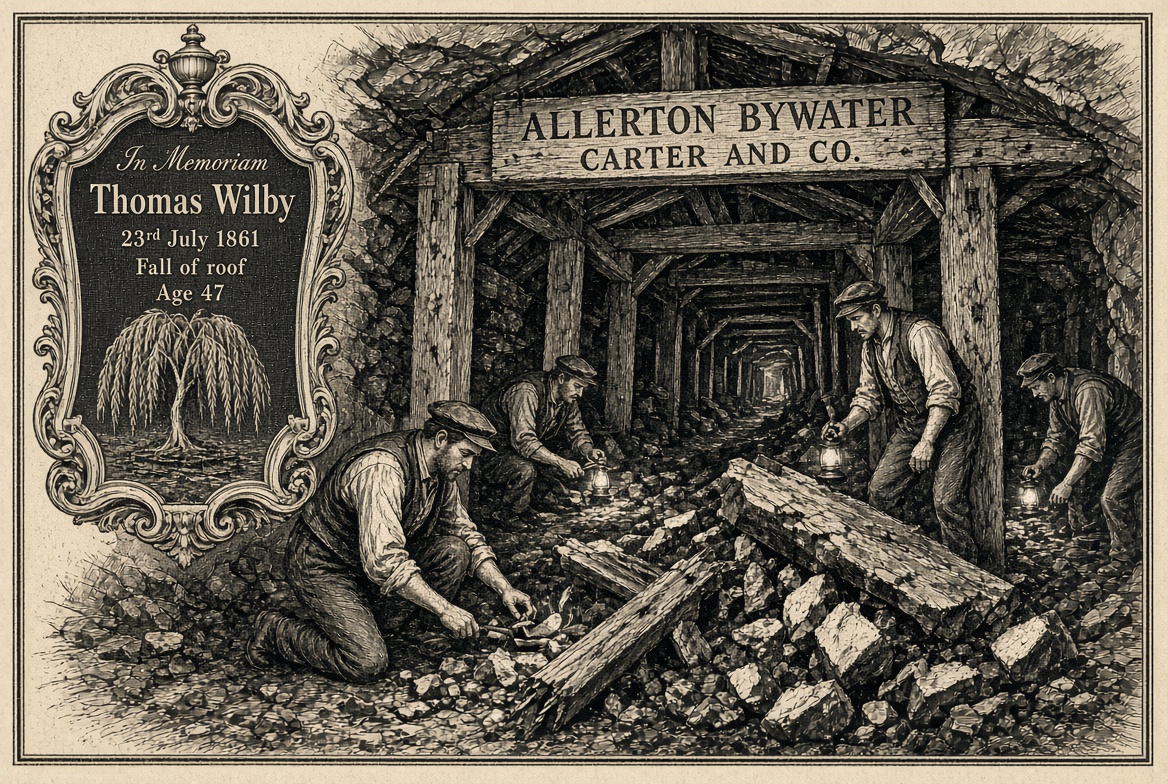
Thomas Wilby

IN MEMORIAM

Thomas Wilby

23 July 1861  ·  age 47

Fall of roof while drawing props

Allerton Bywater  ·  Carter and Co.  ·  of Soothill

His life

Thomas Wilby was a coal miner, aged 47, belonging to Soothill. That is the whole of what the contemporary paper says of him. Soothill was a township in the parish of Dewsbury, on the high ground north of Hanging Heaton and about a mile and a half from Dewsbury town. Age 47 in July 1861 puts his birth about 1814.

The 1861 census was taken on 7 April, three months before he was killed, so he should appear in a Soothill or Dewsbury household. No schedule that can be tied to this man has been found in the open indexes. No baptism, marriage or burial entry has been matched either. Durham Mining Museum still prints burial as not known. Parents, wife and children are not invented.

He was working away from home. Soothill is some fifteen miles from Allerton Bywater. The paper calls the working “Mr. Carter’s new pit.” Carter’s Haigh Moor shafts beside the Aire had been sunk from 1840. “New” may mean a fresh district, or a pit newly in his work, rather than the later Silkstone sinking of 1875, which had not begun.

The accident

On Tuesday evening, 23 July 1861, Wilby was underground in Mr Carter’s pit at Allerton Bywater. He was drawing props. A portion of the roof fell on him and killed him on the spot.

The Leeds and West Riding Express printed that on Saturday 27 July, in the local news, without a heading of its own. Charles Morton, H.M. Inspector, entered the death as Accident No. 41 in his 1861 tabular list, page 155, and described it only as a fall of roof in the mine. He wrote no narrative. The accidents index shortens the cause to “fall of coal.” The paper is the fuller account, and it says roof, not coal.

Newspaper report and conclusion

No coroner’s inquest paper has been traced. The paper does not give a verdict. It says he was killed on the spot.

On Tuesday evening, a coal miner named Thomas Wilby, aged 47, belonging to Soothill, was working in Mr. Carter’s new pit at Allerton Bywater, and whilst in the act of removing some props, a portion of the roof fell upon him, killing the poor fellow on the spot.

Leeds and West Riding Express, Saturday 27 July 1861, vol. IV, no. 189, page 2. The printed word is “spot.” A typed copy of the cutting reads “spct.”

1861 Mines Inspectors Report, Charles Morton, page 155, Accident No. 41. Thomas Wilby, Allerton Bywater, Carter and Co., fall of roof in the mine, 23 July 1861. No age. No narrative. Burial not stated.

Sources and citations

Leeds and West Riding Express, Saturday 27 July 1861, page 2. Thomas Wilby, aged 47, of Soothill, Mr Carter’s new pit, Allerton Bywater, killed on the spot while removing props.

1861 Mines Inspectors Report, Charles Morton, page 155, Accident No. 41. Cited by the Durham Mining Museum: died 23 July 1861, Allerton Bywater, Carter and Co., fall of roof in the mine, burial not known, age blank.

UK Coal Mining Accidents and Deaths Index: Thomas Wilby, 23 July 1861, place given as Normanton, employer Carter and Co, fall of coal in the mine.

Alan Beales, Database of Fatalities in the Coal Fields: Thomas Wilby, Allerton Bywater, 23 July 1861. No age.

Corrections

  • Date. Tuesday evening before the Saturday paper of 27 July is 23 July 1861. The indexes and the paper agree.
  • Cause. Fall of roof while drawing props, as the paper says, and as Morton’s table says. The accidents index’s “fall of coal” is the shorter and wrong form.
  • Place. The pit was Allerton Bywater. Normanton, in the accidents index, is dropped. Home was Soothill, in Dewsbury parish.
  • Age. 47, from the paper. The mining indexes leave it blank.
  • Burial and family. Still not verified. Not filled in.
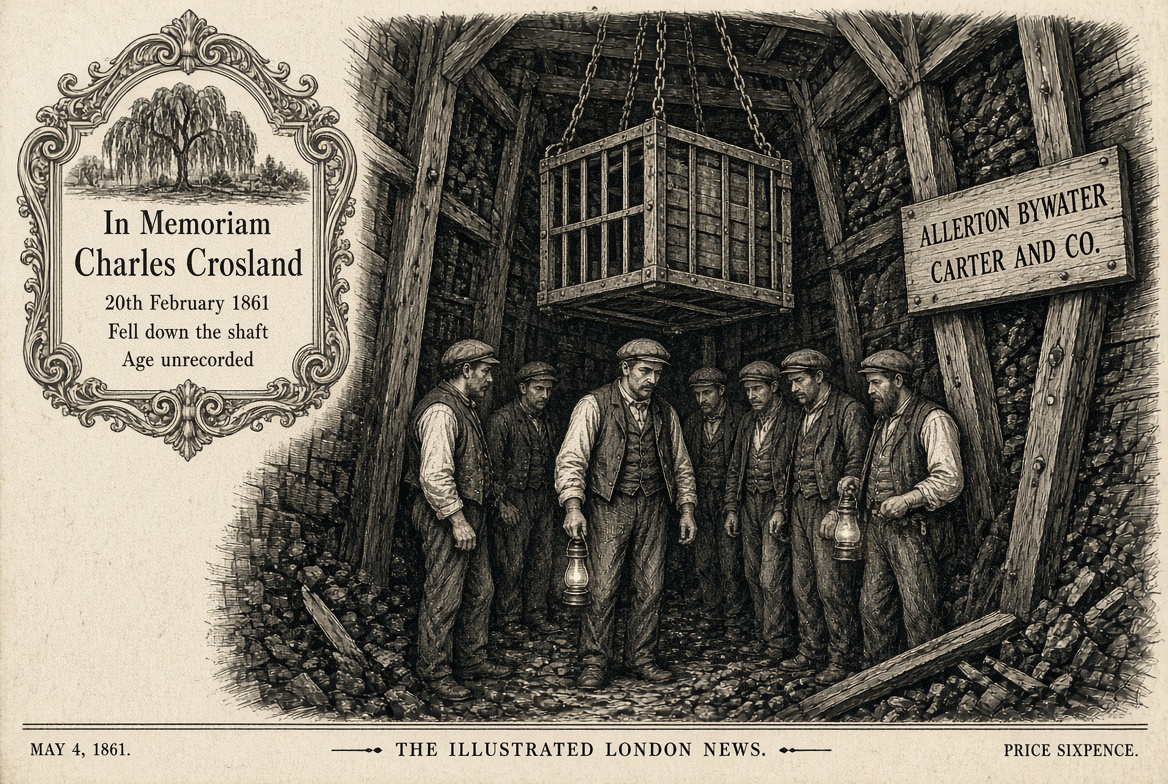
Charles Crosland

IN MEMORIAM

Charles Crosland

20 February 1861  ·  age not known

Fell down the shaft

Allerton Bywater Colliery  ·  Carter and Co.

His life

Almost nothing of Charles Crosland’s life is on the public record. The mining indexes give a name, a colliery, an owner and a date. They do not give an age, a birth year, a trade, a residence or a burial.

The name in the inspector’s list, and in the Durham Mining Museum and the Coal Mining Accidents and Deaths Index, is Crosland. Alan Beales’s Database of Fatalities prints Crossland. Both spellings were used in the West Riding, often for the same family. Crosland is the form taken from the 1861 inspector’s table, so that is the form used here.

No 1851 or 1861 census household has been tied to this man. No baptism and no burial entry has been found in the Allerton Bywater, Kippax, Castleford or Rothwell registers that are indexed online. Durham Mining Museum still prints burial as not known. That gap is real. Parents, wife and children are not invented.

He died on Wednesday 20 February 1861 at Carter’s colliery, Allerton Bywater, the Haigh Moor pit sunk from 1840 beside the River Aire. The later Silkstone sinking was not yet begun.

The accident

The whole of the contemporary official note is four words: falling down the shaft. Charles Morton, H.M. Inspector of Coal Mines, entered it as Accident No. 7 in his tabular list for 1861, page 154. Unlike George Hepworth’s death in 1856, Morton wrote no narrative. There is no account of whether Crosland fell from the bank, from a cage, or while riding the shaft, and no account of the depth.

Carter’s Haigh Moor shafts of that date went about 140 yards to a seam four feet six inches thick, between the present Victoria Street and Robinson Street. That is the pit, not a measured fall.

No Leeds, Pontefract or Castleford newspaper report of this death has been found in the papers indexed online.

Inspector’s report and conclusion

No coroner’s inquest paper, and no newspaper verdict, has been traced. The official record is the inspector’s table only.

1861 Mines Inspectors Report, Charles Morton, H.M. Inspector of Mines, page 154, Accident No. 7. Charles Crosland, Allerton Bywater, Carter and Co., falling down the shaft, 20 February 1861. No age. No occupation. No narrative.

There is nothing further to quote.

Sources and citations

1861 Mines Inspectors Report, Charles Morton, H.M. Inspector of Mines, page 154, Accident Number 7. Cited by the Durham Mining Museum, Charles Crosland individual page: died 20 February 1861, Allerton Bywater, Carter and Co., falling down the shaft, burial not known, age blank.

UK Coal Mining Accidents and Deaths Index: Charles Crosland, 20 February 1861, place given as Normanton, employer Carter and Co, falling down the shaft.

Alan Beales, Database of Fatalities in the Coal Fields: Charles Crossland, Allerton Bywater, 20 February 1861. Spelling differs. No age.

Allerton Bywater Parish Council, coal-mining history: Carter’s Haigh Moor, leased from 1840, two shafts near the River Aire, seam four feet six inches at about 140 yards, worked to 1875.

Corrections

  • Spelling. Crosland, as in the inspector’s list, the Durham Mining Museum and the accidents index. Crossland, on the Beales database and on an earlier plate in this series, is the variant. The plate now reads Crosland.
  • Place. The accidents index gives Normanton. That is not the pit. The colliery was Allerton Bywater. Normanton is a neighbouring registration place and is dropped.
  • Age. Not stated in any source checked. Left as not known. It is not guessed from a census that has not been matched.
  • Burial. Still not known. No parish entry has been verified.
  • Owner. Carter and Co., the 1861 form. Not the later T. M. Carter and Co. used on the plates after 1867.
error: Content is protected !!